

Awaken the barren hills
(Baonghean)Ms. Ha's farm is located more than 6 km from the commune center. What was once barren, rocky land is now covered in the lush green of acacia plantations. Over a cup of strong green tea, Ms. Ha reminisces about the past. In 1994, she and her husband got married and started their own family with nothing but their bare hands. He worked as a bricklayer, and she did various odd jobs selling goods at the market, but poverty clung to them year after year.
In 2006, Ms. Ha and her husband decided to clear land and start a new life in the Con Song hilly area, much to everyone's surprise. Their first day "clearing the land" was daunting; the desolate hills were devoid of human footprints, overgrown with wild berries and providing shelter for snakes, reptiles, and wild boars. Despite the difficulties and challenges, the young couple remained full of faith, believing that "with human effort, even stones can be turned into food." The hilly terrain was mostly rocky and uneven, with heavy rains creating trenches and ditches, making it necessary to level the land to create a forest and farm.
Armed only with hoes, shovels, and manpower, Ms. Ha and her husband worked tirelessly day and night. After more than two years of arduous struggle, they transformed the overgrown hillsides into acacia forests and fertile land. Ms. Ha outlined a very specific production plan: They reclaimed nearly 4 hectares of land to plant hybrid acacia; cleared the lower, flat areas to grow crops and food to develop the farm; and improved the land near the stream for livestock farming. Initially, to generate income, she planted additional crops, bananas, and raised pigs. With borrowed money and loans from banks and relatives, Ms. Ha invested in planting timber forests, primarily hybrid acacia.
Initially, planting hybrid acacia trees was very difficult. The rocky, laterite soil caused the hoes and shovels to bend and chip when digging holes. Planting the trees was hard enough, but caring for them was even harder. Ms. Ha had to carry water from the stream to irrigate each young sapling. But the land did not disappoint her; over the years, the forest grew into a vast expanse of green, and birds gathered to sing. Taking advantage of the shade provided by the hybrid acacia trees, Ms. Ha invested in raising over 300 chickens, nearly 10 pigs, and 6 buffaloes and cows. In 2010, she sold her first batch of acacia trees for over 200 million VND, and combined with the income from livestock, her total revenue reached over 300 million VND per year. The amount wasn't huge, but for a land full of rocks and pebbles, the hard work of tilling the soil day and night, and the diligent care of the trees, that amount was like a dream for Ms. Ha and her husband.
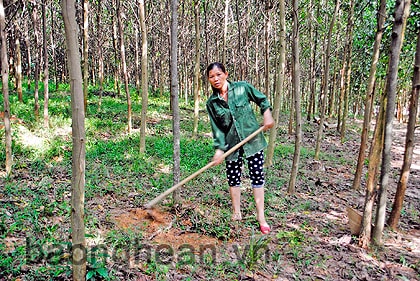
Ms. Phan Thi Ha, residing in Tan Phuc hamlet, Tan Long commune (Tan Ky district), takes care of her hybrid acacia forest.
With their first income from the farm, Ms. Ha and her husband reinvested. Ms. Ha shared: "Previously, we planted hybrid acacia trees but didn't fully understand the technical process, so we planted them very sparsely, only over 1000 trees/hectare. After researching and receiving guidance from technical staff, we planted them according to the correct procedure, reaching over 1600 trees/hectare." With some extra money from acacia farming, Ms. Ha decided to renovate a pond covering more than 2 hectares to raise fish. This pond had long been overgrown with weeds and sedges, so she and her husband continued their "water battle," using pickaxes to dig up each weed and the tangled bushes. After clearing the weeds and bushes, they worked day and night to reinforce the embankment, raising the dam to prevent flooding.
Ms. Ha led me to a fish pond nestled through a three-year-old acacia forest, its trunks already thick and sturdy. At the edge of the acacia forest, the water shimmered with a silvery sheen. A pond teemed with various types of fish—carp, tilapia, and crucian carp. Every day, they selectively caught and sold the fish to supplement their income. Each year, this fish pond generates over 40 million dong in revenue. Ms. Ha's eyes were full of confidence: "Look, the hybrid acacia trees will be ready for harvest in about 3-4 years. Now, transportation is convenient; the government has built an asphalt road right here. The plywood factory in Nghia Dan is nearing completion, so there won't be any shortage of hybrid acacia. We estimate that the hybrid acacia alone will yield about 70 million dong per hectare, plus income from raising pigs, buffaloes, cows, and fish, bringing the total income to around 400 million dong per year."
After our tour of the "ecotourism area," at lunchtime, Ms. Ha invited us to relax in her spacious and impressive house, worth over 250 million VND, standing tall amidst the lush green forest. "The house, the money to raise our children and pay for our living expenses... it's all thanks to the blessings of this rocky land," Ms. Ha proudly boasted.
Her plan is to continue investing in building more barns, expanding the raising of chickens, buffaloes, and cows… interspersed with planting more acacia trees, exploiting all the "rocky" land here to "get rich".
Text and photos: Vuong Tran