

Naming children in mountainous regions
Along with joy, the birth of a child also brings worries. Even during pregnancy, the mother is cared for with a special diet. On the day of labor, the mother-in-law or the husband himself must trek through the forest to find medicinal leaves for bathing water and wild vegetables beneficial to the pregnant woman's health to cook soup.
(Baonghean)Along with joy, the birth of a child also brings worries. Even during pregnancy, the mother is cared for with a special diet. On the day of labor, the mother-in-law or the husband himself must trek through the forest to find medicinal leaves for bathing water and wild vegetables beneficial to the pregnant woman's health to cook soup.
Mrs. Vi Thi May, residing in Canh Thin village (Yen Hoa - Tuong Duong), a woman of unprecedented longevity in the village, recounts that in the old days, a newborn child faced many misfortunes. Besides illness, there were all sorts of evil spirits. Most frightening were the spirits of those who died prematurely, who would often return at night to entice them to "join the army." When a spirit was lured away, the body would become weak and feverish. Therefore, when a child was born, it was essential to place a straw effigy holding a crossbow under the floorboards near where the child lay to ward off evil spirits and protect the baby from these malevolent entities.
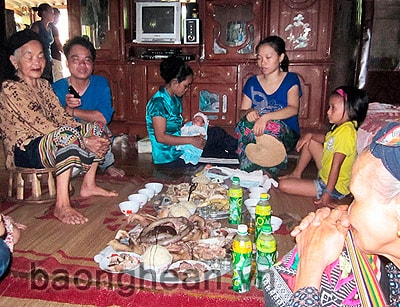
The naming ceremony for baby Bao Tien - To village - Yen Khe commune (Con Cuong).
Nowadays, few people believe in ghosts anymore. People in mountainous areas have learned to seek medical care for childbirth, and when their children are sick, they know to take them to doctors for examination and treatment. Rituals and ceremonies now only have spiritual significance for the child.
Grandma May continued, explaining that the naming ceremony is usually held at least 10 days after the baby is born. The date is carefully chosen, not coinciding with the birth or death anniversaries of family members. The naming day is called "oóc khhọ" or "oóc phi" because from the day of the ceremony, the child and mother are allowed to leave the kitchen, which was previously used for the mother and newborn to sleep in.
On the naming day, the child truly becomes a member of the family, accepted by ancestors and deities, and protected from potential misfortunes in life. Therefore, the rituals are highly valued. Wealthier families slaughter a pig for the offering, while poorer families only need two chickens to prepare two separate offerings. One offering is for the ancestors, and the other is for the ritual of calling the souls of the mother and child. This is also the child's first meal, perhaps only symbolically. The mother takes a piece of sticky rice with chicken and gently dabs it on the baby's lips. Afterwards, the child's wrist is tied with a thread to ensure the soul never leaves the body.
Choosing a name for a child is also given great importance. This is usually entrusted to the child's paternal grandfather, and everyone attending the ceremony must be present to hear. However, in some communities, the selection of the person to name the child differs. According to our observations at the naming ceremony of Luong Thi Bao Tien (To village - Yen Khe - Con Cuong), the name selection was done by the maternal side of the family. This is a customary practice of the clan, reflecting the family's respect for the parents and relatives of the woman who marries into the family.
The choice of name reflects the aspirations for a child's bright future. Common wishes include for a boy to be healthy, to learn to hunt and cut wood early in life, to become wealthy and respected, and for a girl to be beautiful, virtuous, and skilled in weaving and embroidery. Boys named Bun or Khun are believed to have good fortune, while Xanh symbolizes strength like a rhinoceros. Sometimes, animals like bears or mice are also used as names for children. For example, in the mountains, a boy named Mươi might be chosen with the hope that he will be strong and courageous like a bear in the forest.
However, the names of ferocious beasts like tigers, leopards, and wolves are never used for people because they are a source of terror for the mountain dwellers. If you go to the highlands and encounter a boy or girl named Bao (meaning "Leopard"), it's simply because this person was born on a day believed to bring more power than their father or mother. Those born on days considered inauspicious for their parents are sometimes even given up for adoption, albeit only in name. The child remains with their adoptive parents and, during Tet (Vietnamese New Year), must visit them with a pair of sticky rice cakes.
Those who are adopted, in addition to their real name, also have a middle name, May, meaning adopted child. The adoptive parents will call the child May. There are also cases where May or Mày becomes the child's official name. This name is commonly seen among the Tay Muong Thai ethnic group in Yen Khe - Con Cuong, Yen Na, Yen Hoa... in Tuong Duong district.
Traditional Thai names are becoming increasingly unfamiliar to younger generations, especially children born from the 2000s onwards. Due to the influence of television and, more recently, the internet, parents in the highlands often choose beautiful names for their children, even names of famous singers or movie stars. It can be said that the vast majority of Thai children in the highlands of Tuong Duong and Con Cuong districts, under the age of 10, bear names such as Minh Huyen, Anh Tho, Bao Anh, Bao Tien, Nhat Minh, Manh Quan, Minh Quan... There are very few names like Bun Khun, Xanh, May, Thoong... as in the past.
Following the trend of naming children after Kinh or Chinese people, the current trend of teaching children to speak Kinh from birth is very popular in highland communities. Parents believe that teaching children Kinh early will help them avoid feeling overwhelmed when entering kindergarten and will allow them to learn better. Their mother tongue will naturally absorb through communication with the village community. However, it's worth noting that many of these highland parents and grandparents have limited Kinh language skills, often teaching their children broken or awkward phrases... This is certainly not good for the children!
Text and photos: Bun My