

Concerns arising from pesticide residue stockpiles.
Since the 1960s, thousands of tons of pesticides have been transported to localities in Nghe An province. For many years now, these pesticide storage facilities have been out of use, but the impact of residual chemicals from these facilities is seriously affecting the daily lives, health, and production of the people.
(Baonghean)Since the 1960s, thousands of tons of pesticides have been transported to localities in Nghe An province. For many years now, these pesticide storage facilities have been out of use, but the impact of residual chemicals from these facilities is seriously affecting the daily lives, health, and production of the people.
From the Yen Ly intersection, following Deputy Village Head Ho Van Truyen along Highway 48, we reached the Hon Tro area, in Hamlet 15, Dien Yen Commune, Dien Chau District, where an unfinished pesticide storage facility is located. Despite the sunny, dry weather, we struggled to cover the approximately 3km distance to reach the facility. We asked Mr. Truyen, "Dien Yen is one of the communes that has done well in the new rural development program, so why is the road to the village so bad?" He smiled sadly, "Since the storage facility was built, especially after it was rebuilt to store the remaining pesticides, hardly anyone lives here anymore. If there are no residents, what's the point of investing in it?"
As soon as we arrived, we were hit by a strong, unpleasant stench. Pointing to a row of old, dilapidated single-story houses, Mr. Truyen said, "That's where the old pesticides were stored, miss." Looking to either side, there were only a few scattered houses. The desolate scene, combined with the pungent smell, made the entire nearly 7-hectare area feel eerie. After quickly taking a few photos, I followed Mr. Chau deeper into the village.
The first place the village deputy led me to was a dilapidated house. Inside, the first thing that caught my eye was the image of a frail, elderly woman over 70 years old lying curled up. Seeing visitors, Mrs. Nguyen Thi Ly struggled to sit up and whispered, “I had a stroke and can’t walk. My throat has been diagnosed with cancer. I probably don’t have much longer to live…” Her husband, Mr. Nguyen Van Phong, also died of lung cancer when he was just over 50. Mrs. Ly didn’t understand why so many misfortunes had befallen her family in such a short time, but one thing she was certain of was that for over forty years, her family had lived on land contaminated with pesticides.
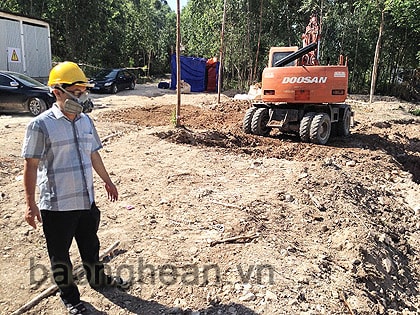
Handling of pesticide storage at Hon Tro, Dien Yen commune, Dien Chau district.
The pesticide storage facility in Dien Yen commune dates back to the 1970s. With eight rows of storage buildings, it was one of the largest along Highway 48, supplying insecticides and herbicides to most of the mountainous western districts of Nghe An province. The facility was in operation for over 20 years, ceasing use around the early 1990s, but the chemicals remained. Later, due to its age, it was demolished to make way for a new one. Construction lasted for many months. During that time, because there was no new storage, all the pesticides, including insecticides and chemicals like Lindane, Aldrin, DDT, and 666, were left exposed to the elements. When it rained, the chemicals seeped into the soil and flowed down the mountainside into the surrounding area. Locals were aware of the contamination, but due to a lack of awareness about the chemicals, few people took precautions and continued to drink water and cultivate crops in the contaminated area as usual. It wasn't until dozens of people in the area died from cancer and many children were born with deformities that the locals began to realize the extent of the danger. Showing me a notebook listing those who had died from cancer, Mr. Ho Van Truyen counted: there were about thirty people, such as Mr. Ho Nhan (nasopharyngeal cancer), Mr. Hoang Van Duyen (liver cancer), Mr. Nguyen Van Khoa (stomach cancer), etc., and six families had children born with deformities. Even in his own family, with six siblings, three had already died from cancer, none of them over 60 years old. Most recently, his sister, Ho Thi Lan, died at the end of 2012 at the age of 53.
Due to the serious impact of the pesticide storage facility in Dien Yen commune, in late May 2013, as part of the National Target Program, the General Department of Environment surveyed the Hon Tro area and proceeded with the remediation of the facility. As a result, over 3,000 cubic meters of soil in the affected area were removed. However, according to Mr. Nguyen Duc Chau, Vice Chairman of Dien Yen commune, the remediation was not thorough because the amount of soil removed only accounted for 50% of the affected area. Furthermore, the excavated soil has remained in the warehouse for two months, not yet removed, thus intensifying the stench. Recently, thieves took advantage of a lapse in security and removed two doors from the warehouse, causing great concern among the local residents.
Currently, there are 913 pesticide residue sites throughout the province, of which 277 have been investigated and analyzed for pollution levels. The results show that 265 sites (96%) exceed permissible standards, including 189 sites causing serious and extremely serious environmental pollution requiring thorough remediation during the 2010-2015 period, and 79 sites causing environmental pollution requiring thorough remediation during the 2016-2025 period. In the list of 100 areas with extremely serious pollution due to pesticide residues under the National Target Program for Pollution Remediation and Environmental Improvement (2012-2015), our province has 55 sites, accounting for 55% of the total number nationwide. Many locations showed levels exceeding permissible limits by thousands of times, such as the pesticide residue site in Hamlet 3, Quang Trung Commune, Hung Nguyen District, where the pesticide content in soil samples was 8 times higher than the standard; the residue site in Hoa Dong Hamlet, Hoa Binh Town, Tuong Duong District, had levels exceeding the standard by 1.4 to 13,824.7 times; and the site in Hamlet 13, Son Hai Commune, Quynh Luu District, had levels exceeding the standard by more than 890 times.

Ms. Ly has cancer and is paralyzed on one side of her body; she is being cared for by her daughter.
Regarding progress, to date, 3 out of 55 pollution sites have been addressed under the National Target Program and 12 out of 179 sites under Decision 1946/QD-TTg of the Prime Minister. According to the plan of the Department of Natural Resources and Environment, from now until the end of 2014, at least 52 pollution sites (12 projects have already been implemented or are being prepared for implementation) will have their projects completed. Afterward, the Provincial People's Committee will be requested to allocate funds and seek matching funds from the central government. However, the remediation process remains very difficult, especially regarding funding. According to regulations, the central government only provides 50% of the funding for each site, with the remainder being matching funds from the province. If implemented as planned, this work will require at least 700-1000 billion VND by 2015. This figure is enormous for a poor province like Nghe An. In addition, the relocation process is an extremely challenging task, as there are currently 423 residential houses and 43 offices located in the affected area.
According to Mr. Ho Sy Dung, Head of the Nghe An Environmental Protection Department, the issue of treatment technology is also at a standstill. Each contaminated site has a different type of chemical, and each region has its own soil conditions, so a single treatment method cannot be applied. Even globally, there is no specific treatment process. Therefore, achieving complete remediation is very difficult. For example, at the pesticide storage facility in Hon Tro (Dien Yen commune), the contaminated soil has been removed, but where to transport it and how to proceed with treatment remains unclear. Similarly, at the contaminated site in Kim Lien commune (Nam Dan district), although treatment began in 2009, the solution remains incomplete, focusing only on identifying hazardous areas. The most critical issue is in Nghia Trung commune, Nghia Dan district, where dozens of inspection teams have surveyed the area over the past five years, but to date, no solution has been found. The fact that pollution levels are announced but then addressed too slowly, or there is no action taken at all, inevitably causes frustration and weariness among the public.
Considered a type of "poison," pesticides have left many serious consequences, including water pollution, toxicity to humans and animals, disruption of natural balance, decline in biodiversity, the emergence of many pests, and the development of pesticide resistance. Given this danger, remediation efforts require thorough treatment, prioritizing exposed areas and those with high levels of contamination.
At the same time, it is necessary to strengthen public awareness campaigns and limit cultivation and production in areas identified as containing pesticide residues. Furthermore, specific solutions are needed to reduce pollution from pesticide use, such as: providing incentives and support for programs producing and applying organic and microbial products in pest control. Improving the legal framework for managing pesticides and establishing a legal framework for managing pesticide residues; strengthening education and awareness campaigns about the harmful effects of pesticide pollution in production to contribute to reducing environmental pollution.
Text and photos: My Ha