

There are still many difficulties.
In the past, Con Cuong oranges were renowned for their delicious taste and brought significant economic value. However, this variety gradually declined. Since 2004, Con Cuong has implemented the "Orange Tree Restoration Project 2004-2015," but the results have not been as desired.
(Baonghean)In the past, Con Cuong oranges were renowned for their delicious taste and brought significant economic value. However, this variety gradually declined. Since 2004, Con Cuong has implemented the "Orange Tree Restoration Project 2004-2015," but the results have not been as desired.
Mr. Vi Van Thin, from Tan Huong village, Yen Khe commune, Con Cuong district, while weeding his orange groves, said: “The district’s orange restoration project started in 2004, but it wasn’t until 2011 that my family was able to plant 1 hectare of oranges. The reason for the slow implementation is that orange cultivation requires a large capital investment and a meticulous care process. Although the district provided fertilizer and 500 late-ripening V2 orange seedlings, to renovate and plant 1 hectare of oranges, my family had to invest nearly 180 million VND. The bank only lent us over 20 million VND, the rest was borrowed from relatives and from selling buffaloes and cows to invest in planting oranges.”
Before planting the oranges, our family received thorough guidance on technical procedures and care from agricultural extension officers. The oranges grew quite well, but it takes over 5 years before they can be harvested. We orange growers are very worried about Chinese oranges being mixed in with the market, making it difficult to sell them after harvest. We urgently need help from relevant agencies to build the "Con Cuong orange" brand so we don't have to worry about finding buyers."
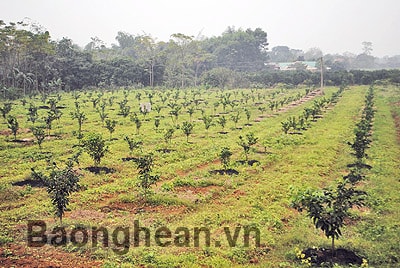
Orange orchard in Tan Huong village, Yen Khe commune (Con Cuong district).
Mr. Tang Ngoc Son from Pha village, Yen Khe commune, recounted: “My family planted about 1 hectare. In phase I, we planted 350 orange trees in 2009, and in phase II, we planted 150 trees in 2011. The total investment was over 150 million VND. The first crop of oranges will only be ready for harvest in 2014.” According to Mr. Son, in the fifth year, the oranges will yield about 8-10 tons, and only when the price of oranges reaches over 30,000 VND/kg will the growers make a profit. However, all of this is still just hope, because in the recent "first harvest" of oranges, many households have struggled due to difficulties in selling their produce. Another challenge now is that orange trees require dry soil but are also not very drought-tolerant.
The recent heatwave has caused significant difficulties for many orange growers in Yen Khe. Mr. Son's family, in particular, has to water their orange trees for 2-3 days every week, using ox carts to transport water from the Diem stream. It is known that the entire Pha village has about 22 hectares of orange trees, of which only 4 hectares are commercially productive, yielding over 400 million VND per hectare. After deducting expenses, the profit is 150-200 million VND per year. Meanwhile, oranges from the areas managed by Xuan Thanh Agricultural Company Limited achieve very high values, averaging 600-700 million VND per hectare, with some households even earning over 1 billion VND per hectare per year. The reason for the high value of Xuan Thanh's oranges is the established "Vinh orange" brand, while oranges in Con Cuong lack large-scale planned cultivation areas, resulting in small-scale sales and low economic value. Mr. Son added: According to the plan, Pha village will plant an additional 6.6 hectares of orange trees in the near future; however, many households are not enthusiastic about planting them because they face many difficulties.
Mr. Vi Van Dau, Chairman of the People's Committee of Yen Khe commune, shared: “The entire commune has over 50 hectares of oranges, of which nearly 10 hectares are already producing fruit. In 2013, the commune registered with the district to plant over 30 hectares of oranges in Trung Yen, Pha, Tan Huong villages… This year, the district only supports the seedlings; the rest must be covered by the farmers themselves. The current difficulty is the enormous capital required for orange cultivation. Banks need to create conditions for people to borrow larger amounts of money, because borrowing 15-20 million VND is very difficult to invest in orange cultivation.”
Mr. Lang Van Ban, Deputy Head of the Con Cuong Agricultural Extension Station, said: The project "Restoring Orange Trees in the period 2004-2015" aimed for 250 hectares, but to date, the entire district only has over 175 hectares. The benefits of orange cultivation are quite evident. Currently, there are 61 hectares of commercially grown oranges, with an average yield of 90 quintals/hectare/year, generating revenue of over 10 billion VND/year. Regarding policies, the district provides 100% support for orange seedlings and subsidizes interest rates on investment capital for new plantings at 20 million VND/hectare. However, the area planted with oranges has not yet reached the target. For example, Yen Khe commune planned for 100 hectares but only achieved over 50 hectares, and Chi Khe commune planned for 54 hectares but has not planted any oranges yet. The reasons for the delay are that orange cultivation is costly, takes at least 5 years to harvest, and the market for oranges is difficult due to the lack of established brands, so many households are not enthusiastic about it.
Text and photos: Van Truong