

Restoring a "tree-related charm" to the land of Nam Dan.
- Earning an average of 17 billion VND per year from 285 hectares of lemon trees is a truly impressive figure for a segment of farmers in the lemon-growing areas of Khánh Sơn, Nam Kim, and Nam Lộc (Nam Đàn). But who knows, this incredibly familiar and almost indispensable fruit in daily cuisine and beverages also experiences its own share of ups and downs...?
(Baonghean)- Earning an average of 17 billion VND per year from 285 hectares of lemon trees is a truly impressive figure for a segment of farmers in the lemon-growing areas of Khánh Sơn, Nam Kim, and Nam Lộc (Nam Đàn). But who knows, this incredibly familiar and almost indispensable fruit in daily cuisine and beverages also experiences its own share of ups and downs...?
There was a time when Nam Dan lemons were in high demand, exceeding supply and fetching good prices. Many farmers in Nam Dan eagerly embraced lemon cultivation, gradually escaping poverty and achieving prosperity. Nam Dan lemons gained market prestige as a large, specialized lemon-growing area was established on the left bank of the Lam River, concentrated in the three communes of Khanh Son, Nam Kim, and Nam Loc, producing two harvests a year.
Mr. Ha Van Hoi, a lemon grower in Hamlet 4, Khanh Son Commune, recalls: After the great flood of 1978, his family and many other households participated in the migration movement to the hilly areas, giving up their farmland for agricultural production. Once settled, they started gardening, planting all kinds of trees, including lemons, but only for family consumption. Even in the 1990s, Mr. Hoi's family and neighbors were still struggling to make ends meet in this semi-hilly, semi-lowland area, where rice and vegetable crops provided only an unstable income. No one imagined that a "breakthrough" would come from the familiar lemon tree in their everyday garden...
Starting in the 1990s, Khanh Son commune implemented a policy of large-scale lemon cultivation. Mr. Ha Van Hoi, one of the pioneers in implementing this policy, achieved surprisingly effective results: Within a few years, with 300 lemon trees, his family harvested an average of 5-9 tons of fruit annually, earning nearly 100 million VND. According to Mr. Hoi, finding a more profitable crop than lemons in Khanh Son is extremely difficult: "With the characteristics of laterite and limestone soil here, no other type of tree can 'take root' except for lemons."
"In reality, growing lemons doesn't require much capital; you just need to be hardworking and know how to apply scientific and technical methods," Mr. Hoi said. He also shared that thanks to lemon cultivation, he and his wife invested 350 million VND to buy 1.5 hectares of rubber forest for their eldest son in Dak Lak, which has now been harvested. They also bought land in Dong Nai for their second daughter to start a business. 2012 was considered a disappointing year for lemon farming; the 300 lemon trees yielded fewer fruits, but the price was high, bringing in about 80 million VND.
In Nam Kim commune, Mr. Pham Van Nam's family in Khe Lau hamlet has 400 lemon trees, yielding an average income of 100 million VND per year, making them one of the wealthiest households in the commune... Many households in the lemon-growing areas of the three communes of Khanh Son, Nam Kim, and Nam Loc have become prosperous thanks to lemon cultivation. Mr. Dang Van Tan, Vice Chairman of Nam Loc commune, said: "The commune has about 800 households growing lemons, with the smallest plots being over 500 m2, and the largest around 4,000 m2. For many years now, lemon trees have truly been a source of wealth for nearly 200 households, with incomes of 40 million VND or more per year." From here, Nam Dan lemons are available throughout the province and in some northern provinces such as Hanoi, Hai Phong, Quang Ninh, and Bac Giang; traders come to buy them directly from the orchards.
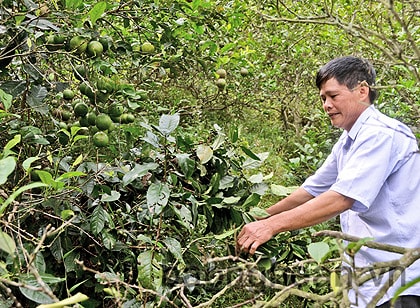
Mr. Ha Van Hoi's lemon orchard (Hamlet 4, Khanh Son Commune) yields nearly 100 million VND per year.
However, the difficulties in developing lemon cultivation arose from many sides that lemon growers in Nam Dan had not anticipated: market demand, the degradation of lemon orchards, etc. This inevitably led to feelings of confusion and discouragement. The total area of lemon orchards in the three communes gradually decreased, from 316.81 hectares in 2005 to only 285 hectares today, and lemon yields also decreased significantly. For example, in Nam Loc commune, lemon yields in 2000, 2005, and 2010 were 20 tons/ha, 18.62 tons/ha, and 10 tons/ha respectively, resulting in a significant decrease in production (from 6,274.60 tons in 2005 to 3,348.19 tons in 2010).
For example, in Khanh Son commune, there were 65 hectares (in 2000) with a yield of 20.97 tons/ha. In 2010, this area increased to 86 hectares, but the yield was only 10.97 tons/ha. In Nam Kim commune, in 2000, there were 45 hectares with a yield of 21.62 tons. In 2010, the area increased to 170.92 hectares, but the yield was only 11.62 tons/ha. Up to recent years, lemon trees in Nam Dan have shown signs of instability: fluctuating prices with sharp drops during the main harvest season; some lemon trees produce very little fruit; and many diseases that are difficult to control appear, especially root rot and fruit graying; the trees degenerate cyclically.
Mr. Ho Quang Vinh, from Hamlet 6, Khanh Son Commune, said: “My lemon orchard has 420 trees, of which only 40 are growing well and yielding high income, 30 are slightly degraded, and the remaining 300 are moderately degraded and 80 are severely degraded, showing a tendency not to bear fruit, or if they do, the fruit will not be of marketable quality.” At his family's lemon orchard, Mr. Pham Van Son, from Nha Huou Hamlet, Nam Kim Commune, shared: “My family has 238 lemon trees, of which 15 are growing well, 185 are slightly and moderately degraded, and 38 are severely degraded. If we can't find a way to improve the quality of our lemon orchard, we probably need to switch to another crop with higher economic value soon.”
Given the above situation, in the last three years, localities have adopted a policy of focusing on planting the Chinese honeysuckle, but this plant quickly died prematurely. The commune then turned to encouraging people to experiment with planting custard apples, oranges, mangoes, jackfruit, lychees, bananas... Still without success! After much deliberation and struggle, the leaders and people of Khanh Son, Nam Loc, and Nam Kim communes remained "loyal" to lemon cultivation and focused on finding solutions to stabilize the profession. From there, they made an important shift in thinking: The decline in lemon yield and production should not only be blamed on objective reasons but also on subjective factors.
Mr. Ha Van Viet, Chairman of the People's Committee of Khanh Son commune, said: "Currently, there are two reasons why lemon trees are producing low yields. The objective reason is that too much rain causes the trees to have too many leaves, resulting in fewer fruits, or the heavy rain shortens the fruiting process from harvest to maturity, causing off-season lemons to be harvested earlier, leading to lower yields and poorer fruit quality. The subjective reason is that for a long time, many families have relied on traditional methods of intensive cultivation, care, and harvesting of lemons, rarely applying scientific and technological advancements."
So, how should scientific and technological advancements be applied? There absolutely must be coordination and support from external sources! For the first time, the State and scientists have joined forces with farmers in the Nam Dan lemon-growing region: At the end of 2012, the Department of Science and Technology provided funding for the Center for Application of Scientific and Technological Advancements to implement the project "Applying scientific and technological advancements to build a model for rehabilitating degraded lemon orchards in Nam Dan district".
The project quickly began its first phase, which involved identifying the causes and proposing solutions for rehabilitating degraded lemon orchards. It was at this point that lemon growers in Nam Dan realized that the cultivation technique, particularly the choice of seedlings, is crucial in determining yield and fruit quality. Meanwhile, the production and distribution of seedlings for the development of these orchards lacked proper management by relevant authorities. Only a small percentage (2 out of 100 households) purchased seedlings from reputable producers; over 87% of households produced seedlings themselves using grafting methods based on experience, without adhering to disease-free seedling production procedures.
Furthermore, some households reported using cuttings from old, nearly destroyed trees without determining whether these branches posed a potential disease risk. Similarly, in pesticide application, lemon growers often only begin spraying after detecting pests and diseases, which is an inefficient method because by the time pests and diseases are detected, they are already in an advanced stage, the disease has developed significantly, making control difficult and ineffective. In addition, households have increased the concentration and dosage of pesticides used on lemon trees beyond recommendations, increasing the pests' adaptability and simultaneously polluting the environment.
Most households annually add soil around the base of lemon trees to prevent waterlogging and promote the growth of secondary roots, supplementing nutrients. This is a good practice for maintaining and increasing lemon tree productivity; however, improper soil application techniques have led to root suffocation and disease. For lemon trees already infected by soil-borne fungal diseases, this soil application creates favorable conditions for the disease to develop, causing severe damage and rapid root degeneration. All of this has resulted in the soil, which is naturally suited to lemon trees in the Nam Dan lemon-growing region, gradually losing its nutritional balance, becoming compacted, and depleted. This leads to weakened vitality, rapid degeneration of the lemon trees, and reduced yield, production, and quality. Conversely, if these limitations are overcome, lemon growers in Nam Dan will continue to have bountiful harvests, bringing high economic value.
The initial effectiveness of the project "Applying scientific and technological advancements to build a model for rehabilitating degraded lemon orchards in Nam Dan district," implemented in three communes – Nam Kim, Nam Loc, and Khanh Son – has restored confidence in this crop, enriching farmers not only in these three communes but also in all five communes on the left bank of the district. Much work remains to be done to improve and combat the degradation of lemon trees here, but the direction and solutions for restoring the position of lemon trees in the economic development of the lemon-specialized farming area in Nam Dan have been identified. Lemon growers can hope for a truly prosperous future by establishing the Nam Dan lemon brand and realizing the dream of having a processing plant established in the area through actively increasing the area, yield, and quality of lemons; sustainably developing the strengths of a region uniquely suited to lemon cultivation!
Text and photos: Anh Vu