

Unleashing potential, accelerating development.
(Baonghean)Comrade Vo Thi Hong Lam - Deputy Secretary of the District Party Committee, Chairman of the Anh Son District People's Committee, gave an interview to Nghe An Newspaper on the occasion of the 50th anniversary of the district's establishment (1963-2013).
PV:Could you please tell us about the outstanding achievements of our district over the past 50 years?
Comrade Vo Thi Hong Lam:According to Decision 52/CP dated April 19, 1963, of the Government Council, the former Anh Son district was divided to establish two new districts: Anh Son and Do Luong. Since then, over the past 50 years, Anh Son has achieved many outstanding accomplishments, simultaneously engaging in production and combat, focusing on overcoming the consequences of war, promoting socio-economic development, protecting the country, and implementing reforms, integration, and development.
Economically: The economic growth rate in recent years has consistently exceeded 11.5%. In 2012, per capita income reached over 17.2 million VND, budget revenue exceeded 32 billion VND, and the economic structure has shifted in the right direction, with agriculture, forestry, and fisheries accounting for 53.6%, industry and construction 23.7%, and services and trade 22.5%. The total food production in the district reached over 59,000 tons. The district has established concentrated industrial crop areas including over 1,700 hectares of sugarcane, over 2,000 hectares of industrial tea, and 2,000 hectares of rubber. Currently, the district has 10 state-owned enterprises, 47 private enterprises, 14 joint-stock companies, 29 limited liability companies, and 4 agricultural product processing factories. The Dinh Son industrial cluster and the town create jobs for many rural workers. Infrastructure is increasingly being invested in to meet development requirements. 100% of communes have roads leading to their headquarters. The system of 7 bridges crossing the rivers includes the Cay Chanh concrete bridge (Dinh Son), the suspension bridge (Ban Bong), the bridge over the Cau Dat spillway (Thanh Son), the Do Rong bridge (Hung Son), the Tri Le concrete bridge (Khai Son), the concrete bridge over the Giang River, the town suspension bridge, and the Duc Son suspension bridge. Two more bridges are under construction: the concrete bridge over the Con River and the Cay Mit bridge (Binh Son), scheduled for completion at the end of 2013. Key routes such as the town-Cao Veu, Nhan Tai-Gia Giang, and inter-commune roads have been standardized. The Cao Veu-Phuc Son area is in the process of being upgraded to a border crossing connecting Vietnam with Laos… These are important conditions for Anh Son to create a breakthrough in socio-economic and cultural development.
Regarding socio-cultural aspects: Currently, 36 out of 77 schools in the district meet national standards. In recent years, the district has been recognized as having an outstanding education movement in the province. 100% of commune health stations meet national health standards, the percentage of communes with doctors is over 71%, the population growth rate remains stable at below 1%, and policies and benefits for war veterans are ensured promptly and in accordance with regulations. Political stability and national defense and security are ensured. In the struggle for national defense and security, Anh Son district has 29 mothers awarded the title of Heroic Vietnamese Mother, over 9376 medals and decorations of various kinds, 6 Heroes of the People's Armed Forces, and 2 communes, Tuong Son and Phuc Son, have been honored by the Party and State with the title of Hero of the People's Armed Forces.
To date, the district has 21 administrative units, 62 grassroots Party organizations with over 5,500 Party members, and 100% of villages, hamlets, and blocks have Party branches. The principle of centralized leadership and direct dialogue to listen to the people's opinions is considered a strict target, creating conditions for the people to build a strong Party and government. Administrative reform and the application of science and technology to state management and internal operations are highly valued by the District People's Committee. All 21 communes and towns have been connected to the Internet, and online meetings with the Provincial People's Committee and relevant departments and schools throughout the district have been implemented synchronously…
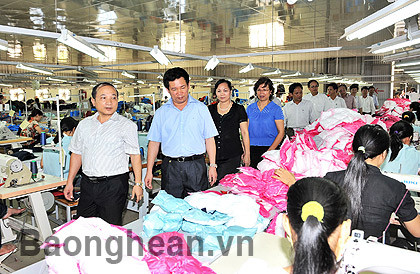
Provincial and district leaders of Anh Son visit Khai Hoan Garment and Embroidery Company in Anh Son. Photo: Sy Minh
PV:Could you please tell us about the breakthroughs in the district's economic development strategy in the recent past?
Comrade Vo Thi Hong Lam:Anh Son district has a relatively large natural land area, over 60,000 hectares, with 21 administrative units and a population distributed along both banks of the Lam River. Although a mountainous district, Anh Son's transportation system developed quite early. National Highway 7A, 47 km long, connects Vietnam and Laos, while the Ho Chi Minh Highway, 13 km long, runs through four communes: Vinh Son, Lang Son, Khai Son, and Cao Son. The district is traversed by three rivers: the Lam River, the Con River, and the Giang River, with the Lam River stretching over 47 km.
To leverage its strengths and accelerate development, the district focuses on the following tasks: Developing the area of food crops, industrial crops, forestry, and livestock farming towards commodity production. Emphasis is placed on forming concentrated industrial crop zones.
Actively mobilize resources, increase investment, and develop infrastructure, focusing on investing in irrigation works to ensure irrigation for over 4,500 hectares of rice and other crops. Prioritize the renovation and upgrading of the road system and the construction of bridges across rivers to facilitate trade and transportation of goods.
Attracting businesses to invest, expanding the processing of raw materials, building materials, and handicrafts; building industrial zones and clusters such as garment, embroidery, brick and tile, electronics, and fine art wood products... creating jobs for workers. Building new urban areas.
PV:Could you please tell us about the development directions of our district?
Comrade Vo Thi Hong Lam:The 19th District Party Congress for the 2010-2015 term determined the district's development direction to strive for Anh Son to become a relatively prosperous district of the province by 2015. The district set several targets (with consideration up to 2020):
In the economic field: Anh Son is leveraging its internal strengths and taking advantage of external resources to strive for an economic growth rate of 12.6%, an annual total production value increase of 14-15%, and an average per capita income exceeding 72 million VND/person/year by 2020. The proportion of the industrial and construction sectors is expected to reach over 47%, services over 29%, and agriculture and forestry over 22.7%. The Anh Son-Hoi Son-Phuc Son area is developing a commercial and industrial belt, a new urban area, and comprehensively developing Cay Chanh town. The area for sugarcane cultivation is stably developed to 1500 hectares, with 2500 hectares of industrial tea plantations and over 2000 hectares of rubber plantations. Successfully achieving 50% of communes meeting the standards for new rural development, and effectively operating the Cao Veu sub-border gate.
In the socio-cultural field: Striving to reduce the poverty rate to 5% by 2020 according to the new standards, the natural population growth rate to 0.52%, promoting comprehensive socialization of education, aiming for 50 schools to meet national standards, 100% of school buildings to be structurally sound, 100% of commune health stations to have doctors, 100% of commune health stations to meet standards, the rate of trained labor reaching 40%, contributing to creating jobs for over 2,000 workers/year, the entire district striving to achieve 87% of culturally exemplary families, 80% of villages, hamlets and units meeting cultural standards...
In the field of national defense and security: Enhance the effectiveness and efficiency of the government apparatus at all levels, strengthen the use and management of resources. Strengthen the work of ensuring political security in border areas, security in special areas and rural areas, build safe and self-reliant bases and clusters, striving to achieve over 92% of bases being comprehensively strong, with no weak bases.
PV:Thank you, comrade!
Luong Mai (Editor)