

Babies learning to walk: things that might surprise you.
Many parents are obsessed with the question from those around them: "Has your baby started walking yet?" or worry because their child is slower to walk than other children. The first steps vary from child to child, usually occurring between 9 and 15 months of age.
1. The timing of when babies learn to walk varies.
Most babies learn to walk by around 13 months old, but some may walk earlier (9-10 months old) or later (15-16 months old).
2. Three stages of a baby learning to walk
- Sitting: Around 6 months old, the muscles in the legs, arms, and neck are strong enough for the baby to learn to sit.
- Pushing up with hands and lifting the buttocks: The time when a baby can push up with their hands and lift their buttocks varies from baby to baby, but it is usually around 10 months old.
- Standing with hands resting on a chair: The timing for a child to start standing with their hands resting on objects varies from child to child. When a child is curious about the objects around them, they will naturally support themselves with their hands, practicing standing.
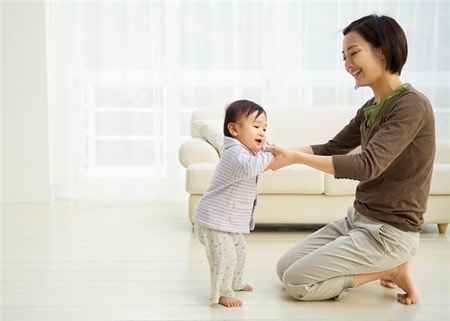
The time when each baby learns to walk varies. (Illustrative image)
3. The first step
The first steps appear when a baby can lift one leg forward while maintaining balance on the other. Of course, at first, the baby will need help from their parents.
To walk proficiently, a baby needs strong muscles, and they learn to relax their hips and knees. The biggest difficulty is that babies often tense their knees when walking, causing them to lose balance; therefore, they are prone to falling (or you might see them wobbling).
From 12 months of age onwards, babies learn to walk quite quickly. You don't have to wait long because after a while, your baby may be taking their first tentative steps around the house.
4. When a baby learns to walk early or late.
It sounds unbelievable, but some parents mistakenly believe that if their child learns to walk early, they will be better learners. The timing of walking can affect a child's development; therefore, if a child is still not walking by around 16 months old, parents should take them to the doctor. However, the link between early walking and being a genius needs further research. Some babies become proficient walkers very quickly, while others constantly fall. Some babies take a long time to learn to walk. This is perfectly normal.
5. Factors affecting learning to walk
- Weight: Overweight children tend to walk more slowly because they have difficulty maintaining balance when standing upright, compared to children with a normal weight.
- Ear infections: If your child is around 16 months old (or older) and hasn't started walking, they may have an underlying medical condition. Ear infections can affect their balance, potentially delaying their walking development.
- Having an older sibling: Babies who participate in walking lessons with an older sibling tend to learn to walk proficiently faster. This is because babies naturally imitate, so when they are integrated with an older sibling, they become more interested in learning to walk.
6. Sometimes, the baby goes back to learning to crawl.
Many babies, while learning to walk, like to combine walking with crawling. They might be toddling around, then suddenly switch to crawling briskly. Parents don't need to worry because in the early stages of learning to walk, babies can't yet distinguish between walking and crawling.
If your baby sees something interesting passing by in the room, they'll immediately be drawn to it and start crawling very quickly. They might be thinking, "Crawling is faster. Walking is too slow."
7. Hard to stop
The next challenge when a baby learns to walk is stopping without falling. Most toddlers fall when they stop walking. Compared to adults, each step a baby takes requires a lot of force because they haven't yet learned to bend their knees or coordinate their heels and toes. Furthermore, they haven't yet learned the principle of stopping by bringing one foot to a balanced position with the other.
8. Let your baby learn to walk barefoot.
Barefoot babies find it easier to walk than with shoes on because they have direct contact with the floor (ground). If your baby is walking on an unsafe surface, you should put shoes on them. Choose shoes with flexible soles; try bending the shoes – if the material is elastic, then they are suitable.
According to Young Intellectuals - PC