

Final article: Family culture in the context of today's events.
The Thai people (in Nghe An) highly value kinship. The importance of kinship is second only to brotherhood. In terms of clan culture, the Khmu people are fundamentally similar to the Thai people. For the Hmong community, members of the same clan often have close ties. They usually live together in close-knit communities.
Of the 12 articles introducing clans, 10 are about Thai clans, and one is about the Vu clan, which is quite important in the Hmong community. This clan includes Mr. Vu Chong Pao, who was awarded the title of Hero of the People's Armed Forces by the State and played a major role in persuading Hmong bandits in the mountainous region of Nghe An to join the revolution. There is also one article about the Moong clan of the Khmu people.
Like the Vi, Lo, Luong, and Ha families of the Thai people, the Moong family of the Khmu people is not a single lineage; most Khmu communities have the Moong surname. The awareness of a common origin among those with the same surname now exists only in the distant memories of the community, and the close ties of the past have faded. However, they share a common totem animal (the black weasel). Furthermore, the Moong people refrain from cooking or lighting fires in the ancestral shrine. Besides the Lunar New Year, the Moong also celebrate the "Taro Festival" in the 8th and 9th lunar months, holding a New Year's offering ceremony at night. The offering tray for the "Taro Festival" of the Moong people includes taro, a pair of chickens (one male, one female), and two jars of rice wine.
The Thai people are the largest community and also play a crucial role in shaping the unique characteristics of the ethnic minorities in Nghe An. Among them are many famous clans, some of which were once aristocratic, serving as village chiefs and leaders. The Lo Cam clan was the ruler of Ton and Nooc villages (Que Phong). According to legend, the clan originated from Ca Da village in western Thanh Hoa. Other sources suggest that the Lo Cam clan ruled the village for 17 generations, with some later changing their surnames to Sam and Cam. Bui Duong Lich's Nghe An Chronicle also records Cam Cong as the founder of Ton village (Bon village) in Tran Ninh prefecture. Aristocratic clans along National Highway 7 include the Lang Vi, Vi, and Lo Luu clans. The Lang Vi clan held the position of district chief for three generations and district magistrate for five generations. The Vi, Lo, and Luong clans held various positions in the old government, such as village chiefs and hamlet leaders.
When the government fell into the hands of the Revolution, these families continued to make important contributions to society. District chief Lang Vi Tao later became Chairman of the Administrative and Resistance Committee of Tuong Duong and Con Cuong districts until his death. The ancestor of the Vi family in Noong Bua village (now Nam Son village - Mon Son - Con Cuong) was a deputy village headman; later, Vi Chien Thang became Chairman of the Administrative and Resistance Committee, and then Vice Chairman of the People's Committee of Nghe An province.
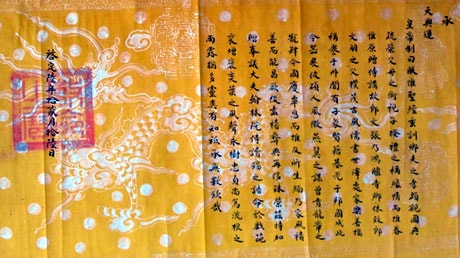
A royal decree from the Hue court praising the Lang Vi (Con Cuong) family.
Each clan made its own contributions to the community and society, including maintaining peace in the villages, such as the Lo clan in Muong Chai (Con Cuong), and the Dang and Luong clans in Yen Hoa and Yen Na (Tuong Duong). They were known for leading troops against other communities that encroached on the villages, and later were rewarded by the imperial court with titles such as village chief, and even high-ranking officials like district and county officials.
One distinctive feature that distinguishes different clans is the totem worship of their ancestral animal. The Vi clan worships the dragonfly, the Luong clan worships the tiger, and even the cat. The Lang clan worships the cuckoo, the Ngan clan worships the snake... Each clan has a legend about an ancestral animal that met with misfortune, and the clan members must wholeheartedly help and bury it, absolutely forbidding any harm to the animals they consider their ancestors.
Each clan has its own legend about its totem. For example, the legend about the totem of the Ngan clan that we have introduced. However, as ethnologist Dr. Vi Van An pointed out, the awareness of clan origins in communities in Nghe An is no longer as strong as in the northern mountainous regions. The practice of totem worship has also faded among ethnic minority communities in Nghe An.
Despite changing times, the prominent ethnic minority clans of the past continue to thrive. According to a member of the clan, the Vi clan in Noong Bua village remains a very close-knit community. They have an operating fund and a scholarship fund to promptly visit and encourage clan members when they are sick, in trouble, or when they achieve academic success.
Clan culture is gradually giving way to village culture, or more broadly, integrating into contemporary culture. However, in some aspects, we can still recognize the unique characteristics of a clan within the community!
Huu Vi