

The "Chaos" of Dietary Supplements: Part 2: Difficulty Distinguishing Between Genuine and Fake Products
In pharmacies, dietary supplements are carefully and attractively packaged with proper labels, but the same product from the same brand has different prices and is widely available, making it difficult for consumers to distinguish between genuine and fake. At a pharmacy on Nguyen Phong Sac Street, holding a box of Royal Jelly dietary supplement priced at 850,000 VND, Ms. Huong from Nghi Phu was told by the pharmacist: "Of the three types I have here, you should take this one; it's the genuine product. It's also royal jelly, but because some consumers are looking for cheaper options, I have to stock these two types, which only cost 500,000 VND."
;)
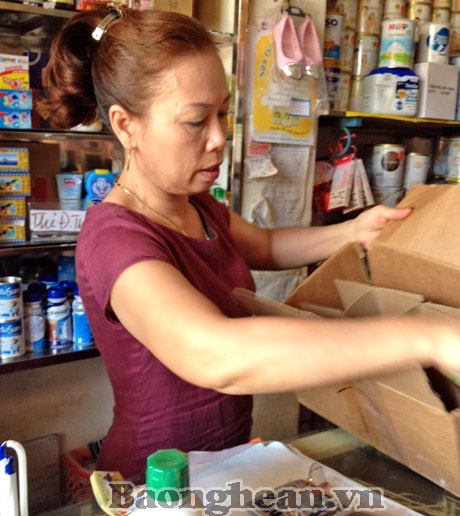
Pharmacist Nguyen Thi Hoa is verifying the authenticity of Royal Jelly products.
Ms. Huong wondered, "Why does it have a seal even though it's not an authentic product?" The pharmacist replied, "There are 5 or 7 different types of seals; nowadays, any pharmaceutical representative could have them. Since we know each other, I'm just revealing this to you!" Ms. Huong trusted her and paid 850,000 VND for the Royal Jelly beauty supplement from Costar, which helps prevent insomnia and supports diabetes treatment.
I was standing nearby and, being a regular customer, I asked the owner, "If pharmaceutical representatives can affix labels to counterfeit products, could smuggled products from China, as reported on television, infiltrate pharmacies?" She replied, "Of course they could, it's just a matter of whether we import them or not. Counterfeit goods look exactly like the real ones."
;)
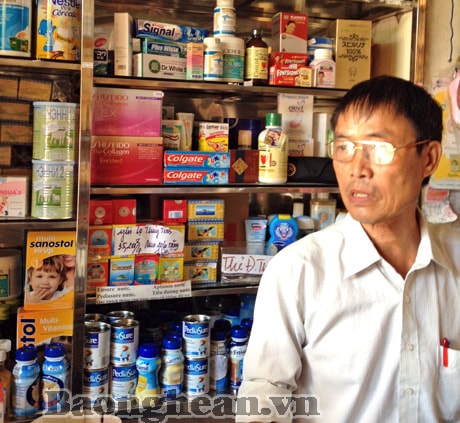
The Quy Thoa stall (on Le Loi Street) has only a few modest items, but many people recommend it as a reliable place to buy from.
At the Quy Thoa milk and confectionery store on Le Loi Street in Vinh City, a place that office workers have long talked about, they say: "These are imported goods, you won't find them anywhere else, they're excellent." Here, functional foods such as sheep placenta, collagen, and spirulina, which are used for skin beautification, from Japanese brands like Shiseido and Wakodo, are sold in very limited quantities.
The shop owner, Ms. Thuy, said: "These are hand-carried items that my aunt imported from flight attendants. There are only a few boxes left; regular customers usually buy them all, so there aren't any left to display on the counter like this. If you want some, you'll have to place an order. My shop has a well-known brand in this city, so you don't have to worry. You'll get addicted to them!"
The genuine, imported products here are not cheap, ranging from 850,000 to 980,000 VND. Each box of Colagell skin care product lasts for two weeks, meaning a user would spend 1,700,000 VND per month. When I asked how to distinguish between real and fake, Aunt Thuy laughed: "It's impossible, basically you have to trust the source of the goods. Chinese products are very sophisticated; they come in proper boxes and have labels. If you just buy cheap, unregulated products, you'll be ruined." However, even regular customers at Aunt Thuy's stall don't know the origin of the products here, and they basically still buy based on trust.
Ms. Nguyen Thi Le Na, an office worker in Quang Trung ward and a regular customer of Quy Thoa, said: “I’ve been using Colagell products for many months now, but I haven’t seen any improvement in my skin. I heard that you need to use about ten boxes to see results. Well, I’ll just keep using it and see.” Ms. Dung, also from the same office and a regular customer, said: “I noticed my skin is smoother, and my dark spots have faded significantly after using the fifth box. Now I’m really addicted to it, so I have to stock up on several boxes at home because I’m afraid of running out.”
Seeking answers about the true effectiveness of the beauty supplements currently available on the market in Vinh City, pharmacist Nguyen Thi Phong Lan, owner of a pharmacy on Doi Cung Street, shared: “We’ve attended many seminars on the issue of functional foods, and they are simply supplements of a few vitamins A, E, C, B1, B12, B6 and some trace elements extracted from natural foods. If you eat a lot of oranges, drink a lot of water, and eat a lot of soybeans and brown rice, you will get enough of those trace elements without needing to take those expensive green and red pills.”
When asked about the origin of the dietary supplements sold on the market, Ms. Lan said: "Besides domestically produced dietary supplements, most of the supplements produced abroad are sourced by pharmacies through online sales services, and some are imported through import companies. Generally, if counterfeit products are mixed in, consumers won't know, but we pharmacies know because the import price is cheaper."
The chaotic state of the dietary supplement market is evident to everyone. Why haven't the authorities taken action to inspect these sensitive products? The answer awaits a response from the regulators!
Thanh Nga