
Part 1: Scams and robberies in a hell on earth
A few years ago, when the labor export market to South Korea was frozen, the markets in Malaysia and Taiwan offered unstable incomes, and countries in the Middle East and West Asia were experiencing political instability, Angola was a paradise for Vietnamese workers. But now, this African nation has become a living hell, a place where Vietnamese people are caught in a dilemma: they can neither leave nor stay.
(Baonghean)A few years ago, when the labor export market to South Korea was frozen, the markets in Malaysia and Taiwan offered unstable incomes, and countries in the Middle East and West Asia were experiencing political instability, Angola was a paradise for Vietnamese workers. But now, this African nation has become a living hell, a place where Vietnamese people are caught in a dilemma: they can neither leave nor stay.
Hell on earth
Sitting motionless on his bed in his small house in Hoi 4 hamlet, Kim Lien commune, Nam Dan district, Nguyen Van Quyen (born in 1983) couldn't hold back his tears as he recounted his time working in Angola – a place he called hell on earth. A skilled and highly technical construction worker, Quyen had previously worked in construction in Saudi Arabia and saved up some money to renovate his mother's house. After finishing the renovations, he ran out of money and went to work as a construction worker, but the wages were too low. In mid-2011, when the movement to work in Angola became popular in Nam Dan district, Quyen decided to borrow $7,000 and asked a contact in a neighboring commune for help to get a job abroad with the promise of "stable employment and a monthly salary of about $1,000."
At the end of November 2011, Quyen boarded a plane with the hopeful anticipation of his family and relatives. After a layover in China, he arrived at Luanda Airport in Angola, his thoughts racing. The country was so poor and desolate, the environment around the airport foul and dirty; how could he possibly earn $1,000 USD? While he was lost in thought, a Vietnamese employer came to pick him up and take him to a camp. After a skills test, Quyen was hired as a finishing worker on construction projects.
This was a harsh climate, with intense sun, strong winds, and a lack of clean water. The workers were herded into a camp that resembled nothing more than a cattle shed back home. At night, the Vietnamese workers were given sleeping space on a wooden platform with a thin blanket, absolutely no mosquito net, and swarms of mosquitoes buzzed like bees. For the first few days, the newcomers couldn't sleep, but later, the work became so exhausting that they fell asleep as soon as they lay down.
Working about 9 hours a day in harsh weather conditions, but being hardworking, resilient, and able to withstand high-intensity labor, people like Mr. Quyen are not afraid of anything; what they fear most is food and water. Usually, the boss will find the most clumsy person in the group of workers to assign the task of cooking.
The food consisted of frozen chicken in Styrofoam containers. After using a shovel to remove the ice and thaw the meat, the cook would pour it directly into a pot of boiling water, where foam would rise to the surface, and then ladle it out for the workers to dip in salt. The broth was used as soup, completely devoid of any vegetables, onions, chili peppers, or other seasonings. This chicken and soup were eaten with hastily cooked, sometimes mushy, sometimes burnt rice. Seven days a week, thirty days a month, the laborers ate the same menu without complaint. In this country, clean water was more precious than gold. Year-round, the workers were provided with cloudy, yellowish water pumped directly to the camps without any treatment. A small bottle of mineral water cost about 50,000 Vietnamese dong, a price very few could afford.
In Angola, malaria has been rampant for decades. Living in such a toxic environment, it's common for Vietnamese workers to contract malaria. Le Van Hung, a close friend of Quyen who returned from Angola with him, said that when he first started working there, he contracted malaria three times. Whenever he felt feverish or chills, the workers had to go for intravenous fluids at the dilapidated medical stations. Each IV drip cost between $250 and $300; if they didn't have the money, the employer would pay for it and deduct it from their wages. "Malaria is always a nightmare in Angola because there are an incredible number of mosquitoes that transmit the disease, the environment is filthy, and there is no clean water."
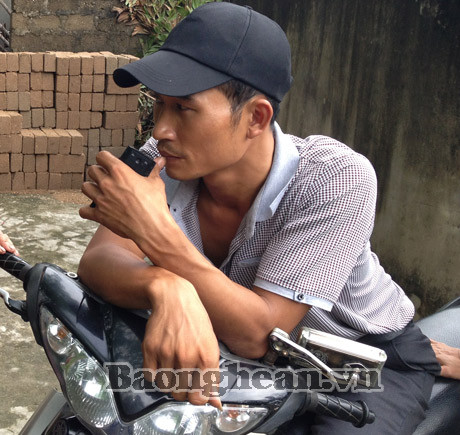
Mr. Le Van Hung, residing in Kim Lien commune, Nam Dan district, has recently returned from a living hell.
Most of the workers who die from malaria here do so because of negligence, not getting IV fluids in time, and also because the cost of IV fluids is too expensive. Many people think going abroad for work is a good life, but only after arriving in Angola do they realize that this is not a paradise for a better life; it's a place where life and death depend solely on luck. Meals and sleep are not guaranteed, and workers also have to worry about being robbed at gunpoint, arrested by the police, and deported back home,” Hung recounted, shuddering.
"Black market banks" and the scams perpetrated by "middlemen"
All Vietnamese laborers who go to Angola for work do so illegally, through the illicit networks of Vietnamese brokers. Upon arriving in Angola, the four things Vietnamese laborers fear most are: being arrested by the police, contracting malaria, being robbed, and especially being cheated out of their money by the brokers. These brokers are actually people who have worked in Angola for 5 to 10 years; some have become construction contractors, others have opened photo shops, photocopy shops, internet cafes, etc. Seeing the high demand for labor in Angola, they return to Vietnam and bring people over for a fee of 5000-7000 USD. After the laborers arrive in Luanda, the brokers will directly meet them and take them to camps, where they begin the job assignment process.
Nguyen Dinh Minh, originally from Hung Nguyen district and currently working in Luanda, said that employers cheating and withholding wages is commonplace, but no one dares to protest because these employers are wealthy and have connections with the police. If they protest, they will be immediately arrested and deported. Working for Black employers means daily wages of $400 USD, but it's very unstable; sometimes the employer pays, sometimes they don't. If you speak up and demand payment, you're beaten and threatened with death. The scariest thing is when building houses for employers with police connections (known as Defa in Vietnamese). When a house worth several billion dong is nearing completion, the workers are overjoyed at the prospect of receiving their wages, only to receive news that the police are chasing them. Without a word, everyone scatters in panic, not daring to think about their money.
The phenomenon of Vietnamese contractors and brokers deceiving and informing on workers to the police in order to avoid paying wages is becoming increasingly common. Vietnamese workers in Angola have formed online groups and associations such as the Vietnamese Association in Angola, the Association of Those Who Have Been Deprived of Wages, the Vietnamese Labor Community in Angola, etc. Through these groups, people in difficult circumstances receive help from the community. They also inform each other about arrests by the Defa (Defense Forces) in various areas to warn workers to be careful, and they expose the fraudulent practices of some employers. Despite the hardships, the spirit of mutual support among Vietnamese workers shines brightly in this impoverished African land. Whenever a Vietnamese worker dies or is seriously injured, the workers here do not hesitate to contribute money to help them get medical treatment, and to help their relatives pay for hospital fees, funeral expenses, and coffin costs. Each repatriation of a deceased person in Angola typically costs between $50,000 and $100,000, with most cases being repatriated thanks to the assistance and intervention of the Embassy and donations from the community. |
In early 2012, from Nghi Xuan commune, Nghi Loc district, two workers, Nguyen Phuc Tung (born in 1991) and Nguyen Van Tung (born in 1983), eagerly paid $6,500 USD to fly to Angola, with a promised salary of $1,000 USD per month. After working for three months, the contractor owed them their wages and promised to pay them all after the project was completed. Just as the project was finished and the group was eagerly awaiting their money, a group of Defa (a Vietnamese laborers) appeared and arrested them, taking them to the police station… After being arrested and cheated out of their money multiple times, the Vietnamese workers realized that their arrests were actually orchestrated by Vietnamese brokers and employers who were helping them cheat out of their wages.
Not being cheated out of their wages in Angola was considered fortunate, but even after receiving their salaries, they struggled to send money home due to the rampant robbery. Typically, after receiving their wages in the afternoon, a gang of armed black men would arrive in the evening to rob them; anyone who resisted would be shot dead. Having been robbed so many times, the workers realized that all the robberies were orchestrated by Vietnamese brokers and employers.
If you want to avoid being robbed, the only way is to use a "broker" to transfer money back to Vietnam through a "black bank." Each time you transfer 1000 USD, the broker deducts a fee of 100-150 USD. "After receiving the money, the broker will call back to Vietnam, and someone will deliver the money to the worker's family. It's very quick, but the fees are exorbitant. When I was in the detention center in Luanda, my wife at home had to send money to cover the repatriation procedures, and she also had to pay a commission from the broker. Only the workers suffer, while the 'brokers' are profiting in every way from the unfortunate," confided Tran Van Hung (born in 1970), who recently returned from Angola.
Witnessing the deceit and robbery in the "promised land" of Angola, Nguyen Van Quyen was determined to earn enough money to return home. At the end of 2012, while working on scaffolding, Quyen tripped over an electrical wire, fell to the ground, and suffered severe burns. Friends and the Vietnamese community in Angola rushed him to a private hospital in Luanda, where he stayed for two days at a cost of $18,000. Having run out of money, Quyen was transferred to a burn center for treatment. His mother had to mortgage their house and borrow from the bank to send $9,000 to his friends to help him return to Vietnam.

Mr. Nguyen Van Quyen returned in a wheelchair.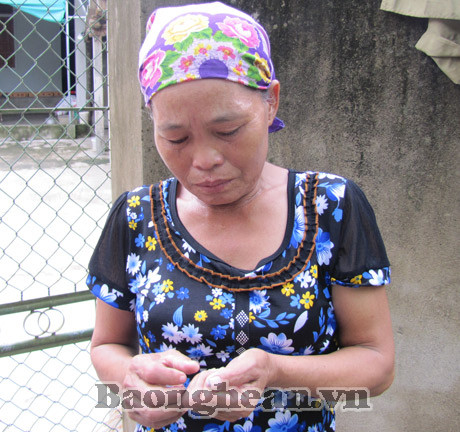
Mrs. Nhung, Quyen's mother, wept uncontrollably as she spoke about her son.
Returning home after two months of treatment at the National Burn Institute, Quyen was left paralyzed on one side of his body, with a sunken head, and resigned to living his life in a wheelchair… Not long after Quyen's return, his friends and hundreds of other Vietnamese laborers also began a mass exodus.
(To be continued)
Nguyen Khoa