

"If Assad dies, all of Syria will be bathed in blood."
According to experts, the planned Western airstrikes on Syria will only target military, intelligence, and government-related objectives, but will not alter the balance of power in the country.
Accordingly, any airstrikes, if they occur, would aim to punish President Bashar al-Assad and send him a message, rather than wipe out government forces or give the rebels a decisive advantage.
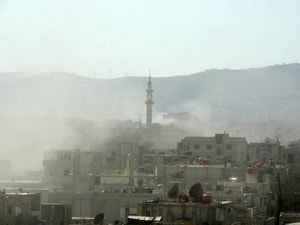
Images released by the Syrian opposition show white smoke believed to be toxic gas used by the Syrian army in a chemical weapons attack on Damascus on August 21 (Source: AFP).
“Specific targets would include headquarters in the Damascus area, military barracks and facilities supporting the Republican Guard divisions, government units believed to be involved in attacks on civilian areas,” analyzed Jeffrey White of the Washington Institute for Far Eastern Policy. “Allied forces could also strike high-level military and intelligence headquarters and command centers associated with military operations around the capital.”
The Republican Guard, renowned as the government's most elite and best-equipped unit, is commanded by the president's brother, Maher al-Assad. The Republican Guard is also responsible for protecting the capital.
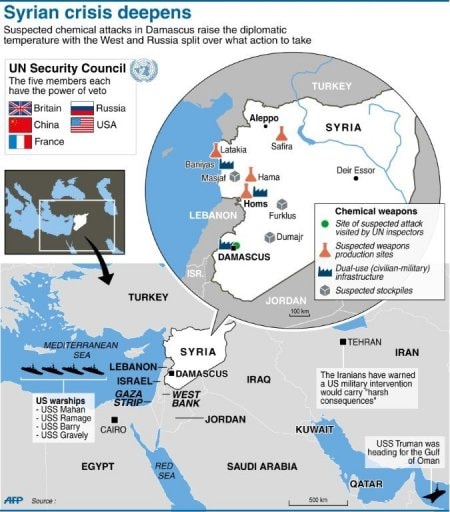
Washington and its allies are pressuring for military action against the Assad regime following reports of possible deadly chemical weapons attacks, but Russia and Iran have warned of dire consequences if the West decides to attack Damascus.
Analysts suggest the U.S. could launch cruise missiles from submarines, warships, and aircraft from outside Syrian territory and territorial waters. French General Vincent Desportes, former director of the Ecole de Guerre military academy, told AFP that any airstrike would be “more symbolic than effective in altering the balance of power.”
"It's a matter of restoring Western trust. They've declared an uncrossable red line, but so far they've done nothing, and if they do nothing, trust in the US will erode, especially on the issue of Iran."
But the attacks wouldn't be too large, because if President Assad were killed or the current regime collapsed, there would be a bloodbath and national-level chaos. That would be a strategic failure, like what happened in Libya.”
Desportes suggested that the airstrikes would be brief, targeting symbolic locations such as government buildings, military command centers, air bases, or even the presidential palace, provided they ensured Assad was not present.
Strategic revelations from Western countries suggest that airstrikes will be limited in time and space, insufficient to completely destroy Syria's military infrastructure and create a decisive advantage for the rebels, according to analysts.
Christopher Harmer, a naval expert at the Institute for the Study of War, said a single Tomahawk missile strike would not be enough to destroy all of Syria's chemical weapons.
The U.S. Navy currently has approximately 200 Tomahawk missiles on four warships off the coast of the Mediterranean, a firepower that Harmer claims is more than enough to conduct a medium-scale, high-intensity strike against multiple targets in Syria.
According to (Vietnam+) - DT