
Buying votive offerings: Sincerity is what matters.
With only a few days left until the full moon of the seventh lunar month, families are preparing offerings with sincere hearts to "atone for the sins of the deceased." However, in these times of economic downturn, coupled with people's awareness of the importance of saving money, offerings to the deceased this year are more modest.
(Baonghean.vn) -With only a few days left until the full moon of the seventh lunar month, families are preparing offerings with sincere hearts to "atone for the sins of the deceased." However, in these times of economic downturn, coupled with people's awareness of the importance of saving money, offerings to the deceased this year are more modest.
Normally a wholesale hub for retail markets, Vinh Market's paper offerings are usually bustling with buyers and sellers around this time of year. However, even on the 10th day of the lunar month, the atmosphere remains quiet. Buyers are few and far between, while sellers leisurely move in and out, eagerly inviting customers with enthusiant greetings: "What do you want, child? I have everything you need, and the prices are reasonable!" Buyers typically only purchase a few sets of clothes, fabrics, and some gold coins – just a little more than usual for the week-long ritual. Ms. Hien, a customer, said: "This year, we'll only buy the usual offerings, as long as there are enough clothes and fabrics for our ancestors. And now, we shouldn't burn too much; it's all about the sincerity of our hearts."
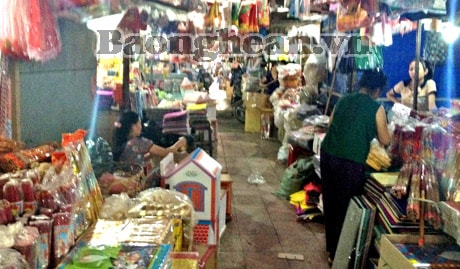
The stalls selling votive offerings at Vinh market have few customers.
According to Ms. Tam, a small businesswoman with nearly twenty years of experience selling votive offerings, "Last year, from the first day of the Vu Lan festival, people flocked to buy them, and I had to mobilize my two daughters to help. We sold tens of millions of dong worth of goods each day. But this year, by the 10th day, I've only sold a few million dong worth of goods. Business is so slow!" When asked if she would lose money this year because she had already imported the typical Vu Lan offerings and could return them if she couldn't sell them, she said, "The goods were ordered more than a month ago, and there's no way I can return them. But if I don't sell them all, I can keep them for next year, or if I have acquaintances who are priests, I can ask them to get them for me, but I'd have to sell them cheaply, so I'd still lose money." According to Ms. Tam, this year the import price has increased slightly by about 5-10%, but she has to keep the selling price the same because everyone wants to sell cheaply to stimulate demand.
As in previous years, the offerings of paper money are very diverse. A plate of cheap paper money costs only 2,000 dong, but a bundle of paper money containing underworld bills, underworld dollars, and 500,000 dong notes can cost up to 40,000 dong. The earthly world mirrors the underworld; the offerings used for burning during the Vu Lan festival are very abundant. Each set of clothes costs an average of 20,000 to 30,000 dong, with various types of office dresses, jeans, etc. Household appliances like gas stoves and rice cookers cost around 20,000 to 40,000 dong; ordinary motorbikes cost 70,000 to 100,000 dong, while newer, more attractive models cost 150,000 dong. However, there are also simpler motorbikes with smaller frames for only 20,000 to 40,000 dong. Cars are more expensive, each costing from 150,000 to 300,000 dong depending on the model. The same goes for housing; some options cost just around 200,000 VND.
However, due to economic difficulties and a shift in public perception—emphasizing sincerity and devotion—high-priced, extravagant items like cars and airplanes are less sought after. Complete sets of almost all necessary household items such as beds, wardrobes, tables, chairs, dishes, teacups, etc., are more popular and cheaper. Many small traders have anticipated this and only stock a full set of offerings, fearing they might lose face if someone asks for them and they're not available.
Not only are there observations from wholesale and retail markets, but this year, the burning of votive paper offerings to "atone for the deceased" by visitors at temples and pagodas is also more modest than in previous years. At Hong Son Temple, visitors usually offer a simple offering of gold coins, five-directional offerings, fabrics, and some sweets. If a family has a deceased person whose remains are sent to the temple, they prepare a more complete and practical offering. Ms. Phuong from Do Luong came to the temple to ask the monk to offer prayers for the soul of her young daughter to find peace. Her offering included items such as multi-layered dresses, pillows, and dolls to express her love and regret for her unfortunate daughter.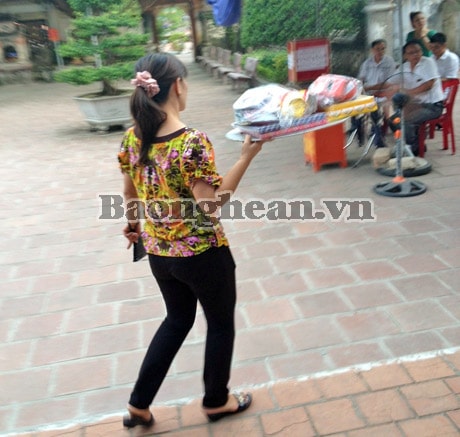
Most people only offer a small token of their sincerity as a gift.
She shared: "My granddaughter passed away when she was too young. People say that if we send her offerings to the temple, she will find peace and become a maidservant, so every year on this day I go to the temple to send her some things. Last year I bought her a lot, including a pink horse and a multi-story house, but this year the monk only allowed us to burn a few offerings. Besides, I think it's a waste; she was relying on the temple for refuge, so what did she need a house for?"
Looking around, the temple was bustling with people today, but no one was bringing as many offerings as in previous years. Mr. Nguyen Cong Tien, from the Hong Son Temple Management Board, said: "The temple is following a directive from the Department of Culture, requiring monks not to allow visitors to bring excessive amounts of paper offerings. Any monk who violates this will be severely punished. As you can see, the temple only has one incinerator, and we haven't had to empty the ashes from morning till evening."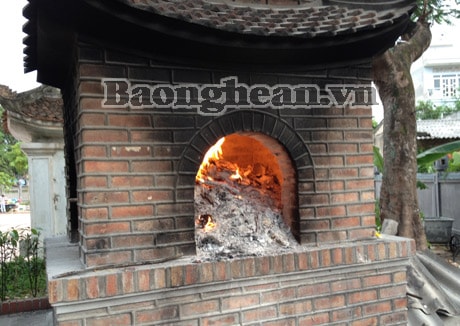
The furnace at the temple is not overloaded.
In previous years, during this time of year, people would be seen burning paper houses, televisions, and refrigerators on the streets and alleys. This year, however, the phenomenon has significantly decreased. Mr. Tran Van Loc, head of Tan Hop - Hung Dung block, said: “In previous years, starting from the 10th day of the lunar month, many households would burn offerings for their ancestors. Some houses would have a tray overflowing with paper offerings of various sizes, while others would leave them overflowing into the yard – houses, cars, everything was ablaze with red. I was terrified and had to announce and ask people to water the offerings to prevent fires. But why haven't I seen many people burning them this year?!” Mr. Loc also added that for the past three days, the Tan Hop block's radio broadcast has been announcing measures against wasteful burning of paper offerings and warning about the potential fire hazards if people are careless.
The Ministry of Culture, Sports and Tourism has issued Circulars No. 04/2009/TT-BVHTTDL and No. 09/2010/TT-BVHTTDL guiding the Departments of Culture, Sports and Tourism. These provincial Departments have sent official letters to the Culture, Sports and Tourism Offices in districts and towns to disseminate regulations on organizing festivals and places of worship, directing and disseminating these regulations. They emphasize the need for proactive coordination with relevant sectors in implementation. Circulars No. 04 and 09 of the Ministry of Culture, Sports and Tourism mention the act of burning votive offerings at festivals, public places, and on the 15th and 1st of each lunar month, highlighting the importance of public compliance and the need for penalties as stipulated in Government Decree No. 75/2010/ND-CP. This aims to bring legal regulations into practice, prevent negative social impacts, and promote a healthy cultural environment and cultural activities. |
Thanh Nga