

Lesson 1: Everywhere is unsafe!
(Baonghean)Following the article "Not just the death of one buffalo..." published in Nghe An Newspaper No. 9513 on August 4th, which reflected on the unsafe power grid infrastructure in Nghia Dung commune (Tan Ky district) causing livestock deaths and the irresponsibility of some local electricity officials, readers have informed us that similar situations exist in many other localities in the province. Furthermore, one electricity employee even died from an electric shock...
The electricity worker who died from an electric shock, according to information provided by a reader, was named TST from Phuc Son commune and worked at the Anh Son District Electricity Branch. However, verifying this information proved difficult. When we contacted the Director of the Anh Son District Electricity Branch, he said he was in a meeting in Vinh City and promised to have the Deputy Director answer. A few minutes later, when we arrived at the Anh Son District Electricity Branch headquarters, the Deputy Director's office was locked. When we tried to contact him by phone, he said he was on duty at a facility (?!). When we requested information about rural electricity infrastructure from the Technical Department, the Deputy Director initially refused, stating that the responsibility for making statements rested with the leadership.

The scene where the Anh Son Power Company employee was electrocuted to death.
However, he later stated that the rural low-voltage power grid infrastructure in Anh Son was very poor at the time of handover, mainly due to contributions from the people in the 1990s, and had deteriorated severely, posing a safety hazard. Although the power sector is investing in rural power infrastructure under the Project to Improve Energy Efficiency in Rural Areas of Nghe An Province, funded by a loan from the German Reconstruction Bank (KFW), this has only been implemented on the main power lines, leaving most of the power lines leading into villages and hamlets largely unchanged. "Almost every commune in Anh Son is in the same situation..." the deputy head of the technical department said. When asked: With such power infrastructure, have there ever been any accidents involving people or property? The deputy head replied: No. When asked: So why is there information about power sector employees in Anh Son being electrocuted to death? The deputy head stammered: Due to negligence while performing his duties!
Through a responsible person in Anh Son district, we learned that an electricity worker was injured while on duty in Lang Son commune on March 23, 2013. Upon arriving in Lang Son commune, residents confirmed that the incident occurred in Hamlet 3, near Mr. Le Van Dinh's house. Visiting Mr. Le Van Dinh's home, we learned that the incident happened right in front of his house, at a low-voltage power pole erected in a rice paddy on the main power line of the hamlet, with several electricity meters hanging on the pole.
Mr. Dinh recounted: "That day it was very sunny, and two electricity company employees came to inspect the electricity meter and power lines. One climbed up to check the wires, and the other stood below to check the meter. The person up high was unharmed, but the person below, due to carelessness, accidentally touched a live wire and was electrocuted. By the time the person up realized it, it was too late. By the time they managed to pull the electrocuted man out of the rice paddy for emergency treatment, he was already dead." As a generator repairman, Mr. Dinh wondered: "According to regulations, the power should be cut off during repairs. I don't understand why they were so careless when the power pole was located in a rice paddy..."
According to many residents and officials in Lang Son commune, electricity issues are a major concern. It has been a year since Lang Son handed over its electricity infrastructure to the power sector, but in every alley and hamlet, the state of the infrastructure is severely degraded, with many old, patched-up wooden poles and crumbling concrete poles with cracked or chipped insulators. Right at the headquarters of the Lang Son Commune People's Committee, where there is a transformer station, there are also numerous wooden, concrete, or other utility poles with broken bases and exposed steel reinforcement. Some poles are leaning precariously, while others are constructed from sections of steel, concrete, and other materials, with a tangled mess of exposed electrical wires attached to them... Mr. Truong Ba Hoan, Head of the Culture Committee of Lang Son Commune, said: "In the central area of the commune, the quality of electricity is relatively good, but further up to hamlets 1 and 2 along the Ho Chi Minh Highway, for about 4km, the electricity is extremely unreliable, sometimes bright, sometimes dim. Often, people can't use it and have to resort to 'electricity above, oil lamps below...'"
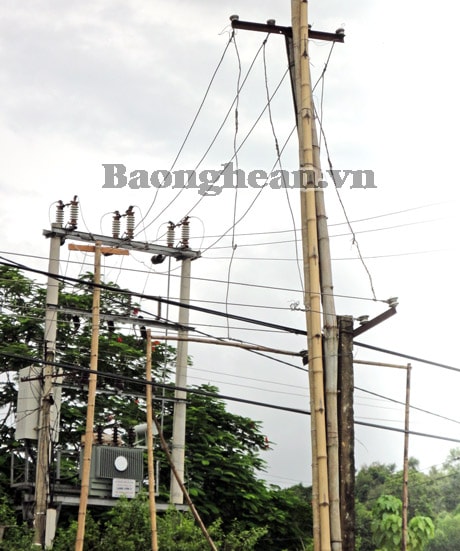
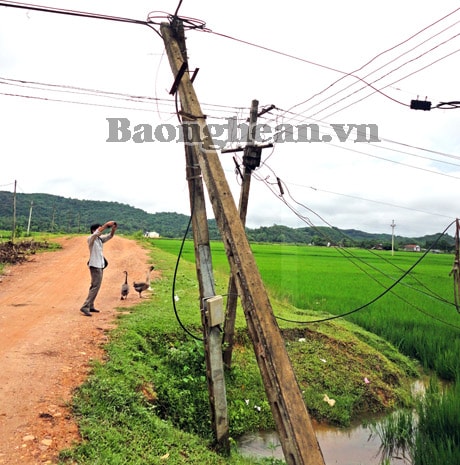
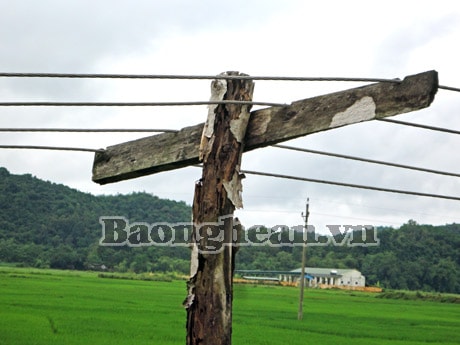
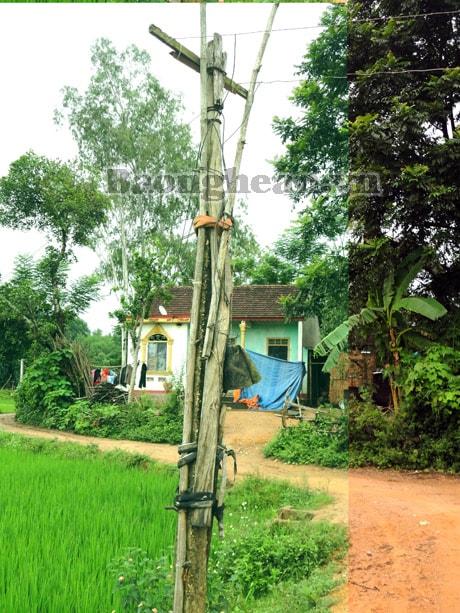
The rickety, makeshift electric poles made of rotten wood and bamboo pose a safety hazard in Lang Son commune (Anh Son district).
;)
Mr. Ha Van Hien, Deputy Head of the Industry and Trade Department of Anh Son district, said: "To date, 15 out of 21 communes have handed over their power grids to the Electricity sector. The Electricity sector has implemented the Rural Energy 2 Expansion Project (RE2 Expansion) and KFW projects. However, due to taking over many communes at the same time, investment and renovation of the power grid system have only been addressed in terms of meters and some main lines. Therefore, the quality of the low-voltage power grid infrastructure has not been improved and is still not in a state that meets the regulations of the Electricity sector..."
Nam Dan district was one of the first to hand over its medium- and low-voltage power grids to the Electricity sector for management and direct electricity sales to households. To date, 19 out of 21 communes and towns have handed over their low-voltage grids to the Electricity sector. According to some officials from the Nam Dan District Department of Industry and Trade, since 2009, the Electricity sector has invested in 35 transformer substations in Nam Dan and is currently upgrading infrastructure under the KFW Project, so the electricity infrastructure here is relatively secure. However, there are still shortcomings such as insufficient electricity supply for production and business in industrial clusters and production households; the development of new electricity demand from organizations and individuals in communes with high electricity needs sometimes takes many days; and power outages are not resolved quickly, leading to prolonged periods of disruption. These are issues causing public concern.
In Xuan Hoa commune (Nam Dan district), although the power grid was handed over more than a year ago, the low-voltage power lines along the inter-village roads are clearly unsafe. When asked, Mr. Tran Huu Khuong, Chairman of the Commune People's Committee, said: "The low-voltage power grid system is severely degraded, but since the handover, the power sector has not taken any action. The commune requested the Electricity Branch to install additional transformer stations to increase capacity and promptly serve the needs of organizations and individuals in the area, but this has also been denied. Recently, several power poles have fallen, and residents have called for repairs, but no power sector officials have come to fix them. In hamlets 7 and 11, there have also been electrical short circuits damaging household items, but the power sector has not yet taken responsibility..."
Traveling along the Ho Chi Minh Highway through the communes of Ngoc Lam, Thanh Thuy, Hanh Lam (Thanh Chuong district), and Khai Son (Anh Son district), one is clearly exposed the unsafe state of rural electricity infrastructure. Along the highway are low, old wooden power poles, broken, patched, and leaning concrete poles requiring supports, and a tangle of bare power lines running through the trees… Further north in Tan Ky district, the same scene of inadequate electricity infrastructure is observed. A leader from Tan Ky district stated: "It's not just Nghia Dung where buffaloes die due to unsafe rural electricity infrastructure. Almost everywhere in Tan Ky has similarly poor electricity infrastructure. From Ky Tan, Nghia Binh, Phu Son… and even the town itself, it's all the same. At every district People's Council meeting, voters criticize the electricity sector for the prolonged state of poor and unsafe rural low-voltage power grid infrastructure and the irresponsible service attitude…"
The Vietnam Electricity Corporation (EVN) stipulates the following regarding the technical management, operation, and safety of rural low-voltage power grids after handover: "...Immediately after handover, the Electricity Companies; District, City, and Town Electricity Companies must send a document to the local authorities and state management agencies detailing the technical shortcomings and safety risks of the newly handed-over rural low-voltage power grid, including the deadline for rectifying the shortcomings that pose safety risks to the grid; Immediately after handover, the units must rectify the shortcomings and make minimal repairs to the power grid to ensure safe operation and electricity sales...;
|
Nhat Lan - Duc Chuyen