
Mo Village - A purely indigenous cultural village
Mo Village, Nghia Xuan Commune, is located at the beginning of Quy Hop District. This peaceful village lies amidst vast fields of sugarcane, cassava, and corn, and dense green bamboo groves. No one remembers exactly when the village was founded. Hundreds of years ago, people came to live here, gradually forming a village. The first indigenous people built houses along the riverbanks and small streams, hunted animals, fished, and wove hemp hammocks… they even built a temple dedicated to the god Mo (water source) and a temple dedicated to the village's tutelary deity, Cao Son Cao Cac. The temple dedicated to the village's tutelary deity was granted royal decrees by two dynasties and is still preserved today: the reign of Emperor Duy Tan (1912) and the reign of Emperor Khai Dinh (1925).
(Baonghean)Mo Village, Nghia Xuan Commune, is located at the beginning of Quy Hop District. This peaceful village lies amidst vast fields of sugarcane, cassava, and corn, and dense green bamboo groves. No one remembers exactly when the village was founded. Hundreds of years ago, people came to live here, gradually forming a village. The first indigenous people built houses along the riverbanks and small streams, hunted animals, fished, and wove hemp hammocks… they even built a temple dedicated to the god Mo (water source) and a temple dedicated to the village's tutelary deity, Cao Son Cao Cac. The temple dedicated to the village's tutelary deity was granted royal decrees by two dynasties and is still preserved today: the reign of Emperor Duy Tan (1912) and the reign of Emperor Khai Dinh (1925).
>>Lesson 3: Na Cang, a Hmong cultural village
From the late 19th to the early 20th century, Mó village was called Sách Mỗ hamlet, then Thái Thịnh hamlet, belonging to Thái Thịnh commune, former Nghĩa Đàn district. From 1961 to the present, the village has been called Mó village (Nghĩa Xuân commune, Quỳ Hợp district). Although the name Mó village was changed, it also reflects the identity of the Thổ ethnic people living here. The Thổ people have a custom of living along springs, streams, and riverbanks. Mó means water source, natural water flow; the people live off the springs, and they worship the Mó god to pray for prosperity and peace...
I returned to Mó village amidst the bustling harvest season. The villagers were all out in the fields harvesting sugarcane to deliver to the sugar factory. The lives and production practices of the people have changed considerably. But the imprint of the Thổ people remains strong in their language, customs, beliefs, and in their songs and melodies, such as "Đu đu điềng điềng," "Tập tính, tập tang," etc.
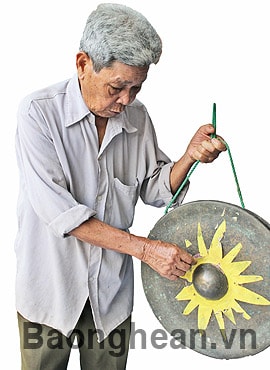
Mr. Truong Cong Hue and the gongs of the Tho people.
To date, Mo village has been a Cultural Village for 13 years and a Purely Indigenous Cultural Village for 8 years. Throughout that time, the people here have continuously preserved their ethnic identity, built a cultural way of life, and actively worked and produced to make their lives increasingly prosperous and rich both materially and spiritually. By effectively implementing the policies and laws of the Party and the State, Mo village rarely experiences social vices, and the community spirit is strong and united. In particular, in 2012, the people of Mo village, with the support and assistance of businesses, restored the village's tutelary deity temple on its original site (which had been destroyed by war), reviving the cultural and religious traditions of the people.
The villagers are remaking traditional crafts such as crossbows and arrows, weaving baskets and mats, and making hammocks from hemp fibers – crafts passed down through generations of the Tho people. To preserve and promote the traditional cultural values of the Tho people, Mo village has established a Tho Folk Arts Club, which has been active for nearly 10 years, rediscovering, collecting, and bringing the ancient songs of the Tho people back to modern life. These artistic activities are no longer just for competitions or performances at festivals, but have become a part of the daily lives of the villagers.
The elderly people were very excited: "We love to sing, we could sing all day long. Everyone is happy and delighted that the government has designated Mo village as a Cultural Village. With the club, more and more people are singing the traditional folk songs, which we only knew and kept to ourselves before. We just hope that these activities and performances will continue for a long time so that after we die, our children and grandchildren will all know and remember the folk songs of our ancestors..."
Achieving the title of Cultural Village is not easy. Mo Village was chosen to build a purely Tho-ethnic cultural village because it has a long history and culture of the Tho people. Currently, the Tho ethnic group accounts for more than 70% of the population, with approximately 201 households and over 1000 people. Maintaining and preserving this title has been a difficult and arduous journey.

The gate of Mó village, Nghĩa Xuân commune (Quỳ Hợp district).
Meeting with village head Ngo Thi Thoa, she said: “In 2000, we were recognized as a Cultural Village by the province, and in 2005, the Ministry of Culture and Information recognized us as a purely Tho ethnic cultural village and established a Tho ethnic folk arts club. Since then, we have strived hard and lived up to the title. We have encouraged traditional weaving, built a cultural center, a spacious sports field with 11 volleyball teams and 2 football teams. Normally, the field is packed with people in the afternoons. The Tho folk arts club has more than 50 members, from elderly people and women to young people. But, there are many worries. We worry about how to maintain the pure Tho culture because when the lives of the villagers are still so difficult, the struggle for food and clothing and raising children for education limits their attention to their culture and identity!”
I visited Mr. Truong Cong Hue (78 years old), the guardian of the village's gong set, and one of the few elders who still possess characteristic tools and implements of the Tho people. Mr. Hue confided: "The Tho people's gong set has four pieces, and one is cracked. The government has given us money, but we villagers are pooling our resources to buy a new set." Then he showed me the items he had made himself for household use, to sell for extra income, and as keepsakes: a crossbow, a knife holder for forest use, a fish trap… "Before, I had even more, but I gave some away to the district and commune," Mr. Hue boasted. Then the old man with gray hair suddenly became pensive: "Old people have the time to do this to remember the craft passed down from their ancestors, but young people are busy with their economic activities and can't just rely on weaving to make a living. The things I make sell out immediately, but it takes a long time to make them. Or take the hemp hammock, for example. Growing the hemp, then harvesting the fibers, weaving it into a hammock takes months, and yet it only sells for a few hundred thousand dong?!"
Speaking with us, Mr. Truong Thanh Hai, a cultural officer of Nghia Xuan commune (Quy Hop district), said: “The most valuable thing about Mo village is that it has maintained and developed a purely Tho ethnic cultural village for decades. That is not easy at all. The concern is that the lives of the people are still difficult, so they do not have the conditions to pay attention to culture. On the other hand, in the long term, the work of preserving, conserving, and promoting the cultural values of the Tho ethnic group requires people with expertise and knowledge!”
Text and photos: Ho Lai