
Bananas ripen "super fast" thanks to chemicals.
A finger-sized tube of chemical, originating from China, was mixed with 2 liters of water and sprayed evenly onto bunches of green bananas stacked on the ground. After just one night, these bunches of bananas turned a vibrant yellow, looking extremely appealing.
A finger-sized tube of chemical, originating from China, was mixed with 2 liters of water and sprayed evenly onto bunches of green bananas stacked on the ground. After just one night, these bunches of bananas turned a vibrant yellow, looking extremely appealing.
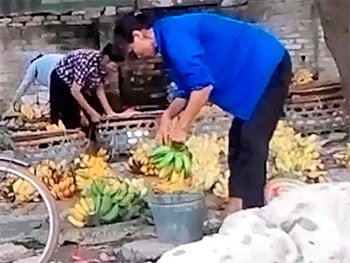
Dipping each bunch of bananas in a "super-fast" ripening chemical - Photo: Ha An
Every day, bananas ripened artificially with this chemical are regularly released onto the domestic market...
Spray-dip technology
To help readers understand the process of artificially ripening bananas, a reporter from Thanh Nien newspaper spent several days investigating the banana market located right next to the Red River, at the end of Ham Tu Quan street (Hoan Kiem District, Hanoi). This is considered one of the largest banana suppliers to Hanoi, having existed for about a decade and showing a tendency to expand further.
"This medicine causes severe itching, so remember to wear gloves when mixing it for safety. Before now, the guys who bought this medicine from me only used it to ferment bananas and tomatoes for resale; I haven't seen anyone say they used it for home consumption."
Owner of a pesticide shop.in Duong Noi Ward (Ha Dong District, Hanoi)
At 3 PM on a day in mid-July, following a boat driver named Tung (from Van Hoa commune, Ba Vi district, Hanoi), we arrived at the banana market along the Red River. More than twenty traders, mostly women, were gathered at the market. Each had "allocated" a small plot of land, about a few square meters, to "display" their goods. Bunches and clusters of ripe yellow bananas were displayed everywhere. The entire area, nearly a thousand square meters, seemed to be dyed yellow with ripe bananas. In the nearby trees, bunches of still-green bananas, in the process of ripening, were piled high and covered with old, damp, moldy blankets. We met a man carrying bunches of green bananas, their unripe fruit still attached, next to a pile of ripening bananas. Speaking in his distinctive Ba Vi accent, he said to a female trader: "Use chemicals to slow the ripening process. So they'll ripen in time for sale tomorrow." After saying that, he took a bottle of colorless liquid and handed it to the woman, before returning to his usual work by the riverbank.
The vendor mixed a small amount of a pungent-smelling liquid into a bucket of water. Then, she dipped each bunch of green bananas into the chemical solution before placing them next to the pile of bananas already ripening. “What are you dipping the bananas in there for…?” I asked. Before I could finish my question, the woman glanced at me and curtly replied, “I don’t know what it’s for,” but then revealed, “Soaking them in this chemical makes them yellow and look nice when they ripen.” Pretending not to understand, I turned to the boat owner, Tùng, and asked, “Everyone at this banana market does the same thing. But they don’t just dip them in the chemical to make them look nice; the main purpose is to accelerate ripening. If they let the bananas ripen naturally, it would take almost a week, and the vendors wouldn’t be able to afford the rent for the docks,” Tùng explained.
Afraid of causing trouble and losing the business deal, Tung quickly pulled me onto the boat. As soon as we were out of sight of the banana vendors, Tung looked at me and rattled off: “The chemical used to ripen the bananas earlier was imported from China. It’s cheap but very effective. After spraying or directly dipping them into the prepared chemical solution, then spreading it evenly on the ground and covering it with a blanket, after just one night, the bunches of bananas will turn yellow and ripen evenly.” To convince me, Tung added: “Here, the banana traders have some leftover chemical. When we get to the dock, just take this empty tube and go to any pesticide store to buy more. Just say you want to buy it to ripen bananas, and they’ll understand.”
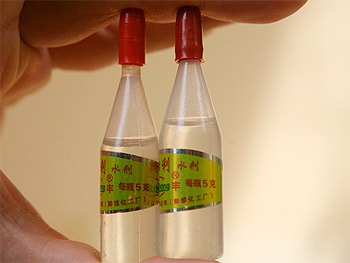
Two types of chemicals used to ripen bananas have been banned from use.
"This chemical causes irritation and itching upon contact with the skin. When absorbed into the body in large quantities, it can cause coma and lead to death."
Ms. Nguyen Thi Nhung, Head of the Department of Pesticides, Weeds and Environment at the Institute of Plant Protection.(Vietnam Academy of Agricultural Sciences)
You can buy as much as you want.
In the Ha Dong district, after just glancing at the tube of chemical that Tung showed me, the owner of a pesticide shop immediately said: "You should go down to the pesticide shops in Dai Mo (Tu Liem district), Duong Noi (Ha Dong district), Song Phuong (Hoai Duc district), Van Noi (Dong Anh district)... and ask around. They specialize in growing tomatoes there, and maybe they still use this chemical to ripen them early." According to this shop owner, besides bananas, people also use this chemical to ripen tomatoes, lychees, and jackfruit. However, due to its direct impact on human health, this chemical is banned from use.
At a pesticide stall in Duong Noi Ward (Ha Dong District), upon hearing someone ask to buy chemicals for ripening bananas, a man in his 50s, wearing a black fedora, rushed out and quickly offered his wares: "Fruit ripening chemicals? I have them. Yes, ripens bananas, tomatoes, or jackfruit. They're all fruits. You've come to the right place. How much do you want?" He then produced a large plastic bag containing several blister packs of chemicals, each containing 10 tubes. Visually, the tubes were made of soft plastic, about the size of a ring finger, and contained a whitish liquid. Each tube had a small label with Chinese characters, but no manufacturing address, expiration date, or Vietnamese label except for the words "Dien Phong". The stall owner said, "Each tube costs 2,000 dong. This kind of pesticide isn't available domestically; it has to be imported all the way from the Lang Son border. But in terms of effectiveness, it's number one. Mix each tube with 2 liters of water and spray it directly onto the banana bunches. Guaranteed, the bananas will ripen evenly after just one night. Every single one will be a golden yellow, just like they ripened on the tree."
I chose a pack of 10 small bottles for 20,000 dong. Before handling the chemicals, I asked, "Is this poison? Can I eat the ripened bananas normally?" He waved his hand dismissively, "Are you guys pretending to be naive? This is for ripening bananas for sale, not for home consumption. Just let them ripen naturally for a few days; they'll be fragrant and safe to eat." Then he leaned closer and whispered, "I don't know if it's poisonous or not. But this poison is very irritating, so remember to wear gloves when mixing it for safety. Before, those of you who bought my poison only used it to ripen bananas and tomatoes for sale; I've never seen anyone say they used it for home consumption." According to him, the poison was imported from China, and if we bought in bulk, the price would only be 1,500 dong per tube.
If absorbed into the body, it can be fatal.
To clarify more about the type of chemical used to ripen fruits "super fast," we spoke with Mr. Nguyen Duy Hong, Head of the Plant Protection Department of Hanoi. Mr. Hong stated that the aforementioned chemical is not on the list of pesticides permitted for use in Vietnam. The chemical is smuggled from China and is currently being sold illegally on the market. According to Mr. Hong: "The most frightening thing about these chemicals is the risk of harmful byproducts and toxic substances being produced during the production process. My view is that all chemicals not on the list of permitted substances in Vietnam should ideally not be used by farmers to avoid affecting their health and the environment."
Speaking with us, Ms. Nguyen Thi Nhung, Head of the Department of Pesticides, Weeds and Environment at the Institute of Plant Protection (Vietnam Academy of Agricultural Sciences), said: It's not difficult to identify bananas that have been artificially ripened. The stem of the banana is green, the body remains firm, but the peel has been dyed yellow. When peeled and eaten, the flesh is still hard and lumpy, like eating raw rice. According to Ms. Nhung, the "super-fast" banana ripening chemicals contain synthetic chemicals that, when mixed with water, react strongly to produce calcium carbide gas. This gas ripens bananas or other fruits like tomatoes and jackfruit within a few hours of being soaked in the chemical. This chemical causes skin irritation and itching upon contact. Ingestion of large amounts can cause coma and even death.
According to Thanhnien -NM