

Upper House Elections - A Turning Point for Japan's Future
On July 4th, approximately 430 candidates officially entered the election campaign to compete for 121 seats out of a total of 242 in Japan's Upper House election scheduled for later this month.
According to the general assessment of observers, although this election is smaller in scale than the Lower House election at the end of last year, it plays a decisive role in shaping what Japan will be like in the future.
In a debate with opposition leaders ahead of the election, Prime Minister Shinzo Abe on July 3rd expressed his determination to end a divided parliament and ensure political stability in the country through a significant victory for the Liberal Democratic Party (LDP) in this election.
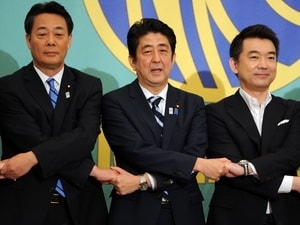
Prime Minister Shinzo Abe (center), DPJ leader Banri Kaieda (left), and JRP co-leader Toru Hashimoto (right). (Source: AFP/VNA)
The reality is that while the ruling coalition between the LDP and the New Komeito Party (NKP) currently holds an overwhelming majority in the powerful Lower House, it lacks a majority in the Upper House, making it difficult for the Abe administration to push through important policies in parliament.
Compared to the opposition parties, the LDP and its ruling coalition have more advantages, even an overwhelming advantage, in this election.
According to the latest opinion poll by the Yomiuri newspaper, 42% of voters surveyed said they would vote for the LDP in the proportional representation constituencies, while support for other political parties did not exceed single digits.
The Democratic Party of Japan (DPJ) – the country's largest opposition party – also only received 9% of the support.
Most observers believe that the LDP's resounding victory in the recent Tokyo City Council election has given the ruling coalition and the Abe administration a significant advantage ahead of the Upper House election. It also represents the clearest assessment yet of voters' appreciation for the Japanese government's "three arrows" strategy, or "Abenomics," aimed at reviving the economy after two decades of deflation.
Positive movements in the Tokyo stock market and the depreciation of the yen following a series of monetary easing measures by the Bank of Japan (BOJ) and massive public spending have contributed to the LDP's impressive record in the eyes of Japanese voters.
A poll conducted by the Yomiuri newspaper revealed that 52% of respondents acknowledged that the LDP and NKP needed to secure a majority in the Upper House, up from 46% previously. This reflects Japanese voters' expectations for political stability by ending the divisions within the parliament.
Furthermore, the survey also indicated that 54% of voters supported Abenomics compared to 31% who opposed it. Clearly, the main reason voters chose to vote for the LDP was their positive sentiment towards Abenomics.
Opposition parties are currently working to bring down the high approval ratings that Prime Minister Abe's administration has enjoyed since the LDP leader took office in December 2012 following a resounding victory over the DPJ in the Lower House election.
DPJ chairman Banri Kaieda criticized Prime Minister Abe's economic policies, saying Abenomics "could harm people's lives" due to concerns about rising prices.
Meanwhile, Toru Hashimoto, co-founder of the Japan Restoration Party (JRP) and mayor of Osaka, is striving to project the image of a reformer.
However, it seems that the opposition parties have yet to make any breakthroughs in their election platforms, amidst the lingering influence of Abenomics on much of Japanese public opinion.
After Prime Minister Abe officially announced his growth strategy, considered the third arrow in his "three arrows" strategy, many analysts expressed skepticism, arguing that the strategy offered little hope for Japan's economic recovery because it was still not strong enough to create breakthroughs.
However, the Abe administration seems to have yet to play its final card ahead of the Upper House election. That card is a series of more radical and aggressive economic reform policies and strategies – something Tokyo can only push through with an Upper House controlled by the ruling party.
This Senate election also plays a decisive role in shaping Japan's foreign policy in the coming period. Since taking power, the Abe administration has advocated for strengthening the Japan-U.S. alliance while also demonstrating a more assertive stance in territorial disputes in the East China Sea and the Sea of Japan.
The Abe cabinet advocates for amending the Constitution to transform the Self-Defense Forces (SDF) into a regular army, promoting the establishment of a National Security Council (NSC), increasing the prime minister's authority in security emergencies, and moving towards recognizing the right to collective self-defense, whereby Japan could intervene militarily to protect allies in the event of an attack by a third party.
Regardless of whether the policies of the LDP and Prime Minister Abe personally have a positive or negative impact both inside and outside Japan, it is clear that this Upper House election is a crucial turning point that will help shape Japan's future. And July 21st will be the "final judgment day" where Japanese voters will have the full power to decide whether or not to resolve this impasse.
According to (VNA) - DT