

Is the "battlefield" of grassroots information being left undefended?
(Baonghean)Currently, 445 out of 480 communes and wards in the province (92.7%) have local broadcasting systems. However, more than 150 stations are completely broken, and over 200 stations operate intermittently. The percentage of people, especially those in remote areas, who have access to books and newspapers is extremely low.
The highlands are "starved" for information…
Leading me into a room temporarily used as a storage area, the cultural officer from Yen Tinh commune (Tuong Duong district) moved a broken armchair aside and pointed to a block-shaped object peeking out from among a pile of yellowed papers and books: "The broadcasting equipment is broken, so it's temporarily stored here." He chuckled when I asked about the officer in charge of the broadcasting station: "There used to be one, but when the station went out of service, the commune transferred him to another job."
Mr. Lam Viet Minh, Vice Chairman of the People's Committee of Yen Tinh commune, said: "In this commune, information is facing major difficulties. The commune has 9 villages, but only 2 in the center have usable public address systems, while 4 villages still lack electricity. That's not even mentioning newspapers; the commune has 14 or 15 newspapers and magazines, both purchased and distributed, but delivering them to villages like Na Cang, which is 17 kilometers away from the commune committee headquarters through the forest, is difficult. Whether anyone actually reads the newspapers is another matter. In Tuong Duong district alone, communes like Huu Khuong, Nhon Mai, and Mon Son still lack roads leading to their centers and electricity, so newspapers only reach these communes once or twice a week."
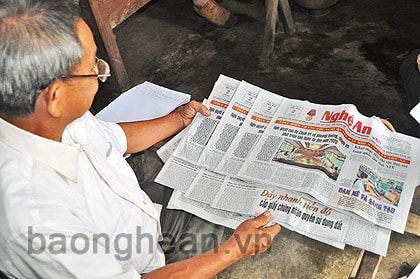
The Party newspaper reaches influential people in the highlands, in areas where there is an abundance of newspapers and in areas where there is a shortage.
(In the photo: Mr. Luong - a respected figure in Cooc village, Yen Hoa commune, Tuong Duong district - receives newspapers twice a month, with some issues receiving up to four copies). Photo: V.D
Unlike the situation in Yen Tinh commune of Tuong Duong district, where equipment is left unused, the situation at the radio station in Lang Son commune (Anh Son district) is different. Mr. Truong Ba Hoan, head of the commune's cultural committee, said: "Just one strong lightning strike can damage the broadcasting equipment in half of the hamlets in the commune. Each repair costs several hundred thousand dong. Some hamlets wait months before taking their equipment for repair."
According to a specialist from the Anh Son District Department of Culture, all 21 communes and towns in the district have wireless broadcasting stations, but currently, six communes have broken equipment and have become "blank areas" for broadcasting. In Tuong Duong District, three communes (Tam Thai, Yen Na, and Nga My) have received three broadcasting stations, 14 communes have radio stations, and 122 out of 153 villages have loudspeaker clusters, but the exact figures may not be accurate, as in the case of Yen Tinh commune mentioned above.
According to a recent survey by the Department of Information and Communications, 445 out of 480 communes and wards in the province (92.7%) have local broadcasting systems. However, more than 150 stations are completely broken, and over 200 are operating intermittently. In districts such as Con Cuong, Quy Hop, and Quy Chau, approximately three-quarters of the stations have been put into storage. According to the authorities, the current broadcasting equipment at the local level was invested in through various programs. Some equipment was purchased 15 or 17 years ago, so malfunctions are understandable.
Besides the activities of local radio stations, a form of entertainment that locals call "listening even without waking up" is television, which is popular among people in all regions. According to a cultural official in Tuong Duong district, 95% of the population listens to radio and 85% watch television. If that's true, it's certainly good news. However, our observations in the communes of Yen Na, Yen Tinh, and Luu Kien show that the vast majority of households with televisions receive signals via satellite dish. But, most of these are illegally installed dishes, making it impossible to receive channels from Nghe An Television or other television relay stations in the area. People mainly watch television for entertainment and cultural programs. It is known that similar situations exist in mountainous districts, especially in the highlands.
The village radio station – the primary means of disseminating information to the people – is already lacking, let alone books and newspapers. Currently, in Tuong Duong and other highland districts like Ky Son and Con Cuong, most villages and commune-level units, in addition to the two Party newspapers, Nhan Dan and Nghe An, also have 15 other newspapers and magazines related to their respective sectors and organizations. However, except for village leaders and commune officials, the villagers, for various reasons, do not have access to this type of information.
Not to mention that the Anh Son Cultural Center has a cabinet full of dozens of books, such as "The Epic of BAHNAR KRIEM - BAHNAR KONKDEH" published by the Labor Publishing House, which is almost as thick as a finger joint, and "Folklore of Ha Giang" published by the Youth Publishing House, which is twice as thick, with 1,155 pages! The book "Festivals of the Cham and Ede People" also has 500 pages… upon inquiry, it was revealed that these books were brought here by a central-level project for the Thai ethnic people to read. Just looking at the titles and their enormous thickness, it's unlikely the locals would even look at them, let alone read them.
This situation leads to the fact that the dissemination of policies and other information relies on reporters, propagandists, officials from various sectors and organizations, and key village and hamlet leaders. However, not all people attend meetings, and the level of understanding also depends on the information delivery capacity of the propagandists.
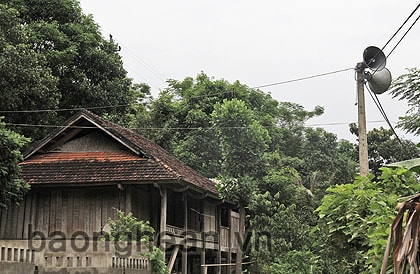
A cluster of loudspeakers in Na Khom village, Yen Na commune (Tuong Duong district).
Starting with the officials
Mr. Nguyen Van Quan, a speaker from Thanh Thinh commune (Thanh Chuong district), is a passionate worker. According to him, speaking in the old style is difficult to get the audience's attention; every household has a television, and if needed, they can go to a cafe and watch online. Therefore, to prevent Party members and the people from falling asleep during his "current affairs" lectures, he dedicates time to reading newspapers, listening to the radio, watching television, and especially to internal news bulletins from the province and district, then relating them to local realities to update his knowledge. As for his speaking skills, there's no need to discuss them; many say that when Mr. Quan speaks, even an ant in its hole would come out to listen.
Meanwhile, Lo Mai Hang, the head of the Yen Na commune radio station (Tuong Duong district), with a degree from the Nghe An Broadcasting and Television School, is a truly versatile employee. Besides his role as vice chairman of the education promotion association, he dedicates most of his time to writing news articles, editing, organizing programs, and acting as a broadcaster. Regularly, each week, Hang produces a program consisting of 5 news items, 1 audio report, and 1 story about a "good person doing good deeds" or "a true story." On one occasion, Mr. Lo Van Thanh from Na Khom village asked to appear on the radio to promise to cut down on alcohol. And Mr. Vi Van Tuyen from Co Phao village, after reading newspapers and listening to the radio, built a farm to raise porcupines and pigs, selling nearly a ton of live pigs and two batches of porcupines annually.
However, the number of reporters, propagandists, and radio station managers at the grassroots level, like Mr. Quan in Thanh Thinh and Mr. Hang in Yen Na, is not large, especially in mountainous, remote, and isolated areas.
Anyone who thinks that in today's information "explosion" era, oral communication has lost its relevance is greatly mistaken. In fact, in this digital age, oral communication is more necessary than ever. It is the best way to guide public opinion amidst the chaotic, even harmful, information disseminated from unofficial sources. Furthermore, it contributes to raising political, social, legal, and other awareness among cadres, Party members, and people at the grassroots level. The reality in the two remote communes of Yen Na and Yen Tinh (Tuong Duong district) and low-lying mountainous communes such as Lang Son (Anh Son district) and Thanh Thinh (Thanh Chuong district) shows that where information and communication work is done well, there is unity and consensus among cadres and people in all matters, and socio-economic development flourishes, and vice versa!
Currently, at the commune level, there is at least one speaker and 5-7 propagandists in each field, and if there is a radio station, there is at least one person in charge. With 480 communes in the province, multiplying that number, the information workforce at the grassroots level in our province is indeed substantial. However, it can be affirmed that the quality of this workforce is not commensurate with the requirements; the number of speakers and propagandists with persuasive abilities and in-depth knowledge in various fields is very small.
It is known that before the implementation of the "Bringing Information to the Grassroots" Program (in 2012), only 20.13% of information officers in the entire province, from district to commune level, had received training in information and communication skills, 12.2% had received training in operating equipment and machinery, and 28.3% had received computer literacy training. Given this low quality of the information workforce, it is not surprising that there are increasingly more "blank spots" in grassroots radio broadcasting, the effectiveness of other forms of information such as books, newspapers, and oral propaganda is weak in many areas, and many people remain uninformed.
Enhance the dissemination of information about the facility.
The program "Bringing information to grassroots levels in mountainous, remote, border, and island areas," abbreviated as "Program to bring information to grassroots levels," chaired by the Ministry of Information and Communications, is one of 15 national target programs issued by the Prime Minister on November 20, 2012.
This is a major policy of our Party and State aimed at narrowing the gap in access to information and improving the cultural and spiritual lives of the people, especially those in remote areas. The program consists of three projects: strengthening the capacity of grassroots information and communication officials; strengthening the infrastructure of the information and communication system; and enhancing the content of information and communication. It is known that out of more than 12,600 communes nationwide, 265 communes in 18 districts of Nghe An province are benefiting from this program.
According to specialists from the Department of Information and Communications, the province has surveyed and is gradually implementing this program at the grassroots level. Accordingly, four training courses have been organized to provide knowledge to 30% of information and communication officials in 165 communes; two radio and television relay stations have been completed in Nga My commune (Tuong Duong district) and Chau Thon commune (Que Phong district); radio stations have been installed in seven communes in Nghia Dan, Dien Chau, Thanh Chuong, and Anh Son districts; audio-visual equipment has been installed in 12 villages in Ky Son, Tuong Duong, and Que Phong districts; and some operational equipment has been provided to grassroots information officials in Que Phong.
On the other hand, 470,400 books covering various fields relevant to people in rural and remote areas have also been delivered to commune post offices and cultural centers, and 20 border guard posts.
Since the program has only been implemented for half of its planned duration (2011-2015), it's too early to say much about its effectiveness. However, upon investigation, if the three projects of the program are implemented systematically and scientifically by the relevant authorities, with appropriate equipment and content for disseminating information to the grassroots level, they will certainly be able to address the current gaps in information dissemination at the local level. Otherwise, the results of these three projects will likely repeat those of previous projects aimed at strengthening information and culture in mountainous and highland communes. And the official information front at the grassroots level will once again be left unattended.
Text and photos: Viet Long