

Many shortcomings exist in the management of female cadres.
(Baonghean) - As one of the female principals with many innovative ideas in management and leadership, Ms. Nguyen Thi Tu (Principal of Kim Lien Secondary School, Nam Dan) has spent over 20 years dedicated to teaching and has over 20 years in management.
From 1990, she was promoted to vice principal, then principal. In her managerial role, she gradually improved the professional skills and ethics of the teaching staff; mobilized all resources to invest in upgrading facilities, building Kim Lien Secondary School into a leading school in Nam Dan's education sector, an outstanding labor collective at the provincial level; and was recognized as a national standard school in 2005. Afterward, she was transferred to Nam Cat Primary School, where she also played a key role in transforming the school from a weak unit into a strong school and an advanced labor collective.
For her contributions, she was honored with a Certificate of Merit for outstanding performance by the Provincial Party Committee; a Certificate of Merit from the Provincial People's Committee for her excellent work performance and for being a grassroots emulation fighter for many consecutive years; a Certificate of Merit from the Central Committee of the Vietnam Women's Union for her achievements in "Excellent in national affairs, competent in household affairs for 5 consecutive years"; and a Certificate of Merit from the Vietnam General Confederation of Labor.
She shared: “As a woman, shouldering two responsibilities – work and family – in management, I face many difficulties: limited opportunities and conditions to improve my skills and qualifications, time constraints, and communication challenges… This requires not only personal effort but also the support and assistance, both material and spiritual, from relevant authorities, understanding and sharing from family, and recognition from society. Only then can we create the motivation to strive and develop our roles and abilities…”
Currently, there are nearly 40,000 female teachers and staff in the education sector throughout the province, accounting for over 73% of the total number of teachers and staff in the sector. Specifically, at the Department of Education and Training, there are 7 female management staff (1 Deputy Director, 2 Deputy Chairpersons of the Education Union, 1 Head of Department, and 3 Deputy Heads of Department); in the high school sector, there are 51 female Principals and Deputy Principals; in continuing education, there are 10 female Directors and Deputy Directors; Hoa Sen Kindergarten and other vocational schools under the Department have 11 female management staff. In the Education and Training Departments, there are 19 female Heads and Deputy Heads of Departments, 8 female Chairpersons of the District Education Unions, 2,081 female Principals and Deputy Principals across the three levels of education; and over 800 female Chairpersons of grassroots trade unions. In addition, nearly 17 female members participate in People's Councils at various levels, and 1 female member participates in the Provincial People's Council.
In recent years, the work related to female staff in the education sector has seen many positive changes, with female administrators making significant contributions to the development of education in the province. However, the percentage of female administrators remains low, not commensurate with the workforce in the sector; the proportion of female administrators is not uniform. This percentage decreases at higher educational levels: 99.8% in preschool; 85.9% in primary school; while it is only 29.6% in lower secondary school and 23.5% in upper secondary school.
That's the situation at the school level, but what about at the district level? For example, in Dien Chau, after 5 years of implementing the Law on Gender Equality, Dien Chau is considered a locality that has done well in the work of female cadres. Currently, the percentage of women participating in the Party Committee for the 2010-2015 term is 7 out of 41, accounting for 17% (an increase of 5.6% compared to the previous term), and in the People's Council is 12 out of 50 (reaching 24%); At the grassroots level: The percentage of women participating in the Party Committee is 112 out of 574, accounting for 19.5% (an increase of 2% compared to the previous term); In the People's Council, there are 226 out of 1004, reaching 22.5% (an increase of 3% compared to the previous term). Among them, 26 women are heads and deputy heads of departments, agencies, mass organizations and agencies located in the district. Twenty-two women are members of the Standing Committee of the People's Committee and People's Council at the commune and town levels, including 3 Party Secretaries, 5 Deputy Party Secretaries, 1 Chairman of the People's Committee, and 3 Vice-Chairmen of the People's Committee. Most of these female cadres have demonstrated their abilities and strengths, successfully fulfilling their assigned tasks. However, the number of women holding key leadership roles remains low.
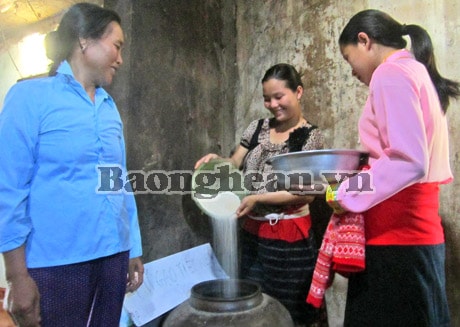
Women from Bản Mới village, Thành Sơn commune (Anh Sơn district) contribute rice to the "Rice Savings Jar" at the home of Ms. Vi Thị Thủy - Head of the Women's Association branch. Photo: Diệp Anh.
Increasing the proportion of women participating in Party committees is a particularly important criterion in the Party's personnel strategy. During the 2010-2015 term, the percentage of women in our province participating in Party committees was as follows: Provincial Party Committee: 5/65 = 7.2%; District Party Committee: 122/777 = 15.7%; Commune Party Committee: 1313/7621 = 17.2%. However, ensuring a rate of 30% or more of women participating as National Assembly and People's Council representatives at all levels, as directed by the Prime Minister and the National Committee for the Advancement of Women, is by no means a simple task.
There are several reasons for this: firstly, many Party committees and government agencies still lack a comprehensive understanding of gender and gender equality within the political system and society. Secondly, the evaluation of female cadres at some levels and sectors is not objective or scientific, and there is still a lack of trust in their abilities. Therefore, there is inconsistency between words and actions in the work related to female cadres. Furthermore, current policies and mechanisms for female cadres are inadequate and inconsistent; gender issues and female cadres have not been incorporated into some socio-economic policies and regulations, such as promotion age, retirement age, and salary policies.
While women start from the same point and also have to fulfill their roles as mothers and wives, the discriminatory age for promotion and retirement further reduces the already low number and proportion of female cadres. This is compounded by a prevalent tendency among women to be complacent, self-conscious, hesitant to confront challenges, and reluctant to change work environments. Some female cadres lack ambition, while others harbor narrow-minded attitudes, clinging to each other and failing to honor and support one another. These are significant obstacles to the current work of female cadres.
To build a team of female cadres that is sufficient in both quantity and quality, and in line with the themes of "Strengthening leadership in the work of female cadres during the period of accelerated industrialization and modernization of the country" and "Training and fostering ethnic minority cadres, female cadres, grassroots cadres, and promising young cadres," Party committees and authorities at all levels in the province have proactively disseminated and promoted the Party's guidelines and policies and the State's laws regarding women. This has led to positive changes in the awareness of Party committees and authorities at all levels regarding gender equality and the advancement of women.
Mr. Phan Thanh Hung, Deputy Secretary of the Ben Thuy Ward Party Committee, stated: "In recent times, the ward has paid great attention to the training of female cadres, prioritizing the planning of women for positions and creating conditions for them to participate in training to improve their professional and political theoretical knowledge. Currently, the ward has two women serving on the Party Committee, six women as heads and deputy heads of mass organizations, and one woman as the Vice Chairman of the Ward People's Committee. In the near future, we will add two to three more women to the Party Committee. However, in reality, the percentage of female cadres still does not meet the regulations."
In his Testament, President Ho Chi Minh wrote: "Women themselves must strive to rise up. This is a revolution that will bring about true equality for women." Therefore, along with the attention of Party committees at all levels, female cadres need to proactively overcome difficulties, strive to improve their qualities and skills in all aspects, assert their abilities, and know how to harmoniously combine family work and social work. Only then can women consolidate their position and role, and contribute more to the development of the country.
Duy Nam