
Improving the quality of education and training.
(Baonghean) - Implementing Directive No. 34/CT-T.Ư, dated May 30, 1998, of the Politburo on "Strengthening political and ideological work; consolidating grassroots Party organizations, mass organizations, and Party member development in schools," the work of creating sources and developing Party members in schools has achieved positive results. However, limitations and difficulties still remain.
(Baonghean) - Implementing Directive No. 34/CT-T.Ư, dated May 30, 1998, of the Politburo on "Strengthening political and ideological work; consolidating grassroots Party organizations, mass organizations, and Party member development in schools," the work of creating sources and developing Party members in schools has achieved positive results. However, limitations and difficulties still remain.
Cultivate the ambition to join the Party.
A survey conducted in several schools revealed that most staff, teachers, and students aspire to join the Party. Nguyen Thi Ly, a K50 student in the Geography Department at Vinh University, shared: “As soon as I entered university, I was determined to join the Party. For three consecutive years, I had to excel in my studies while also demonstrating leadership in the Youth Union and other extracurricular activities of my class, department, and university. Finally, taking the oath under the Party flag made me feel incredibly honored, proud, and happy.”
In class 12A0 of Vinh University's specialized high school, many students diligently strive to join the Party. Among them, seven students who excelled in their studies and training were selected for future Party membership, and three have already been admitted. Nguyen The Tien, one of the three young Party members admitted in July 2013, shared: “To achieve this glorious moment (of joining the Party) is not just because I was one of the six outstanding students selected for the international mathematics competition team, but also because I am an exemplary Youth Union member, leading in all Youth Union movements. Striving to join the Party is a difficult step for us students, but overcoming it will help us mature and become more responsible to the community and society.” Comrade Pham Tien Dong, Secretary of the Youth Union of the History Faculty, Vinh University, said: “In our faculty, right from the beginning of their studies, most students have nurtured the will and desire to join the ranks of the Party. The attention of the Party Committee and the Standing Committee of the University's Youth Union has created momentum for outstanding members to join the Party. Each year, the Youth Union admits about 30 new Party members.”
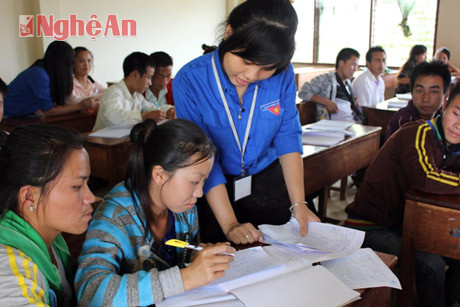 |
| A class session for Vinh University students in Xieng Khouang, Laos. |
The Party Committee of Vinh University has achieved the best results in Party member development among all university, college, and vocational high school Party committees, not only in the province but also nationwide. To create an environment and conditions for students to be admitted to the Party in accordance with Directive 34, the Party Committee of Vinh University always focuses on political and ideological education and the cultivation of revolutionary ethics among its staff, students, and faculty; it has issued a system of guiding documents on Party member development; and it has established 14 student Party branches under the Party committees of the training faculties. Each year, the Party Committee assigns targets for admitting new Party members to the branches, considering this an important criterion for evaluating and ranking Party organizations at the end of the year. On average, the university's Party committee has over 1,000 staff, students, and faculty members participating in Party membership training courses each year, and approximately 300-400 outstanding individuals are admitted to the Party.
In the 2012-2013 school year, Phan Boi Chau Specialized High School admitted 18 student Party members. Mr. Dau Van Mui, the Party Secretary and Principal of the school, stated: “To achieve such results in Party development, in addition to the leadership and guidance of the Party Committee, the School Youth Union Executive Committee plays a crucial role in helping students contribute. Every year, the activities of the Youth Union are linked to the needs and aspirations of the students, based on the direction of the school's Party Committee, to raise awareness, support them in their studies, and guide them towards becoming Party members while still in school.”
Comrade Nguyen Trong Hoan – Deputy Chief of the Office of the Department of Education and Training, said: In implementing Directive 34 of the Politburo, Party committees at all levels, especially Party organizations in schools, have strengthened political and ideological education and revolutionary ethics training among teachers, students, and staff; and focused on building and developing strong Party organizations in schools. As a result, political awareness among cadres, teachers, students, and staff has been raised, and notably, 100% of schools from preschool to university in the province have established their own Party organizations, facilitating the recruitment of Party members. Party development work is planned annually by Party committees and branches in schools; the Youth Union and Trade Union are tasked with monitoring and guiding outstanding individuals to strive for advancement. In just the last three years, an average of 310-350 cadres, teachers, and staff members in schools throughout the province have been admitted to the Party each year.
Be flexible and "soften" the criteria.
Although the pool of potential party members in schools is abundant, developing party members among students faces unique challenges. According to general regulations on the criteria for admitting student party members, they must first be outstanding members of their respective youth union branches, student associations, or advanced classes; achieve an average academic score of 7 or higher; have achievements in youth union and student association activities and class movements; and strictly adhere to the school and faculty's regulations on academics and examinations. Based on these general regulations, some party organizations add their own specific criteria. For example, the Party Committee of Vinh University requires students to meet the following criteria to be admitted to the Party: achieve an academic score of 8 or higher and receive a certificate of merit from the school level or higher; play a core role in youth union activities and social work, and achieve many accomplishments in youth union activities and student movements. It enjoys the trust of the majority (over 90%) of the members in the branch.
Nguyen Anh Chuong, Secretary of the Youth Union of Vinh University, shared: “For each new cohort of students, the Youth Union organizes dissemination sessions to ensure students understand the criteria for Party membership, thereby helping each student to orient themselves and build motivation for their own efforts. However, in practice, many students, despite being academically excellent, actively participating in Youth Union activities, and possessing pure morals and motivations for joining the Party, are not admitted simply because they do not receive 90% of the votes from the Youth Union branch members. We regret this, but the criteria are set as they are, and we cannot interfere.”
Comrade Nguyen Anh Chuong also added that one of the reasons for the insufficient number of votes from the youth union branches is that the credit-based training system has disrupted traditional youth union branches, leaving students within the same branch with fewer opportunities to interact and understand each other, making it difficult to find consensus and genuine support.
Meanwhile, at Vinh University of Technology and Education, with over 10,000 students across all courses, it is becoming a reliable institution for training in mechanical engineering, electronics, refrigeration, and other related fields. However, the biggest "obstacle" in developing Party members is the academic quality standard, as the entrance quality is low, with not many students achieving above-average academic performance. According to the general regulations of the university's Party Committee, students must have above-average academic performance and be outstanding members of the Youth Union in various activities; however, most students participating in the Party membership orientation class only meet the second requirement.
According to Comrade Nguyen Phung Viet, Chief of the Party Committee Office of the school, achieving a GPA of 7 or higher is very difficult for students. Because it is a technical school, achieving high scores in exams is extremely rare. Therefore, to create opportunities for more students to strive and have a chance to join the Party, while also increasing the number of Party members admitted each year, the school has lowered the GPA requirement to 6.2 points. With this approach, each year about 200 students qualify to participate in the Party membership orientation class, but only slightly more than 10% of them are admitted, equivalent to a few dozen students, while the target is to admit 40%.
For high school level, the results in developing Party members among students are still modest. At the Party branch of Nguyen Duy Trinh High School (Nghi Loc district), the work of developing Party members among students, which saw the most progress in the last four years (2010-2013), only resulted in the recruitment of 14 student Party members. Furthermore, in the period from 2009 onwards (2005), no new Party members were recruited for five consecutive years.
Mr. Hoang Van Thai – Secretary of the school's Party Branch – frankly admitted: “We set the requirements too high for admitting students into the Party. Specifically, they had to have a correct understanding of the Party, a genuine desire and motivation to join the Party; good morals and excellent academic performance; and be active and effective Youth Union or class leaders. This is the reason why in some years we couldn't admit any students into the Party. The Party Committee has seriously reviewed this issue and will adjust it accordingly in the future based on general standards.”
Besides some schools setting excessively high criteria for students, there are also schools that have not focused on developing Party members among students, such as Tan Ky High School (Tan Ky district). Ms. Pham Thi Thuy Vinh - Deputy Secretary of the Party Committee and Deputy Principal of Tan Ky High School admitted: "In the past, the school did not have a plan to develop Party members among students. Because the school's teaching staff are of Youth Union age, the percentage is high, while the school's quota for admitting Party members is small, so the school only focuses on admitting Party members among teachers. If we exceed the quota, we fear that superiors will assess it as mass development without quality."
In addition to the reasons mentioned above, according to the Party Charter, those admitted to the Party must be at least 18 years old. Therefore, some students, after three years of striving in high school and meeting the criteria for admission, are not yet old enough. By the time they reach the age, they have already moved on to higher education (university, college, vocational school) and must start over, requiring them to be monitored and strive again from the beginning. This results in a low rate of Party membership recruitment among high school students.
On the other hand, many students in vocational secondary education, despite achieving outstanding academic and extracurricular achievements, are not included in the planning and recruitment process due to the short study period (2 years). For students in joint programs, in addition to their studies, they have to work or return to their hometowns, making it difficult to gather and encourage their participation in extracurricular activities. Many students, after completing their probationary period and receiving Party awareness training, move elsewhere for work or further studies after graduation, thus failing to be admitted to the Party...
Comrade Dau Van Thanh – Deputy Head of the Provincial Party Committee's Organization Department – stated: “The school sector, like the business sector and rural areas, faces certain difficulties in developing Party members. However, compared to other sectors, it still has its own advantages. The issue is the extent to which Party organizations in schools pay attention and what impact this has on the work of developing Party members. Practical experience has shown that where there is attention, the work of developing Party members is done well, and conversely, where there is little or no attention, the results will be poor, affecting first and foremost the strength of the Party organization itself.”
And through practical experience in developing Party members in schools, it is clear that to do a good job of developing Party members in schools in general and among students in particular, Party organizations in schools need to develop specific plans, select candidates for training and recommendation to the Party for consideration and admission; and create a healthy environment for the masses to strive for, giving them opportunities to contribute and grow. This is linked to improving the quality of activities of mass organizations such as the Youth Union and the Trade Union, creating many rich and diverse activities so that students have an environment to contribute and develop. Through this, positive individuals can be identified and recommended to Party organizations for training and admission.
Furthermore, Party organizations within schools need to enhance their leadership role in carrying out political tasks and improving the quality of education and training to produce individuals who are both politically sound and professionally competent, thus providing a source of personnel for the Party. Since most Party organizations in schools are under the direct control of district-level Party committees, districts, cities, and towns need to strengthen their guidance on Party development in these areas.
Mai Hoa - Thanh Nga