
Remember the taste of Nam Dan soy sauce
(Baonghean) - Every time I go back to my hometown, my mother always reminds me to buy a few jars of soy sauce when I pass through Nam Dan. Because when she was young, my mother studied at the School...
(Baonghean) - Every time I go back to my hometown, my mother always reminds me to buy a few jars of soy sauce in Nam Dan. When she was young, she studied at Nam Thanh Teacher Training College and became "addicted" to this specialty of Nam Dan. Now that she's left teaching and is busy taking care of her grandchildren, she can't forget the taste of soy sauce. Every time I remember to bring some back, the whole family gets to enjoy braised fish with soy sauce, or boiled sweet potato leaves or water spinach dipped in it. My mother shares those jars of soy sauce with relatives and neighbors, then carefully stores and preserves them.
During these sunny June days, I visited a friend's home in Nam Dan, a renowned soy sauce-making village. Entering Phan Boi Chau Hamlet (in the town), a recognized traditional soy sauce-making village, I was immediately greeted by the rich aroma emanating from the jars of soy sauce placed around the gardens of the households. I was fortunate to meet Mrs. Nguyen Thi Ho (nearly 90 years old), a once-famous soy sauce maker. She told me that she learned to make soy sauce when she was a young girl, before she got married. From a young age, her mother passed down to her the secret of making fermented soy sauce. Now, some of her great-grandchildren are in 10th grade, and she still holds the secret to making delicious soy sauce.
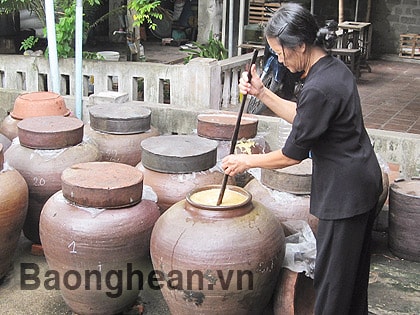
One step in the process of making soy sauce. Photo: Mai Hoa
The main ingredients for making soy sauce are all familiar and common in daily life: soybeans, glutinous rice or corn, salt, and water. Adding anything, whether accidentally or intentionally, will spoil the soy sauce. Making delicious soy sauce requires meticulous effort and attention to detail. The first step in the soy sauce making process is making the mold. The mold is made from corn or glutinous rice grains; previously, it was usually made from corn, but now it is mainly made from glutinous rice. The glutinous rice must be of the right season, with plump, fragrant grains. The rice is thoroughly washed and steamed into sticky rice, then spread evenly on a tray. Once the sticky rice cools, a little strong tea water is poured over it, and it is sealed with longan leaves. After more than 10 days, if the mold turns a mustard green color or a glossy black like molasses, it is ready. This is considered the most difficult step in the soy sauce making process, fundamentally determining the success or failure of the product.
The next step is processing the soybeans. You must choose seasonal soybeans, with uniformly sized grains, then wash them thoroughly, dry them in the sun, and roast them. For a fragrant and delicious soy sauce, the beans must be roasted evenly, so the roasting process should be done over low heat. It's best to roast them in an earthenware pot for even cooking. Once cooled, the beans are crushed, mixed with clean water, and cooked over low heat for about 10-12 hours. After cooking, the soybean liquid is transferred to a jar and left to dry in the sun for about a week. When the liquid emits a fragrant aroma, it's ready for the soy sauce fermentation process. This process is usually done late at night. The soy sauce maker mixes mold and salt into the sun-dried soybean liquid, stirs it well with a bamboo stick, and then carefully covers the jar. Note that good quality salt must be used, and it should be dried in the sun for several days to remove impurities before being used for fermentation.
The ingredients for making soy sauce are mixed in a specific ratio, depending on the secret recipe and experience of each family. After the soy sauce is fermented, every morning, the maker opens the jar and stirs it thoroughly with a bamboo stick to ensure the water, soybeans, and mold are always well mixed. After about 1.5 to 2 months, when the jar is opened, a rich aroma rises and spreads, indicating that the soy sauce is ready to use. Standard soy sauce should have a strong aroma and a straw yellow or amber color. At this point, when bottled and left to settle, the soy sauce will have three layers: soybeans on top, water in the middle, and mold at the bottom. When scooping or pouring the soy sauce, it must be shaken or stirred well. If the process is done correctly and with proper quality control, a jar of soy sauce can be used for 2-3 years.
It's easy to see that, similar to pickled vegetables like fermented bamboo shoots, pickled eggplant, and pickled cucumbers, soy sauce was a traditional food item used for long-term storage. Because people were poor and food wasn't as readily available as it is now, they had to find ways to prepare dishes that could last for months, even years. But unlike the dishes mentioned above, soy sauce was prepared with more care, lasted longer, and was, of course, more nutritious.
From a humble folk dish, Nam Dan soy sauce has now become a specialty, found in upscale restaurants and traveling with people from North to South Vietnam. Perhaps the original purpose of the ancients when preparing soy sauce was to pour over rice, as life was difficult and fish and meat were scarce. Soy sauce became a nutritious daily food source, providing people with the strength to work and regenerate their energy. When eating a bowl of rice with soy sauce, one can feel the refreshing coolness of the alluvial soil in each bean, the aroma of the fields in the sticky rice, the salty taste of the sea in the salt, and the warm, earthy flavor of the homeland in every drop of water. Soy sauce is also used to braise fish. Freshly cleaned fish braised in soy sauce in an earthenware pot will release a fragrant aroma.
Returning home after a long absence, enjoying braised fish with soy sauce makes many people want to stay longer, the flavor lingering in their memories. Soy sauce is also a dipping sauce. On hot summer days, having a plate of boiled sweet potato leaves or water spinach ready at home suddenly dispels feelings of discomfort and fatigue, and the stomach starts rumbling with hunger. These rustic dishes were once a daily staple in rural households. Now, in upscale restaurants, they are a preferred choice for diners after consuming beer, wine, and fatty, protein-rich foods. They act as a "cooling agent" and "catalyst" to enhance the flavor of lavish feasts. And we can't forget the rare boiled meats (beef, goat, pork) dipped in soy sauce, with added spices like ginger and garlic. Enjoying this dish, one might sometimes feel as if nothing else in the world tastes better. In particular, Nam Dan currently boasts two quite famous specialties: Cau Don goat meat and Nam Nghia roasted veal. Without the flavor of soy sauce, those two specialties would hardly have the taste they have now.
Let me add a little more about soybeans – the main ingredient in making soy sauce. According to the experience of long-time soy sauce makers in Nam Dan, only the soybean variety grown here on the alluvial plains along the Lam River in this region can produce delicious soy sauce. If soybeans are taken from other regions or the variety is grown elsewhere, the soy sauce will certainly not have the characteristic flavor. It's similar to Luc Ngan lychees or Hung Yen longan, which are only accustomed to the climate and soil where they are grown.
This raises the question: Why is it that only the soybean variety from Nam Dan, grown on the alluvial soil of Nam Dan, gives the soy sauce its distinctive flavor? Could it be that it is nurtured and infused by the sacred energy of the mountains and rivers of this land, considered a land of outstanding people and rich history? This is why some assert that the key to the unique flavor of Nam Dan soy sauce lies in the local soybean variety. Others suggest that the region's water source plays a decisive role. Still others argue that the deciding factor lies in the "secret" of the soy sauce makers, passed down from generation to generation within a family. Perhaps all three explanations are correct, reflecting the concept of the convergence of the elements of nature, the earth, and humanity in a single product (heaven-earth-human).
It is said that, after being away from his hometown for decades, President Ho Chi Minh never forgot the taste of soy sauce. Every time the delegation from Nghe An province visited him, they could not fail to bring some soy sauce as a gift. This shows how deeply, specifically, and humanely the old folk song expresses the feelings of those from Nghe An who are far from home: “When I leave, I remember my homeland / I remember the water spinach soup, I remember the pickled eggplant with soy sauce / I remember those who toiled in the sun and rain / I remember those who drew water by the roadside that day.”
Leaving Nam Dan, the flavor of the soy sauce seems to linger. Surely, anyone who has ever tasted that soy sauce will have similar thoughts and feelings to the author of this article?!
CONG KIEN