

Cassia seeds treat high blood pressure.
The Cassia tora plant, also known as Cassia tora L., belongs to the Fabaceae family and grows wild in many regions of Vietnam. The fruit ripens in late autumn; people harvest the fruit, dry it, and extract the seeds. Before use, the seeds must be roasted until fragrant.
The Cassia tora plant, also known as Cassia tora L., belongs to the Fabaceae family and grows wild in many regions of Vietnam. The fruit ripens in late autumn; people harvest the fruit, dry it, and extract the seeds. Before use, the seeds must be roasted until fragrant.
Cassia fistula is a small shrub 0.5-1m tall. Its leaves are alternate, compound pinnate, bearing 2-4 pairs of obovate leaflets. Yellow flowers grow in the leaf axils, usually in irregular clusters of 1-3. The fruit is a long, narrow pod containing many light brown seeds.
According to traditional Chinese medicine, Cassia obtusifolia is called *Thảo quyết minh* or *Quyết minh tử*. Fresh Cassia obtusifolia seeds have a mild, slightly bitter taste and contain mucilage; when roasted, they have a sweet, bitter, and salty taste and are slightly cooling in nature. They are used to clear liver heat, dispel wind-heat, benefit the kidneys, calm the nerves, promote urination, lubricate the intestines, and improve eyesight.
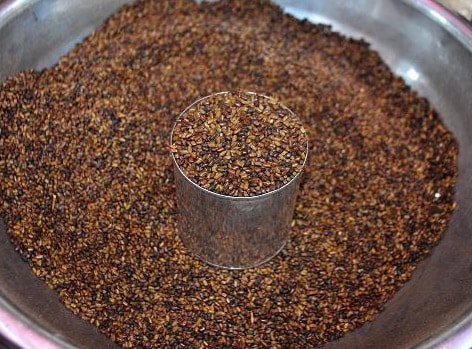
How to roast mung bean seeds: Put the mung bean seeds in a pot or saucepan, simmer over low heat, stirring constantly until the entire outer surface of the seeds is glossy. Continue roasting until the seeds crackle and pop. When all the seeds have popped, the roasting process is complete.
If you continue stir-frying until a layer of orange-yellow smoke rises from the mung bean seeds, continue stirring until the smoke gradually dissipates, a light black smoke with a fragrant aroma appears in the pan, and the outer shell of the mung beans is slightly charred – this indicates that the stir-frying process is complete.
The following are the medicinal uses of cassia seeds:
- To treat subcutaneous bleeding, bloody stools, dysentery syndrome, hemorrhoids with constipation and bleeding, and to prevent cerebral hemorrhage: Roast 10g each of Cassia seeds and Sophora japonica flowers, decoct and drink. Alternatively, roast equal amounts of both, grind into powder, and take 5g three times a day.
-Treatment for hypertension: 12g of roasted Cassia seeds, 10g of roasted Sophora japonica flowers, 4g of chrysanthemum flowers, 6g of Stevia rebaudiana, brewed as a tea and drunk several times a day. A course of treatment lasts 3-4 weeks.
-Treatment for insomnia: Roast 12g of Cassia seeds until charred, then brew and drink daily, or roast 12g of Cassia seeds until charred and 10g of jujube seeds until blackened, brew and drink daily in the afternoon and before bedtime.
- Treating constipation: For difficult bowel movements, use roasted Cassia seeds, 16-20g/day, brewed as a tea, and drink several times a day until bowel movements become regular. For the elderly, postpartum women, young children, those with constipation, hemorrhoids, or chronic constipation, use charred roasted Cassia seeds, 10-15g/day, brewed as a tea, and drink several times a day.
-Treatment for conjunctivitis and blurred vision: 12g of roasted Cassia seeds, 6g of yellow chrysanthemum flowers, 8g of Coptis chinensis, 8g of Cynanchum stauntonii, 8g of licorice root, decocted and drunk once a day. A course of treatment lasts approximately 3 weeks.
- Treatment of acute keratitis: 10g each of Cassia seeds and Chrysanthemum seeds, 5g each of Acorus calamus fruit and Equisetum arvense, decocted and drunk.
Note: Drinking too much cassia seed tea can easily cause diarrhea and poor digestion. If you experience these symptoms, stop drinking it.
According to NNVN -TL