

Concerns about the ancient artifacts of Vạc village.
The artifacts of Lang Vac village are ancient relics dating back to the Dong Son culture period, unearthed from burial sites in the Lang Vac historical site, Nghia Hoa commune, Thai Hoa town today. Protecting these historical values requires the joint efforts of all levels of government, relevant departments, and the people.
(Baonghean)The artifacts of Lang Vac village are ancient relics dating back to the Dong Son culture period, unearthed from burial sites in the Lang Vac historical site, Nghia Hoa commune, Thai Hoa town today. Protecting these historical values requires the joint efforts of all levels of government, relevant departments, and the people.
In 1972, the Vietnam Institute of Archaeology conducted excavations at the Lang Vac archaeological site, covering an area of 3 hectares. To date, after five excavations, the Lang Vac site has been identified as the site with the most burial mounds among dozens of Dong Son culture archaeological sites in Vietnam. At 347 burial mounds, 1,228 artifacts were discovered, including many valuable items such as bronze drums, axes, daggers with handles depicting women and men, daggers with handles shaped like snakes coiled around elephant legs, leg and arm covers with bells, various finely crafted stone and glass jewelry, various molds, rice husk fragments, and even bronze crossbow triggers and arrowheads identical to those found at Co Loa in Dong Anh district (Hanoi). All artifacts date back to the 3rd century BC.
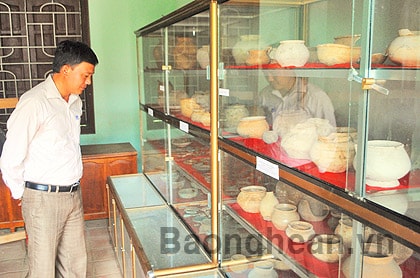
The antique exhibition room at Lang Vac Temple.
The artifacts unearthed at the Lang Vac archaeological site are beautiful and diverse, with 665 bronze items alone. Besides the famous bronze drums, there are also daggers with handles depicting vivid animals, such as two tigers supporting an elephant with their front legs, or two snakes intertwined supporting an elephant with a saddle on its back… These unique artifacts are found only in Lang Vac. With these discovered artifacts, Lang Vac was recognized as a National Archaeological Site in 1999…
Mr. Le Van Thai, a member of the management board of the Lang Vac temple, recounted a sad story that occurred there after the archaeological site was recognized: “When the Lang Vac site became famous far and wide for its many valuable artifacts, highly regarded compared to the level of civilization throughout Southeast Asia at that time, collectors and antique dealers from all over came to buy the artifacts that the local people found during farming. Many beautiful and valuable artifacts, such as bronze drums, disappeared without a trace. Furthermore, these antique hunters incited the local people to dig for artifacts by declaring their willingness to buy them at high prices.”
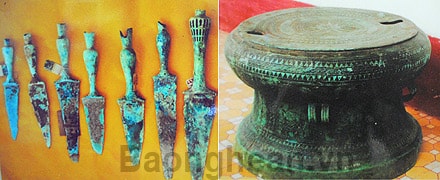
Bronze drums and a collection of ancient daggers in Lang Vac village.
Within a seven-year period (1999-2006), the Lang Vac archaeological site suffered massive destruction. Countless areas of rubber plantations were destroyed in Lang Vac and the surrounding hills, countless deep pits were dug, and numerous tombs were desecrated. Excavators were active in the middle of the night and early morning, even injuring anyone who tried to stop them. A sophisticated network for buying and selling artifacts had formed in the area… Mr. To Thanh Son, Head of the Culture and Information Department of Thai Hoa Town, recalled: “This situation only ended when Nghe An province directed Nghia Dan district and the provincial police to increase patrols, arrest, and severely punish those involved in illegal excavation. To date, order and safety have been ensured… But that doesn’t mean the ‘bleeding’ of artifacts has stopped. Even today, artifacts from Lang Vac are still being eagerly sought after by antique collectors.”
Beginning in 1999, after being recognized and granted the status of a National Archaeological Site, the Lang Vac Festival has received attention and organization from all levels and sectors, attracting tens of thousands of visitors from all over to participate in the ceremony. This festival expresses the filial piety of the descendants of Lac Viet, remembering their ancestors who contributed to the exploration, construction, and protection of the country. At the same time, the Party Committee and the government of Thai Hoa Town decided to build a memorial stele for the Lang Vac cultural site and a sacred temple dedicated to the spirits of the Vietnamese ancestors of Lang Vac to fulfill the heartfelt aspirations of the people. The organization of the festival and the construction of the temple, in addition to their religious and spiritual significance, also serve to protect the relics and artifacts of Lang Vac.
Based on this festival, Thai Hoa town and Nghia Hoa commune have mobilized the people to donate artifacts and antiques originating from the Lang Vac archaeological site to be displayed in the exhibition hall within the temple grounds for visitors. Ms. Thai Thi Yen, a member of the Lang Vac Temple Management Board – who played a leading role in mobilizing the people to donate artifacts – said: Currently, the temple's exhibition hall has 89 artifacts including various types of axe blades, knife blades, bronze bowls; porcelain bowls, bracelets, and anklets. Notably, many of these artifacts have been identified as being over 3,000 years old… However, the vast majority of these artifacts are no longer intact. Many more beautiful items are still in the possession of the people, but the Management Board can only borrow them for display during the festival.
In a conversation with Mr. To Thanh Son, Head of the Culture and Information Department of Thai Hoa Town, it was learned that the town is working with the Department of Culture, Sports and Tourism to study ways to promote the religious values of King Hung in Vac Village. With this approach, it is hoped that the values of Vac Village will be better preserved and enhanced… Losing the artifacts of Vac Village means that future generations will forever lose an opportunity to learn about their ancestors' history. To preserve the artifacts of Vac Village, it is thought that the people should be clearly aware of this and join hands to protect the Vac Village site, especially the remaining artifacts.
Text and photos: Thanh Chung