
"The bond of friendship forged on a hundred ferry crossings."
(Baonghean) - I remember back in school, there was a boy in my class who was the son of a teacher. Because of that, he was always exemplary, and even the slightest mistake would be immediately reported to his mother. It was a bit unfair, but on the bright side, he didn't need to write a permission slip if he was sick – how cool! I wonder what it would be like if his father, uncles, aunts, and cousins all studied and taught at the same school?
(Baonghean) - I remember back in school, there was a boy in my class who was the son of a teacher. Because of that, he was always exemplary, and even the slightest mistake would be immediately reported to his mother. It was a bit unfair, but on the bright side, he didn't need to write a permission slip if he was sick – how cool! I wonder what it would be like if his father, uncles, aunts, and cousins all studied and taught at the same school?
To "answer" the above question, we visited the oldest school in the city: Huynh Thuc Khang High School. Formerly Vinh National School and Huynh Thuc Khang Specialized School (separated from Hue National School), this 93-year-old school is the cradle that has produced many generations of outstanding students for the country and the province. Ms. Le Thi Hong Lam - the school's vice principal - smiled when she heard our question: "Perhaps only Mr. Pham Nhuong can answer your question. His children and grandchildren are also students of the school. His son is a math teacher who retired a year ago, his granddaughter is a chemistry teacher, and his youngest grandson is currently in 12th grade. Today, his class has a lesson at the school."
"The teacher didn't call my parents to tell them, but she told my uncle and my grandfather!"
When we arrived, class 12A4 was having a math lesson. Ms. Lam pointed out Pham Xuan Chau – a bespectacled student sitting in the front row, attentively listening to the teacher's lecture. After a brief explanation of the investigation, Chau breathed a sigh of relief and smiled awkwardly: "I thought I was going to be called out for some kind of reprimand." – "You must get reprimanded a lot, you look like a bookworm, but you're quite mischievous, aren't you?" Chau shook his head vigorously: "No, ma'am, I do have some flaws. When it comes to private conversations, every student talks..."
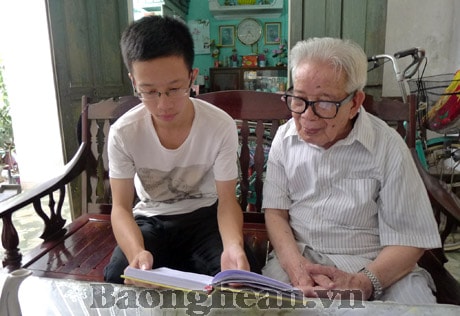
The grandfather and grandson (Mr. Nhuong and his grandson Chau) are looking at the grandfather's poems.
When asked about her grandfather, Mr. Pham Nhuong, Chau happily boasted that her house was right in front of his, so she often went to visit him. The other day, he had just published a collection of poems, titled "The Loyalty of a Hundred Ferry Crossings," and gave her a copy. The idea of learning about her family, especially her grandfather, surprised Chau somewhat: "My grandfather was indeed the principal, but it was a long time ago, so my classmates don't know much about it. They only know that I'm the granddaughter of Mr. Binh (Mr. Pham Binh), the recently retired math teacher, and Ms. Thanh (Ms. Pham Thi Phuong Thanh), the chemistry teacher. And don't think I get any special treatment, though; talking to him gets 'reported' to my uncle and aunt immediately, it's quite troublesome!" "Has your teacher ever told Mr. Nhuong?" "Yes, of course! When I was in 10th grade, Ms. Lam, my history teacher, called me up to answer questions, and I didn't know the answers. So she told Mr. Binh, who called my grandfather, but not my parents!" We exchanged glances, sticking out our tongues, certain that this time the boy would either get a beating or a thorough scolding. But no, "Grandpa reminded me to study the elective subjects well, so that the subject teachers don't feel disrespected, and Uncle Binh reminded me the same thing. Grandpa and Uncle are kind!"
The young student, with his still childlike face and endearingly honest way of speaking, recounted how over a dozen members of his family had attended Huynh Thuc Khang School. It was as if wearing the school uniform with its emblem had become a matter of course for every member of the family. Chau said that his grandfather's five children and ten grandchildren were all students at the school. Being the youngest, he was the only one still wearing the Huynh Thuc Khang School emblem. His uncles and aunts, wanting to inquire about the old school, naturally had to "ask" Chau for help.
My grandfather, in particular, "would often ask about the students' behavior at school, whether they were well-behaved, whether they loved their teachers, who the current principal was, and whether he was strict or gentle." Each time, he would tell Chau stories about the time he evacuated the school from one district to another, telling Chau that now she was studying in modern facilities and should focus on her studies and moral development. After talking for a while, Chau excused herself to go home as it was almost noon. Before saying goodbye, she carefully showed us the way to the house of her uncle, Mr. Pham Binh, and invited us to visit and...read his poems!
"I became a teacher because of my father!"
Stepping into Mr. Pham Binh's house, shaded by lush greenery, one could hear the cheerful sound of a red-themed record playing. Mr. Binh chuckled, "I recorded this to... lull my grandchildren to sleep. Ask any of the teachers or students at school, and everyone knows that Mr. Binh sings. He's been famous for his singing since his school days. Whenever they see him, the younger girls excitedly say, 'That guy who sings so well is Mr. Nhuong's son!'" Contrary to his witty way of speaking, he insisted that, among his four brothers, he was the most well-behaved. "Every week I strived to be commended during the flag ceremony. Uncle Luong, who was one year ahead of me, was also well-behaved, but he couldn't compare to me. As for Thai, well, don't even get me a word in; my father called him out for criticism during the flag ceremony several times. Because of that, my mother was angry with my father, but what could I do? Mr. Nhuong was very gentle when he was kind, and extremely strict when he was strict."
Graduating from Huynh Thuc Khang High School in 1974, Mr. Binh decided to follow in his father's footsteps, enrolling in Vinh University of Education. After graduation, he served three years in the general mobilization force before returning to work at the high school where he had studied. Including his teaching and learning time, Mr. Pham Binh has nearly 40 years of dedication to Huynh Thuc Khang High School, filled with many joyful and sad memories. Mr. Binh reminisces about the day the school's cafeteria worker and two students were killed by a bomb while carrying water. That year, 1967, and the place name Hung Tay (Hung Nguyen) were the first impressions of war for the young student. In 1972, the school evacuated to Thanh Ha (Thanh Chuong), where B52s carpet-bombed during the Battle of Dien Bien Phu in the air. Teachers and students were unharmed, but countless civilians died. Those years of fleeing with books, scavenging for potatoes, catching fish, and digging bomb shelters have become unforgettable memories, inextricably linked to the image of a father figure – a teacher – steering his family and school through the turmoil.
As one of Mr. Pham Nhuong's two children following in his father's footsteps, Mr. Binh's family is also a typical teaching family, with his wife and two daughters all being teachers. His wife, Ms. Ho Thi Vuong Kim, teaches Mathematics at Ha Huy Tap High School. His eldest daughter, Pham Thi Phuong Thanh, teaches Chemistry at Huynh Thuc Khang High School, and his youngest daughter, Pham Thi Huong, teaches English at Phan Boi Chau Specialized High School. Mr. Binh jokingly said, "Our house is full of teachers; when we sit together, we always talk about school and other things. When my daughter was a student, she came back to the school for training, and my wife and I sat and acted as models for her to teach. After retiring, we still miss the school and ask her about the classes and students."
In saying these things, the teacher couldn't help but feel proud and respectful when mentioning Mr. Pham Nhuong as a teacher and father figure who had instilled in him and his two daughters a deep and beautiful impression of the noble profession of teaching. "My wife and I, as children, always strive to ensure that he wouldn't be ashamed of being a teacher who couldn't teach our children. I chose the teaching profession because of my husband!"
"Teaching is about teaching character and morality."
Mr. Pham Nhuong's granddaughter led us into the house, then invited her grandfather out to greet us. His hair, as white as chalk dust, and his wrinkled eyes, full of crow's feet, couldn't hide the affectionate yet stern gaze of the teacher. Mr. Nhuong slowly said, "I'm old, but my hearing isn't deaf, my eyesight isn't blind, and I don't need a hearing aid." "How old are you this year, sir?" he asked. "My real age is 93, but including my grandmother's age, it's 94," his granddaughter replied. The granddaughter, quickly pouring water, boasted, "My grandfather is the same age as Mr. Huynh; the school was founded in 1920, so my grandfather was also born that year." Then, true to the clear and concise style of a math teacher, Mr. Nhuong asked us, "So, what do you want to ask about?"
We were astonished by the sharp mind and memory of our nearly centenarian teacher as we listened to him recount the anxieties and struggles of guiding hundreds of people through different periods. During the evacuation period (1965-1973), the biggest challenge was ensuring that teaching and learning were not interrupted. Teacher Nhuong still vividly remembers when the school first evacuated to Hung Tay, with 8 classes, each with an average of 50 students. The evacuation meant moving with the whole family, hundreds of people struggling to make ends meet, not to mention having to teach and learn.
Recalling those years, Mr. Nhuong couldn't help but feel emotional: "Luckily, the people believed and appreciated me, and lent us rooms to use as classrooms. Several times when the school was bombed, I was afraid they would think the Americans were bombing because the school had returned, but they didn't blame us; instead, they took care of the teachers and students. I'm so grateful, so full of kindness!" When the school returned to Vinh, the main "task" he set for himself was to reorganize and refine the discipline of both teachers and students: "I re-established the Head Supervisor to oversee discipline, with the heads of the subject departments as members. When it was time to assemble, each class lined up in their designated rows. I would call on rows 15 and 16 to stand up; if any student was absent, I knew immediately! In 1978 and 1979, the school's discipline was excellent. I remember that class 10E was the most exemplary class in the school; in a school year of 34 weeks, they were commended every week." At this point, the teacher's eyes suddenly lit up, and the enthusiasm of yesteryear resurfaced in his voice, which had lost some of its vigor due to age.
When asked about his children and grandchildren, the principal happily boasted that he has five children, ten grandchildren, and eleven great-grandchildren. Most of his descendants graduated from Huynh Thuc Khang School, and some have returned there as teachers. His daughter and two daughters-in-law, although not teaching at Huynh Thuc Khang School, are also teachers, extending the family's tradition of teaching and learning beyond the school walls. Perhaps it is because this multi-generational family has followed in each other's footsteps, connected to the school, the blackboard, and the chalk, that the image of the principal, the teacher, the grandfather, and the father intertwine into a single entity – both serious and approachable – before us.
Teacher Nhuong confided, "For a school to be good, its discipline must first be excellent. That means students cherish their teachers like fathers, and teachers cherish their students like children. Because they cherish each other, they trust each other, not because they fear each other and therefore deceive or hide things. A teacher who wants to teach effectively must teach from the heart. To teach from the heart, one must have a heart. If you have a heart, they will trust and respect you; if you say something and you can do it, they will listen and follow!" We listened while looking at the photos covering the walls. Some were black and white photos from the 1970s, showing high school students who looked small and petite. Others were taken in 2006, commemorating the 30th anniversary of their graduation. The students were now older than their teacher, their youthful heads gathered around the teacher whose hair had turned gray. The students of then and now still retained their smiles, seemingly attentively listening to every word their teacher said.
Leaving Mr. Pham Nhuong's house, I held in my hand the poetry collection "The Affection of a Hundred Ferry Crossings." Turning the pages of poems about the bond between teacher and student and the sentiments of the teaching profession, I involuntarily thought of my teachers from the past and tears welled up in my eyes. The reunion of three generations of a family connected to these ferry crossings left us deep in thought and reflection. Thinking about the tradition of studiousness, the tradition of the teaching profession, is also thinking about the preservation of traditional values in general. The family is the seed and foundation of society; we only now truly understand this principle.
Hai Trieu - Thanh Phuc