

5 minutes of Vietnamese memories every day on VTV.
On the exact anniversary of the August Revolution (August 19, 2013), VTV1 will broadcast the first documentary in the series "Memories of Vietnam," which has long been part of the vast archive of wartime documentaries of the Japanese television network NDN.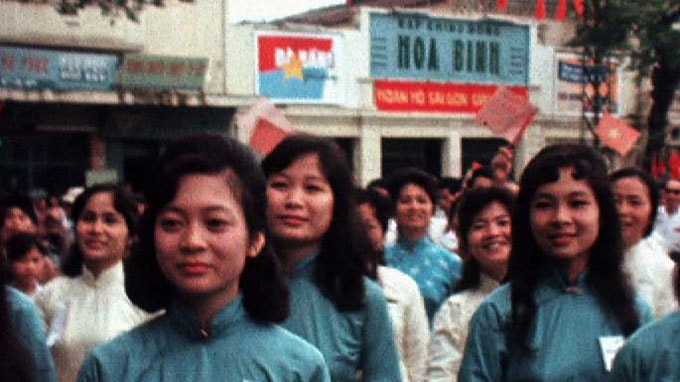
Photo provided by VTV.
After three years of negotiations to obtain the single color film reel, and two years of painstakingly sifting through a vast archive of images filling an entire room, reporters from the VTV1 News Department, along with their colleagues, have released the first episodes of "Memories of Vietnam."
History is objective, but history also has a heart.
Northern Vietnam in the 1960s. A group of filmmakers from the Japanese television network NDN arrived in Hanoi and requested an audience with President Ho Chi Minh. Their wish was to establish a representative office in Vietnam. President Ho Chi Minh agreed. It was the only international television network with a representative office in Hanoi during those years.
And with the approval of President Ho Chi Minh, NDN became the only international television station to broadcast comprehensive information and images about North Vietnam during the period from 1964-1981, especially during the most intense period of the war: from the start of the bombing (February 1965) until peace was restored throughout Vietnam after the Paris Agreement.
For 17 years, day after day, Japanese television filmmakers, armed with 16mm film cameras, traveled throughout Hanoi and its surrounding areas, capturing what they saw: Fidel Castro, tall and imposing, being embraced by Vietnamese children; President Ho Chi Minh sitting comfortably on the steps of the Presidential Palace, chatting with a group of foreign friends; General Secretary Le Duan visiting a Hanoi family on the eve of Tet; a swimming competition at the 10-10 swimming pool (Ba Dinh); a spectacular scene of young men from the Old Quarter jumping from the The Huc Bridge into the clear blue Hoan Kiem Lake on a summer afternoon; a scene of farmers in the North working on irrigation projects to combat drought; a scene of devastation and ruin when the Hai Phong cement factory was bombed by the Americans; the radiant smile of a flower vendor on Hang Luoc Street during Tet...
Modest, meticulous, and objective, true to the Japanese character, 1,510 television documentaries, totaling 6,000 minutes of footage spanning a historical period—equivalent to a person's youth—are meticulously preserved. The films are remarkably well-preserved, free from scratches, smudges, or mold, and feature original Japanese narrations broadcast on NDN or other Western channels at the time.
"This is an invaluable archive, not only for us, those of us working in television, but for all of us Vietnamese who experienced those years or were born entirely after the war. It's valuable because it's authentic and objective. But it's also valuable because it's full of humanity, empathy, and shared experiences with us during the war. That's why VTV wants to introduce it to all its viewers," said journalist Le Quang Minh, head of the current affairs department at VTV1, enthusiastically.
"I hope many people will recognize themselves in Memories of Vietnam."
One surprise for the VTV1 film crew when they took over the film archive was that they didn't expect it to be so large, the workload so heavy, and especially the amount of material they... "didn't know anything about" in the films. For example: a factory burning after a bombing raid; the news report had very short commentary, and the subjects were not identified. Therefore, an advisory board was formed: veteran cinematographer Nguyen Huu Tuan, director People's Artist Thanh Van, journalist and "subsidy-era scholar" Nguyen Ngoc Tien, and writer Nguyen Viet Ha. The advisory board's mission was simple but not simple: for each "unidentified" frame, they had to clearly identify: Who? Where? How? And if it was still not certain, they needed to ask someone else to get the answer.
Cinematographer Nguyen Huu Tuan said: "It was a strange reunion. In 1968, I was 20 years old, studying filmmaking, and we went on field trips carrying cameras to the streets of Hanoi for our practical training. And we met Japanese cinematographers – arguably the only foreigners in Hanoi at that time. We couldn't film as much because we didn't have much film, and we couldn't preserve it because of the war and the climate. So much has been lost over time, and seeing these images makes me realize that we need a way to accurately preserve our memories. There are many things that my generation naturally knows, but young people naturally wouldn't know, for example, the image of the Hai Phong cement factory in the film. Our job was to clearly identify those things that seemed already known."
Journalists Xuan Tung and Gia Hien are quite worried about the progress of their team's "film editing": "We've completed 16 episodes and are working on another 15, enough to last for two months. The amount of material that needs processing is enormous, and there are so many historical witnesses appearing in the film whose names need to be identified and whom we need to meet again. The Japanese filmmakers shot these documentaries for daily broadcasts on Japanese television at the time, so they have very little necessary information for 'insiders' like us."
Therefore, what the film crew hopes for most when the series airs is that after the first two weeks, people will start to take an interest in the program and will recognize themselves, or their parents, uncles, aunts, relatives, siblings, or their house, neighborhood, or mementos from that time, and will respond. The story of Vietnamese memories will be continued because the series itself is far from over.
According to Tuoi Tre - TH