

Overcoming difficulties and challenges.
(Baonghean) - 2013 was considered a busy year for the population sector in Nghe An province. It was also the first year of vigorous implementation of several population and family planning policies in the province, achieving significant results. Nghe An Newspaper conducted an interview with Ms. Nguyen Thi Hong Hoa, Deputy Director of the Department of Health and Head of the Provincial Population and Family Planning Sub-Department.
 |
PV: 2013 was a year of significant milestones for population and family planning work, with many targets met and exceeded. Could you elaborate on the achievements of the population sector in the past year?
Comrade Nguyen Thi Hong Hoa:In 2013, based on newly issued provincial policy documents on population work such as Directive 09/CT-TU of the Provincial Party Committee, Resolution 52/NQ-HĐND of the Provincial People's Council, Decision 76 of the Provincial People's Committee... and the advisory efforts of the Health and Population sectors, Party committees, governments, and mass organizations at all levels have become more decisive, strengthening leadership and guidance in implementing population policies, creating a transformation throughout the entire political system. Political commitment in implementing population policies has been significantly strengthened.
According to reports from various units, to date, 100% of districts, cities, towns, and communes have implemented new directives and resolutions on population work; 95.3% of officials and Party members and 84.9% of the people have signed commitments not to violate the population and family planning policy. Communication and mobilization efforts continue to be strengthened and have undergone many innovations towards suitability, making an important contribution to raising awareness and changing people's behavior in complying with the population and family planning policy. Communication on population and family planning through mass media continues to be effective, generating public interest.
Coordination activities with various departments, agencies, and organizations continued to be effectively organized. During the year, the Health and Population sector signed cooperation programs with 16 provincial-level departments, agencies, and organizations to promote population work; notable activities included: organizing a review of 10 years of implementing the Population Ordinance in the province; successfully coordinating with the Provincial Women's Union to organize a conference honoring exemplary families with only one child who effectively implemented the population and family planning policy and built happy families; projects and models to improve population quality and structure were effectively implemented; and a communication campaign to provide reproductive health/family planning services was implemented in two phases in communes in remote areas, areas with high birth rates, and special areas, achieving high effectiveness.
The collection, processing, and management of population data systems have been strengthened and ensured to be timely; monthly statistical reporting has been carried out using a unified population data management software across the entire sector.
The work of consolidating and building the organizational structure, training, and implementing policies for cadres has been given attention, especially the grassroots cadres and collaborators. To date, the population cadres at the commune level have been recruited as civil servants, possessing sufficient qualifications and expertise to meet job requirements. In coordination with the Institute of Population and Social Issues, a 3-month professional training course on population and family planning was organized for commune-level population cadres to improve their skills and meet civil servant standards. As a result, the team of population cadres at the grassroots level is stable and they can work with peace of mind.
Thanks to the efforts of the sector, in 2013, the assigned targets were basically met and exceeded, such as: the estimated crude birth rate decreased by 0.77% compared to 2012 (the plan was to reduce it by 0.4-0.5‰); the rate of third or subsequent births decreased by 0.36% compared to 2012; the population growth rate, the rate of reduction in gender imbalance at birth, and the rate of couples of reproductive age using contraception all met the assigned plan; the number of Party members violating population policies decreased significantly compared to 2012,... These achievements made a significant contribution to the socio-economic development of the province. This result is not only the effort of the Population and Health sector but also of the entire political system in 2013.
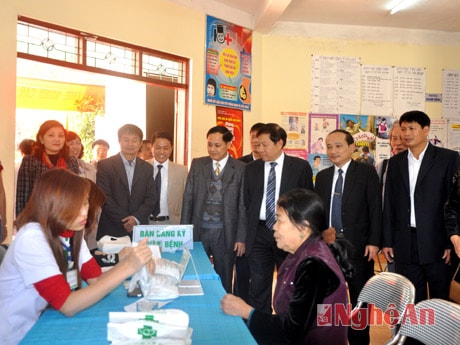 |
| Central, provincial, and district leaders in Anh Son inspect a healthcare facility for the elderly. Photo: Thanh Hung. |
PV: Vietnam has just reached the milestone of 90 million people and entered the "golden population" period. This is a special event for the country, for the province in general, and for population and family planning work in particular, but it also poses significant difficulties and challenges for the sustainable development of the province in the coming time. So, in your opinion, what are those advantages, difficulties, and challenges?
Comrade Nguyen Thi Hong Hoa:According to reports from the General Statistics Office and the Ministry of Planning and Investment, at 00:00 on November 1, 2013, Vietnam's population reached 90 million. This is a very impressive and significant figure, marking an achievement in Vietnam's population management. However, currently, Vietnam ranks 13th in the world in terms of population size, with a large proportion (over 60%) of the population in the working age group (15-49 years old), achieving a "golden population structure". It can be seen that Vietnam in general, and our province in particular, currently has a large labor market, creating favorable conditions for the social division of labor. We have sufficient manpower to build and develop the country. This is truly a "golden" opportunity for economic and social development if we know how to utilize and develop it. In Nghe An province, more than 30,000 people enter the working age each year. In terms of structure and workforce, this is an extremely favorable time to attract investment, develop socio-economic activities, and alleviate poverty.
In reality, if the "demographic dividend" occurs at a time when the economy is stable and the education system effectively trains the workforce, it will become a powerful driving force for economic development. Conversely, if we miss the opportunity of an abundant labor force, it will create social problems, primarily unemployment, followed by many other social issues.
However, currently, the quality of the workforce is a matter of concern. The professional and vocational skills of the workforce are still inadequate, and the percentage of trained workers remains low (over 35%). Furthermore, the health and physical fitness of workers do not meet the demands of the labor market. Unemployment and underemployment are pressing issues, while the ability to invest in job creation locally is not balanced with the annual increase in the workforce. Furthermore, with the current "golden population" period in our country, many other provinces are also experiencing a surplus of labor, making it increasingly difficult for workers to seek employment elsewhere. These factors necessitate greater attention to the quality of the population and human resources to meet the requirements of industrialization and modernization, and to build a prosperous and civilized province.
PV: To effectively implement population and family planning work in the coming period, what solutions has the sector come up with, Comrade?
Comrade Nguyen Thi Hong Hoa:Despite the achievements, the population and family planning work in our province still faces many difficulties and challenges: Nghe An remains a province with a high birth rate and a large population size; the rate of having a third child or more has decreased but not sustainably and remains high. Violations of population policies by officials and Party members are still prevalent. The issue of gender imbalance at birth is high, and an "aging population" structure is emerging. Population quality and reproductive health remain limited. Meanwhile, the national target program's funding for 2014 was significantly cut, affecting the implementation and maintenance of models and projects.
Faced with these challenges, in order for the population and family planning work in our province to achieve good results, the sector has identified the following key tasks and solutions:
Firstly: Actively advise Party committees, government agencies, departments, and mass organizations at all levels to strengthen leadership and guidance in population and family planning work. Continue to effectively implement new provincial policy documents in a manner appropriate to the specific characteristics of each locality and unit. Strengthen inspection and supervision of the implementation of annual plan targets and population and family planning policies at the grassroots level.
Secondly: Strengthen propaganda and mobilization efforts tailored to specific goals, target groups, and regions. Focus on innovating the content and forms of propaganda to ensure that officials and the public fully understand and actively participate in population and family planning policies in the new context. Coordinate more closely and effectively with relevant departments, agencies, and organizations to promote propaganda activities and create social consensus.
Thirdly: Continue to strengthen and improve the quality of staff working in population and family planning from the provincial to the grassroots level, and increase the number of training courses for staff on professional skills and expertise, in order to ensure they are adequately equipped to perform their tasks in population and family planning.
Fourth: Focus on effectively implementing the plan for population and family planning projects in 2014, such as: the project on population control in coastal and maritime areas; the project on prenatal and neonatal screening; the project on pre-marital health counseling; the project on reducing gender imbalance at birth; and building a community-based elderly care model for the period 2012-2015...
Fifth: Improve the quality of reproductive health/family planning services to ensure convenience, safety, and timeliness for the people. Strengthen training for service and technical staff; promote the implementation of the overall plan for social marketing of contraceptives throughout the sector.
Sixth: Effectively implement specialized statistical work, efficiently utilize population data management software, and ensure timely and accurate updates to serve as a basis for advising all levels on the development of population management policies and work programs.
PV: Thank you, comrade.
My Ha(Perform)