

Vietnam invests over $3 billion in Cambodia.
On the morning of January 13th, Prime Minister Nguyen Tan Dung and Cambodian Prime Minister Hun Sen co-chaired the 4th Vietnam-Cambodia Investment and Trade Promotion Conference.
The conference was attended by 650 delegates, including 450 businesses from both countries – the largest number ever.
According to a report by Deputy Minister of Planning and Investment Nguyen The Phuong, business activities in Cambodia are increasing and becoming more efficient. As of the end of December 2013, the Vietnamese government had licensed 143 investment projects in Cambodia, with a total registered capital of US$3.035 billion. Currently, 128 projects remain active with a total registered capital of nearly US$3 billion. The projects are most concentrated in the agriculture and forestry sector (accounting for 51.1% of total registered capital and 57% of total implemented capital), followed by energy (26.7% of total registered capital); and then finance and banking.
These include several large projects such as the rubber plantation project of Hoang Anh Gia Lai Group, the Five Star Fertilizer Plant in Cambodia, and the complex sugar, ethanol and thermal power plant in Karatie province, Cambodia…
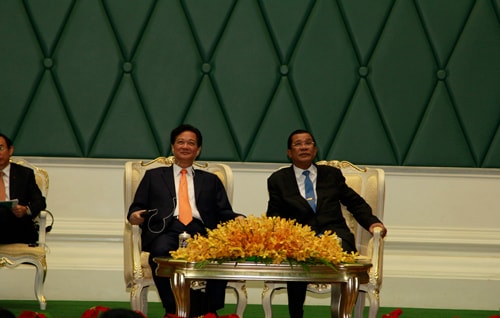 |
Prime Minister Nguyen Tan Dung and Prime Minister Hun Sen co-chaired the conference.
However, Vietnam's foreign investment activities still lag behind some countries. Data from the Association of Cambodian Investors (AVIC) shows that from 1994 to the present, nearly 50 countries and territories have registered investments in Cambodia with approximately 2,252 projects, totaling an estimated US$55 billion in registered capital. Of these, China leads with over US$18 billion, followed by South Korea with over US$5 billion… Vietnam ranks fifth with over US$3 billion.
In particular, the amount disbursed only reached approximately 1.2 billion USD (accounting for 40% of the total registered capital).
According to Mr. Tran Bac Ha, Chairman of AVIC, the reason investment in Cambodia has not met the expectations of both countries is due to several unresolved difficulties. Some projects have not been implemented as planned, and some investors still prioritize short-term profits over medium- and long-term investment. “Some businesses have not focused on researching and understanding Cambodian laws and regulations, or updating their strategies accordingly. On the Cambodian side, there are difficulties regarding infrastructure, an inconsistent legal system, and overlapping management practices…,” Mr. Ha said.
According to Thanh Nien newspaper.