
Proactive measures to prevent and control post-flood diseases.
(Baonghean) - Two weeks after the "historic" flood, we visited Hoang Mai Town, where life is gradually returning to normal. Clearly identifying the tasks that need to be done after the flood as environmental sanitation and disease prevention for humans and livestock, Hoang Mai Town and Quynh Luu District have focused on mobilizing the people to conduct a general cleanup of the environment…
(Baonghean) - Two weeks after the "historic" flood, we visited Hoang Mai Town, where life is gradually returning to normal. Clearly identifying the tasks that need to be done after the flood as environmental sanitation and disease prevention for humans and livestock, Hoang Mai Town and Quynh Luu District have focused on mobilizing the people to conduct a general cleanup of the environment…
After the floodwaters receded, they left behind a massive amount of mud, debris, and animal carcasses scattered everywhere—inside houses, outside, in wells, on roads, and in fields—posing a high risk of disease outbreaks. To assist flood victims in environmental cleanup, units from the Provincial Border Guard Command, the District Military Command, and the District Youth Union sent soldiers and volunteers to help local communities clean up, collect animal carcasses, sanitize classrooms, and repair roads damaged by landslides. Local authorities, in addition to directing residents to collect their own household waste and transport it to designated collection points, mobilized youth and other organizations to assist schools.
800 liters of disinfectant chemicals provided by the Provincial Veterinary Department have been used by the Hoang Mai Town Veterinary Station to disinfect livestock farms in all 10 wards and communes. Mr. Pham Chi Dien, Head of the Economic and General Affairs Department of Hoang Mai Town, said: “Drinking water is one of the most challenging issues after the floods. People's wells are all contaminated, so alongside providing food and stabilizing people's lives, the town has also focused on treating drinking water for residents.”
Out of a total of over 11,429 households in 181 villages and hamlets of Hoang Mai town affected by flooding, 10,473 out of 11,377 flooded wells have been treated; 4,543 out of 4,543 empty water tanks have been treated with chemicals (Chloramine B and alum). Along with water tanks and wells, 100% of sanitation facilities in flooded households have been sprayed with disinfectants and chemicals. Dr. Nguyen Thi Phuong, Head of the Health Station of Quynh Thien Ward, said: “Households with dug wells and empty water tanks have been guided by health station staff and ward health workers on how to treat them with chemicals and rinse them immediately after the water recedes. Regarding the carcasses of dead livestock and poultry that drifted into the area, the commune directed the hamlets to collect them, dig deep pits for burial, and treat them with lime powder.”
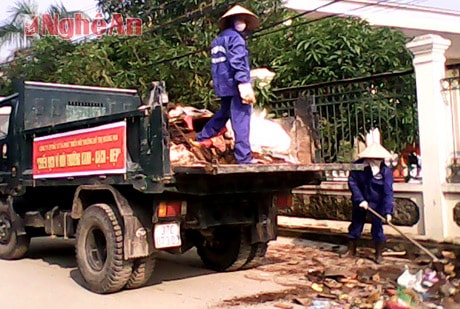 |
| Workers from Hoang Mai Town Environmental Investment and Development Joint Stock Company are helping residents clean up waste after Typhoon No. 10. |
Although nearly 100% of wells and shallow tanks have been treated, people remain very cautious. After treatment, well water and water from containers are only used for washing, and in the early days, households bought bottled water or tap water for drinking and cooking. Recently, with the rain, people have been collecting water in shallow tanks for use. Currently, although no outbreaks have occurred, according to our observations at the Quynh Di Commune Health Station, some post-flood illnesses have appeared, such as respiratory illnesses in children (due to the humid climate); skin rashes and itching; and gynecological diseases…
Dr. Le Van Thao, Director of the Quynh Luu District Health Center (including Hoang Mai area), said: “Following the directives of the health sector and learning from previous outbreaks, right before the flood occurred, based on the allocated supplies, we promptly distributed to the flood-affected communes and wards: 144 kg of Chloramine B, 14,500 Aquatabs water purification tablets, and 15,000 Chloramine B tablets to all communes in Quynh Luu and Hoang Mai districts. For areas severely affected by flooding, in addition to the supplementary supplies provided after the flood caused by Typhoon No. 10, the center provided more supplies and currently has a full supply of medical equipment and medicines to prepare for emergency disease outbreaks.”
Nearly three weeks have passed since the floods subsided, and so far, no major disease outbreaks have occurred, which is good news for the people in the flooded areas. However, in an interview with us, Mr. Tran Nguyen Truyen, Head of the Planning Department of the Provincial Center for Preventive Medicine, said: “Although no major disease outbreaks have occurred after the floods, because Hoang Mai Town, especially Quynh Di and Hoang Mai Town, were previously hotspots for acute diarrhea, cholera, and dengue fever, the health sector cannot be complacent. The Provincial and District Centers for Preventive Medicine are regularly deploying staff to monitor and update developments from the communes so that as soon as signs of an outbreak are detected, they can immediately contain and handle it.”
Currently, waste in Hoang Mai town is only collected and transported to the central landfill once a week. Due to the lack of planned collection points and limited equipment and vehicles, waste accumulation and haphazard disposal still occur. In the context of heavy rain and high humidity, this, combined with accumulated waste, creates a high risk of disease outbreaks. Therefore, in addition to environmental management, Hoang Mai town needs solutions to increase the timely collection, transportation, and processing of waste to prevent accumulation and contribute to a cleaner environment, limiting the conditions for disease outbreaks.
Nguyen Hai