

Is Vietnam's shrimp market facing difficulties in the US?
In addition to the already high anti-dumping duties, the US will impose countervailing duties (CVD) on shrimp imported from Vietnam at a rate of 4.52%. Although this rate is significantly lower than the preliminary results.
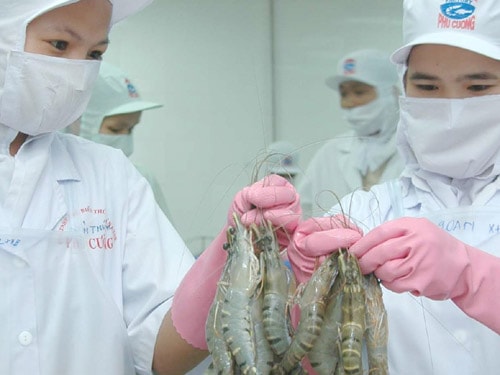
Unjust imposition
According to the final ruling of the US Department of Commerce (DOC) on the imposition of CVD (Continued Value Added Tax) on frozen warmwater shrimp imported from Vietnam, announced on August 12, 2013, the applicable tax rate for all Vietnamese shrimp exporting companies to the US is 4.52%. However, the two mandatory respondents, Minh Qui Seafoods Co. Ltd., will be subject to a CVD rate of 7.88% (an increase from the 5.08% rate in the preliminary decision), and Nha Trang Seaproduct Co., Ltd., will be subject to a CVD rate of 1.15% (a significant decrease from the 7.05% rate in the preliminary decision).
Mr. Le Van Quang, General Director of Minh Phu Joint Stock Company, Vietnam's largest shrimp exporter, believes that the DOC's ruling will create many difficulties for shrimp exporters to the US, especially given the current high cost of Vietnamese shrimp.
According to Mr. Nguyen Huu Dung, Vice President of the Vietnam Association of Seafood Processing and Export (VASEP): "The DOC's imposition of CVD duties on imported Vietnamese shrimp is unacceptable."
"With a tariff of around 4.52%, Vietnamese businesses will certainly be affected, but the extent of the impact on the trade sector depends on many other factors. However, what is certain is that American consumers will have to pay more for shrimp," Mr. Dung added.
American businesses protest.
Late December 2012,The Coalition of Gulf Shrimp Industries (COGSI) has filed a petition with the DOC requesting the imposition of CVD duties on warm-water shrimp imported from seven countries:
Shortly afterward, Tom Mazzetta, CEO of Mazzetta Co. Ltd., one of the largest shrimp importers in the US, voiced his strong opposition to COGSI's actions.
Tom Mazzetta suggests that recent trade practices against imported shrimp remind him of the "trick" that the US wild-caught shrimp industry has been maintaining and applying to imported farmed shrimp for many years.
“Caught shrimp and farmed shrimp are two different products. Caught shrimp cannot compete with farmed shrimp in terms of price, yield, or supply stability. It’s time to put an end to this deception. The key to success for the U.S. shrimp industry is to focus on developing and promoting its products, rather than engaging in price wars and criticizing farmed shrimp producers,” Tom Mazzetta asserted.
Recently, after the DOC issued its final decision on CVD tax, during the final hearing of the case at the US International Trade Commission (ITC) on August 14, 2013, many American businesses also unanimously voiced their opposition to the request to impose CVD tax on the product.
Eric Buckner, Director of Seafood at Sysco Corporation, one of the largest shrimp distributors in the United States, argues that farmed and wild-caught shrimp are two completely different products, targeting different customer segments, and therefore cannot compete with each other.
Concurring with this view, Guy Pizzuti, Head of Seafood at Publix Super Markets – one of the top 10 supermarket chains in the US – stated: “I never thought of imported farmed shrimp and wild-caught shrimp as two products that directly compete with each other. Our company has different marketing and sales plans for each item. Even our suppliers don’t have cross-competition. Imported shrimp suppliers compete with each other, and so do wild-caught shrimp suppliers.”
On Seafoodsource.com, Editor Fiona Robinson also wrote an article titled "Tariffs are not a long-term solution" to voice her opposition to the previous imposition of CVD and anti-dumping duties by the US.
This editor argues: “Nationwide wild-harvested shrimp and imported frozen farmed shrimp are different products. Obviously, these products enter two different markets and have different prices to reflect that.”
"And only lawyers are the winners in CVD or anti-subsidy tax cases. I want the domestic shrimp industry to find long-term solutions to its problems without hanging the future of the shrimp industry on the hook of tariffs," Fiona Robinson added.
It also depends on ITC.
According to VASEP, similar to anti-dumping cases, the countervailing duty case is also being investigated independently by two US agencies, the DOC and the ITC. Only when both agencies agree will the imposition of tariffs take effect. Currently, the ITC is investigating whether shrimp imports from Vietnam and other countries are causing damage to the domestic shrimp industry, and the final results are expected on September 26, 2013.
If the ITC determines that shrimp imports from the aforementioned countries are harming the domestic shrimp industry, then the DOC's tariffs will remain in place and apply to shipments imported into the US from June 2013 (the date of the DOC's preliminary ruling).
Conversely, if the ITC confirms that U.S. businesses have not suffered or are not threatened with material harm from imported shrimp, the case will be terminated entirely, and all deposits collected or intended to be collected from the businesses will be refunded or waived.
According to VASEP General Secretary Truong Dinh Hoe, Vietnam has high hopes stemming from the ITC's conclusion because Vietnam has the lowest CVD tax rate among the five countries subject to the DOC's ruling. US importers and retailers also support shrimp exporting countries because imported shrimp accounts for over 90% of the total shrimp supply to the US market. This DOC decision will directly impact American consumers, who will have to pay higher prices for imported shrimp products they are accustomed to consuming.
Currently, VASEP and businesses are working actively with lawyers to present evidence showing that Vietnamese shrimp exporting businesses are engaging in unfair practices.
DOC reverses its decision regarding Thailand and Ecuador. In its preliminary decision on May 29, 2013, the DOC stated that five of these seven countries had received government subsidies, with Thailand receiving between 1.75% and 2.09%, while Ecuador received no subsidies. However, on August 13, 2013, the DOC changed its decision, confirming that Thai shrimp and |
According to baocongthuong.PH