

Lesson 7: Following the legend of the Ngan family
(Baonghean) - Many people in Dinh village (Chi Khe - Con Cuong) still believe in a half-true, half-fictional story, perhaps a legend, that the ancestor of the Ngan family, who had over 20 households residing in the village, once raised a mythical serpent, called "to nguoc" in the Thai language. Some even translate it as a dragon or a mythical dragon.
>>Lesson 6: The Vu family in the Hmong community
Ban Dinh is the old name for the three villages of Lien Dinh, Trung Dinh, and Nam Dinh today, which were separated from Lien Dinh village in 2005. Most people in the village know the story about the legend of the Ngan family mentioned above.
Mrs. Vi Thi Chien, a resident of Trung Dinh village, recounted: "Nearly a hundred years ago, there was an old man named Xanh who worked as a shaman. He was a famous shaman throughout the neighboring villages. In those days, shamans were the 'bridge' between the human world and the spirits. Whenever someone in the family was sick, or they wanted to exorcise evil spirits, ward off bad luck, or perform a ritual, they had to immediately send someone to find and bring a shaman back."
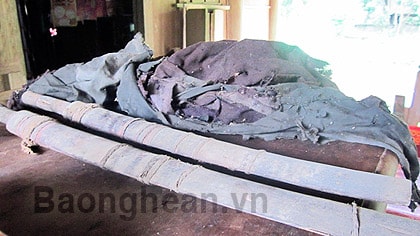
The sword and shaman's robe of old man Xanh.
Besides attending religious ceremonies, Mr. Xanh went to the forest to cultivate fields and cut wood like the locals. In the evenings, he liked to go to the river and streams to cast his net to catch fish and shrimp. One evening, with lightning flashing on the horizon, he carried his net to a section of the Lam River called Vang Cua. He found no fish or shrimp, only an unusually large snake egg caught in his net. He brought it home for his hen to incubate. Two weeks later, he saw the hen jumping out of the nest and squawking loudly in alarm. He went to the nest and found that the egg had hatched into a baby snake. He decided to leave it alone, letting the snake go wherever it wanted, but unexpectedly, the snake stayed by his side, clinging to him.
The snake often followed the ducks, eating worms and insects, and hunting birds and mice, so it grew very quickly. It followed people in the morning and slept on the rafters at night. One day, Mrs. Xanh was digging worms for the ducks when she saw the snake circling around her feet. She thought to herself, "This creature is always getting in my way; I can't go anywhere. Let it just die!" She swung her shovel, severing the snake's tail. Immediately, dark clouds gathered, and thunder and lightning erupted. Only then did she realize the creature was sacred, and she said, "I'm sorry, son." The dark clouds and lightning subsided. The couple treated the snake's wound and always regarded it as a sacred creature bestowed upon their family by heaven. From then on, the snake was called "Tao Cun," an affectionate name to commemorate the event of its tail being severed. Many years later, a rainbow crest grew on the snake's head. People believed that it had now transformed into a dragon.
On the day Mr. Xanh passed away, a dragon led its descendants to a large rock and circled it three times. Understanding the symbolic meaning, the family easily cut the rock to make a coffin for him, as easily as cutting a banana tree.
After its owner's death, the dragon returned to the Vang Cua ravine. Before leaving, the dragon broke off a rainbow-colored crest and gave it to the old woman to place on the altar. From then on, the family's business prospered, and all their descendants became successful.
Nowadays, whenever the Ngan family has an event, big or small, from weddings to ancestral rites, it rains. The people of Dinh village believe that this is when the dragon returns.
Mrs. Quang, now over 80 years old, is the granddaughter-in-law of Mrs. Xanh. She said that when Mrs. Xanh married into the family, the five-colored crest was still on the altar. In 1983, during her eldest daughter's wedding, it rained heavily, and all the guests were soaked. After the wedding, she took the five-colored crest to a pool of water near her house called Vang Cooc and returned it to the dragon. However, whenever the Ngan family undertakes any event, it still rains.
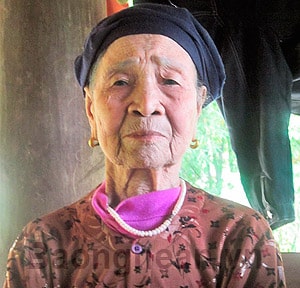
Grandma Quang, the daughter-in-law of the dragon breeder.
The Ngan family, from Dinh village, belongs to the Thai Tay Thanh group, originally from Thanh Hoa province. Having lived alongside the indigenous Thai Tay Muong group for generations, they speak the Thai Tay Muong language but still retain the customs of the original Thai Tay Thanh group from Thanh Hoa. During Tet (Vietnamese New Year), they often offer black sticky rice cakes made from glutinous rice, using ash water from burnt rice straw to create the black color.
Today, the descendants of Mr. Xanh still possess the shaman's robe and two sacred swords dating back hundreds of years. In addition, there is an ancient set of gongs. These are family treasures. When we visited to film these artifacts, Mr. Ngan Van Tho, a descendant of the person believed to have once raised dragons, had to perform a ritual before he could remove them from the altar. Mrs. Quang said that every year on the 15th day of the 8th lunar month, the family performs a cleansing ceremony for the two precious swords!
Text and photos: Huu Vi