

Continuing the aspirations of our ancestors.
In recent years, like many other localities in the province, the "revival" of clans in Nghi Loc has been very strong: We have seen elderly people carrying packed lunches to search for their clans; descendants from all over returning to seek recognition of their ancestors; and many ancestral temples being recognized as provincial and national historical and cultural relics. The clans have been and are striving to educate their descendants to preserve and promote the fine traditions of their forefathers.
(Baonghean)In recent years, like many other localities in the province, the "revival" of clans in Nghi Loc has been very strong: We have seen elderly people carrying packed lunches to search for their clans; descendants from all over returning to seek recognition of their ancestors; and many ancestral temples being recognized as provincial and national historical and cultural relics. The clans have been and are striving to educate their descendants to preserve and promote the fine traditions of their forefathers.
July 19, 2013 was a joyous day for the descendants of the Nguyen Dinh clan, branch 5, in Nghi Hop commune, Nghi Loc district, when the tomb and ancestral temple of Thai Bao Thuong Tru Quoc Sai Quan Cong Nguyen Ke Sai (the clan's ancestor) were recognized as a National Historical Monument. The Nguyen Dinh clan, branch 5, currently has approximately 10,300 descendants (generations 18, 19, 20, and 21), with 4,000 to 5,000 people from all over Vietnam and even abroad gathering for the ceremony. Many arrived 3-4 days in advance to contribute their resources and efforts to ensure the celebration was complete. On this important day, the procession, marked as a National Historical Monument, stretched over 1 kilometer from the commune's stadium to the ancestral temple; flags fluttered brightly, gongs and drums resounded, and everyone was smiling with joy.
During the procession, we met Mr. Nguyen Dinh Duong, 80 years old, who had come from Hanoi. Although his health was very poor, he was still determined to "march" with the children, leaning on his cane, following the lion dance. He believed that everyone was equal before their ancestors. He believed that the elderly should be respectful and filial to set an example for their descendants, embodying the principle: "Filial piety is paramount in human conduct. A tree needs roots to have green branches and a fresh top; water needs a source to flow into the vast ocean and deep rivers."
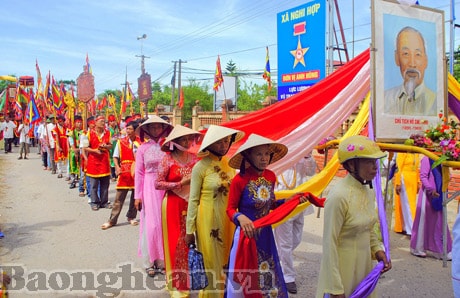
Descendants of the Nguyen Dinh family - branch 5 receive the Certificate recognizing the site as a National Historical Monument.
Tomb and Church of Nguyen Ke Sai
Mr. Duong introduced the history of his family: Grand Tutor and Supreme Commander Nguyen Ke Sai was the fifth of sixteen sons of Grand Tutor and Supreme Commander Nguyen Xi. During his lifetime, he, along with his father and older brother, contributed to the ascension of King Le Thanh Tong to the throne, suppressed the Champa army, defended Nghe An and later Thuan Hoa. Furthermore, he and his eldest brother, Nguyen Su Hoi, were instrumental in attracting settlers, reclaiming and expanding the land, and improving the barren, saline coastal areas of Chau Phuc district, Duc Quang prefecture, especially Thuong Xa – the area near present-day Cua Lo. In his later years, Grand Tutor and Supreme Commander Nguyen Ke Sai settled permanently in Thuong Xa, directly supervising the defense of 12 seaports (from Thanh Hoa to Quang Binh), establishing schools, and building Son Market.
He had nine sons, most of whom held the title of Marquis, while some were granted the titles of Duke, Grand Tutor, and Grand Marshal, thus forming nine branches of the Nguyen Dinh family throughout the country. Throughout its development, the fifth branch of the Nguyen Dinh family was primarily focused on military affairs. During the feudal period, eight members were granted the title of Duke, 44 were granted the title of Marquis, and 20 were granted the title of Baron.
We learned that the Nguyen Dinh clan, branch 5, is a lineage with many "exceptional" figures (there are about 30-40 such clans in our province). The culture of the Nguyen Dinh clan, branch 5, is characterized by a fervent patriotism and unwavering dedication to the well-being of the people. This spirit is built upon the examples of their ancestors, such as the ancestor Nguyen Xi, Nguyen Ke Sai, and others. Following Mr. Duong's introduction, we met Mr. Nguyen Dinh Tu, Deputy Chief Administrator of the Nguyen Dinh clan, branch 5.
Mr. Tu affirmed: “The family's traditions have always been upheld. Following the example of our ancestors, thousands have participated in the revolution, and many have developed their careers through education, scientific research, and actively engaged in production to develop the country and their homeland. The family always educates its descendants: no matter what position they hold or what profession they pursue, they must always remember their ancestral homeland, uphold family traditions, correctly implement the Party's guidelines and policies, the laws of the State, and make worthy contributions to the locality and the nation. Descendants of the Nguyen Dinh family, branch 5, are present throughout the country. Currently, there are 174 ancestral temples of the medium and small branches. With such a large family, creating unity to educate the descendants is no easy task.”
Fulfilling the wishes of our ancestors, the Family Council was established with 47 members. These are virtuous individuals who take the lead and are responsible for connecting and representing 174 branches and sub-branches. Over the past time, the Family Council has translated and supplemented the family genealogy, sending it to the branches so that descendants can know the glorious history of the family. In 2010, we drafted the family charter and established subcommittees to assist the main family council, such as the construction subcommittee, the cultural subcommittee, the finance subcommittee, the internal affairs subcommittee, the historical site construction subcommittee, the education and talent promotion subcommittee, and the inspection subcommittee. The family charter came into effect in 2012 and has been disseminated by the Council members so that the branches can develop action programs for their descendants to implement.”
Mr. Nguyen Dinh Tu earnestly invited reporters to attend the ancestral commemoration ceremony on the 24th day of the 7th lunar month. The ancestral commemoration day of the Nguyen Dinh clan, branch 5, has long become a major festival. Besides the ancestral worship ceremony, the clan will also conduct activities to promote education and talent, rewarding descendants who excel in their studies with prizes ranging from 500,000 VND to 2,000,000 VND. They will also offer constructive criticism regarding areas for improvement, with the aim of encouraging mutual progress.
We visited Hamlet 6, Nghi Truong Commune (formerly Ky Tran) – the ancestral land of the renowned Nguyen Nang family. The family's founder was Nguyen Dang Trieu, a scholar who migrated from the North to settle here in the early 18th century. The most outstanding figure in the family was Nguyen Nang Tinh, who earned a bachelor's degree and rose to the rank of Imperial Censor under Emperor Minh Mang. He was a virtuous official who always cared for the well-being of the people. He was instrumental in compiling and editing the entire body of poetry and prose by Nguyen Trai.
After resigning from his official position and returning to his hometown, he became a skilled physician and teacher. Currently, the ancestral temple and tomb of Mr. Nguyen Nang Tinh have been recognized as a provincial-level historical and cultural relic. During the Nguyen Dynasty and the French colonial period, many members of the Nguyen Nang family were famous for their teaching and traditional medicine, including Mr. Nguyen Nang Tuan, Mr. Nguyen Huu Tao, Mr. Nguyen Nang Chuc, and others. Many of their students held high positions. Many people were saved by them. Although they only settled in Ky Tran a little over two centuries ago, with a relatively small number of households, generations of descendants of the Nguyen Nang family have built a beautiful cultural tradition, contributing to the regional and national culture.
Mr. Nguyen Xuan Son, the clan leader of the Nguyen Nang family, led us to visit a vast family heritage. This includes thousands of literary works and hundreds of traditional medicinal recipes passed down through generations. Mr. Xuan shared: "The traditional culture of our family is teaching and practicing medicine. Both professions are dedicated to the development of humankind… In a time of national suffering, two of our ancestors answered the call of Phan Bo Chau and went abroad to study. Six were recognized as veteran revolutionaries in the Soviet movement, and many bravely sacrificed their lives in the cause of national liberation."
Following in the tradition of their ancestors, after the revolution's success, around 40 members of the family became primary, secondary, and high school teachers, as well as lecturers at vocational schools and universities. In the field of medicine, there were many renowned physicians such as Nguyen Xuan Lam, Nguyen Xuan Luu, Nguyen Nang Vien, Nguyen Xuan Cong, etc., whose names were known far and wide. Even today, the family's traditional remedies for joint pain and tumors remain effective and trusted. Sadly, however, after the passing of the elders (Mr. Son's father and uncles), the practice of medicine temporarily declined. None of the current descendants have been able to continue or preserve the tradition. In the future, the Nguyen Nang family will continue to encourage and guide their descendants to pursue medicine, carrying on the legacy of their ancestors' desire to heal and save lives, ensuring that these precious remedies are not lost.
The stories of the descendants of the Nguyen Dinh branch 5 and Nguyen Nang in Nghi Loc district are just two of countless stories about the descendants of various families striving to uphold the fine traditions of their ancestors in our province. These ancient families have developed differently: some have excelled in literature and scholarship, others in martial arts, and still others in agriculture or small-scale handicrafts. However, all have made worthy contributions to their homeland and country.
Let me conclude this article by quoting Associate Professor Ninh Viet Giao: “Regardless of where those families originated, whether they were originally from Nghe An or migrated there at any particular time, throughout their development, they have cherished this land, contributing to the creation of prosperous villages with a healthy and beautiful cultural tradition… It is these families who have revived age-old cultural values, contributing to the process of building an increasingly prosperous and beautiful homeland.”
Thanh Chung