

More information about the national seal and national sword of the Nguyen Dynasty.
On the afternoon of August 30, 1945, at Ngo Mon Gate in Hue, the Nguyen Dynasty's imperial seal and sword were handed over by Emperor Bao Dai to a representative of the Viet Minh. What was the name of the golden seal, how much did it weigh, when was it made, and what was its shape? What material was the sword made of, what was its appearance and origin? Where are these two precious artifacts now located?
(Baonghean)On the afternoon of August 30, 1945, at Ngo Mon Gate in Hue, the Nguyen Dynasty's imperial seal and sword were handed over by Emperor Bao Dai to a representative of the Viet Minh. What was the name of the golden seal, how much did it weigh, when was it made, and what was its shape? What material was the sword made of, what was its appearance and origin? Where are these two precious artifacts now located?
Although books and articles published both domestically and internationally, in print and online, have long sought to uncover information related to that pair of seals and swords, unfortunately, the questions raised above have yet to be satisfactorily answered.
On the afternoon of August 30, 1945, in the imperial city of Hue, at Ngo Mon Gate, on the Ngu Phung tower, beside the last emperor of the Nguyen dynasty, Bao Dai, were his younger brother Vinh Can and Chief of Staff Pham Khac Hoe. Emperor Bao Dai read the abdication decree, then handed over the imperial seal and sword to representatives of the Provisional Government – including Tran Huy Lieu, head of the delegation, and Nguyen Luong Bang and Cu Huy Can – who had just arrived from the North.
At that time, approximately 50,000 people gathered in the square at the foot of the Monument. However, for various reasons, primarily the distance in space and time, most did not clearly observe the event, and furthermore, memories – even those of those involved – were either faded or contained inaccuracies.
Therefore, first, I invite you, dear readers, to join me in reviewing books and articles mentioning that pair of swords and seals, to see that a series of information contradicts each other. In the quoted passages, the annotations in square brackets are by Phanxipăng, and the details that need attention are printed in bold.
CONTRADICTORY
The head of the Viet Minh delegation who received the seal and sword wrote in Tran Huy Lieu's memoirs (Social Sciences Publishing House, Hanoi, 1991, page 370): "These two long, jewel-encrusted swords and the golden seal, according to what people say, are both..."The dynasty was established by Gia Long after he overthrew the Tay Son dynasty and ruled the entire country.Along with the imperial sword, there was also a brocade bag containing a set of jade chess pieces and other precious trinkets. Receiving the sword from Bảo Đại was unremarkable. But receiving the golden seal, I was unexpectedly overwhelmed by its weight. The seal weighed 7 kg of gold! To be honest, when I raised my hands to support it, I didn't realize how heavy it was, so I wasn't prepared. However, when the heavy seal rested in my hands, I had to exert all my strength to support it, to prevent it from slipping, and especially to keep myself from swaying, because my posture at that moment wasn't just my own; it was the posture of a representative of the Government of the Democratic Republic of Vietnam performing a very important task at a historic moment.”
The deputy head of the delegation, the poet Huy Cận, recalled a different part in his "Double Memoirs" (Vietnam Writers Association Publishing House, Hanoi, 2009, page 89): “After Bảo Đại finished reading, the flagpole lowered the king's yellow flag and raised the red flag with a yellow star. The people applauded like thunder. Bảo Đại handed over the golden national seal,Forged during the reign of Minh Mạng, weighing nearly 10 kg, and a national sword with a gold scabbard inlaid with jewels, but the blade has rusted."Brother Lieu handed the seal and sword back to me and the comrades in the People's Revolutionary Committee, then read the declaration of the delegation of the Provisional Government."
Pham Khac Hoe later recorded in his memoir "From the Hue Court to the Viet Bac War Zone" (Hanoi Publishing House, 1983, page 78): “Bao Dai read the abdication decree with such emotion that he sometimes lost his voice. After Bao Dai finished reading, the yellow flag of the king was slowly lowered from the flagpole, and a bright red flag with five golden stars was raised amidst thunderous applause and cheers, interrupted by 21 gun salutes to the new national flag of the reborn nation. The gunfire ceased. Bao Dai raised both hands and presented the head of the government delegation with the heavy gold seal.”10 kilogramsand the national sword kept insidegold casing inlaid with jewels"
Ngoc Trang wrote about the August Revolution and the last Nguyen Dynasty king in the magazine Hue Past and Present 40 (June 2000): “Bao Dai respectfully presented to the head of the delegation, Tran Huy Lieu, the 10kg gold national seal and the national sword in a gold sheath inlaid with jewels.”
In the article "The Hue Court Before and After the Viet Minh Ultimatum" published in The New World Magazine 550 (August 26, 2003), Nguyen Xuyen wrote: "Bao Dai raised both hands and handed the head of the government delegation the heavy gold national seal."11.2368 kgand the national sword was kept inside.gold casing inlaid with silver"
After receiving the seal and sword, the delegation led by Tran Huy Lieu immediately took them to Hanoi in time for the Independence Day ceremony on September 2, 1945, at Ba Dinh Square. One of the members of the Organizing Committee for the Independence Day ceremony had the opportunity to see the treasure: Nguyen Huu Dang – Deputy Minister of Propaganda of the Expanded Provisional Government. Later, in his article "The Seal and Sword of the Nguyen Dynasty's Royal Power on the Platform on Independence Day," published in the magazine "Past and Present" 31 (September 1996), Nguyen Huu Dang described: "This seal and sword, both made of gold, are two treasures symbolizing the power of the Nguyen Dynasty."The blade is also made of gold, just like the scabbard.But it was thicker, only about two-thirds the length of the scabbard, with the widest part about two centimeters, tapering to a point like a rice leaf. The scabbard was meticulously embossed. I don't know when it was made. As for the seal, according to a historian, it was cast around 1774, during the reign of Lord Nguyen Phuc Khoat. On the square seal (the large knob is also square), Nguyen Phuc Khoat had four Chinese characters engraved.Kingdom's SealIt means a political manifesto.
Regarding the weight of the national seal, in the same article, Nguyen Huu Dang provides some rather intriguing details: “Uncle Ho read the Declaration of Independence, then Vo Nguyen Giap presented the policies and guidelines of the expanded Provisional Government. Then it was Tran Huy Lieu's turn to report. I stood ready beside a small table, on which lay the seal and sword. When Mr. Lieu said that Bao Dai would respectfully hand over the seal and sword, I would press his left arm to make him pause. Then, with my right hand holding the sword, I calmly used the fingertips of my left hand to pick up the knob of the seal, intending to raise both simultaneously for the people to see. Unexpectedly, the sword was relatively light, easily controlled with one hand, but the stubborn seal refused to budge. It was small, yet so heavy!”
I only found out it was heavy later.over 5kg"I quickly dropped my sword, using both hands to pull the seal up about thirty centimeters from the table. I slipped my right hand underneath, positioning it on my palm, then bent down and slowly raised it straight up like a weightlifter, while my left hand grabbed my sword and held it up to the level of the seal. The crowd cheered loudly and continuously. I tried to stand firm, with both arms raised like that for four or five minutes. My arms, supporting the seal, began to ache, turn numb, and threatened to sag downwards."
Nguyen Huu Dang further added in parentheses: "In 1992, after reading Mr. Lieu's memoirs, I learned that on August 30, 1945, at Ngo Mon Gate, during the display of the imperial seal and sword for the people of Hue to see, he was also as overconfident, surprised, confused, and exhausted as I was, perhaps even more so: he was so exhausted that he almost stumbled!"
In her compilation of "The Story of the Nguyen Dynasty's Royal Seal," published in the book "Hue of a Bygone Era" (Nam Viet Publishing House, California, 2006; Tre Pheo Publishing House, California, 2008, page 399), Vo Huong An states: "When Emperor Bao Dai (1926-1945) announced his abdication in front of Ngo Mon Gate on August 30, 1945, to 'be a citizen of an independent country rather than a king of a slave country,' he handed over the royal seal and sword to a representative of the Viet Minh Government. That was the seal."Emperor's Treasuremade of pure gold (10-karat gold), weighing approximately...10 kg 500"
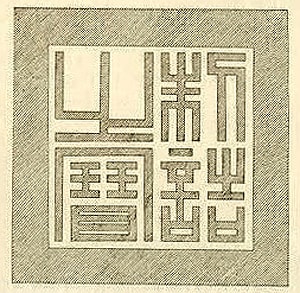
The Imperial Seal.
Bui Mong Diep, a concubine of Emperor Bao Dai, who had guarded the pair of imperial seals and sword for a time, stated in an interview with the Lao Dong newspaper on December 8, 1996: "As for the gold seal, I weighed it myself."weighing 12.9 kg.The dragon-shaped push knobThe dragon was bent and raised its head. The dragon wasn't very finely crafted, adorned with two red pearls, resembling a snake. I turned it over and saw four seal characters underneath. According to someone who could read Chinese characters, those four characters were...Treasure of the Nguyen Dynasty"
SWORD AND STAMP MOVEMENT
To uncover the truth about the national seal and national sword of the Nguyen Dynasty, let's continue following the "adventure" of these artifacts.
Just over a year after Independence Day, the French recaptured Hanoi. The resistance against the French erupted with the first shots fired at 8:03 a.m. on December 19, 1946, from the Lang fortress. After many days of holding back the enemy, the Capital Regiment(1)They retreated on the night of February 17, 1947, to preserve their forces. Before heading to the Viet Bac War Zone, Viet Minh officers and soldiers hastily buried many important documents and state treasures – including the historical pair of seals and swords.
Ironically! When the French raided the ancient temple in Nghia Do village, Hanoi, they discovered a tin kerosene container, inside which were a pair of precious seals and swords. In the Nguoi Lao Dong newspaper on September 5, 1997, Nguyen Huu Nhon reported that this event took place on a specific date.28/2/1952At that time, the seal and sword were found to have been painted black for camouflage, and the sword itself was broken in two "due to being touched during excavation." In the books *Through France to Find Ancient Hue* (Thuan Hoa Publishing House, Hue, 2000) and *Volume 2* *Questions and Answers about the Nguyen Dynasty and Ancient Hue* (Tre Publishing House, 2000), Nguyen Dac Xuan recorded that "people broke the sword in half to make it easier to put into a kerosene barrel" and that the black color of the seal and sword was due to "rusting from mud and soil, not because someone intentionally painted it black." The document *The Last Imperial Seal of the Vietnamese Emperor*, compiled by Le Van Lan (self-published, USA, 1998), asserts: "The burial place [of the seal and sword] was the wall of an ancient temple in the North, where commando soldiers..."(2)According to Le Van Lan, the French, while on a military operation, accidentally discovered and captured the prisoners, then brought them back to the French commanding general, De Linarès. Le Van Lan also claims the event happened earlier: in 1951.
Whether in 1951 or 1952, Bảo Đại served as head of state in the national government established by the French colonialists. General François Jean Antonin Gonzalez de Linarès then organized a grand ceremony in Hanoi to hand over the royal seal and sword to Head of State Bảo Đại.
Based on the Vietnamese translation of L'Aventure.(3)According to Jacques Massu and Jean Julien Fonde (Plon Publishing House, Paris, 1980), Le Van Lan believes that the ceremony of handing over the seal and sword took place on that day.8/3/1952Then, the Paris Match magazine dedicated a special issue to a report with many fascinating images. In the article "Some Thoughts on the Last Seal and Sword Set of the Nguyen Dynasty" published in Research and Development Magazine 35 (Hue, 2002), Phan Thanh Hai recorded the date of the ceremony for handing over the seal and sword as3/3/1952.
Another irony is that Bảo Đại was absent from the solemn ceremony of returning the royal seal and sword. Bùi Mộng Điệp recounted: “They [the French] wanted to return the [seal and sword] to the Nguyễn dynasty, but former Emperor Bảo Đại was on vacation in the West at the time, and no one was qualified to receive them. Mr. Lê Thanh Cảnh, who worked for the French, saw this and called me on the telephone in Buôn Mê Thuột.”(4)"He asked me to take them to clean because those two objects, buried in the mud, had already rusted. But I had never seen those treasures before, and I didn't know if they were the same two seals and swords that the former emperor had given to Mr. Tran Huy Lieu in 1945. I was hesitant, so I invited Empress Dowager Tu Cung from Hue to come by plane. On the day I received the seals, she said I had to set up a table at Buon Ma Thuot airport, cover it with a red cloth, and bow five times to the seals and swords before I was allowed to bring them back to the palace. After washing them at the palace, I placed them on a table in the middle of the house and covered them completely with a red cloth. There were guards day and night."
Mộng Điệp continued: “Speaking of swords, the Nguyễn emperors had many. But the ones displayed at the Musée militaire and Au Bon Marché that many people (including Mr. Hoàng Xuân Hãn) have seen are not the sword that Emperor Bảo Đại gave to Mr. Trần Huy Liệu in August 1945. When Ambassador Trịnh Ngọc Thái came to ask, I told him:The sword has only one blade, slightly curved, and its hilt is made of white jade.I personally cleaned it when Mr. Le Thanh Canh flew from Hanoi to Buon Ma Thuot to give it to me. The sword was broken in two and then put along with the seal into a twenty-liter kerosene barrel. I asked two of my attendants, Mr. Tu Lang and Mr. Thua Te, to weld it and then have it polished so that no trace of the break would be visible. Whenever you see a sword like that, just have someone shine a light on it and you'll see the weld marks immediately.”
According to Mong Diep, from 1953 onwards, the war intensified, and they dared not bring the imperial seal and sword back to Hue. If they had brought them back at that time, they wouldn't know where to store them. Finally, Bao Dai wrote a letter of authorization for Mong Diep to take the seal and sword to France. Later, Mong Diep handed over the two treasures to former Empress Nam Phuong and former Crown Prince Bao Long in the presence of Nguyen De, Nguyen Duy Quang, Nguyen Tien Lang, and Pham Bich (son of Pham Quynh).
Since the death of Empress Nam Phuong in 1963, Bao Long had exclusive management of the imperial seal and sword, and had them entrusted to the Union of European Banks for safekeeping. In 1980, he published his memoir, *Le Dragon d'Annam* (The Dragon of Annam).(5)Bảo Đại desperately wanted to use that historical seal to stamp each chapter, creating a meaningful decorative vignette. Ironically, Bảo Long absolutely refused to lend the seal to his father! Enraged, Bảo Đại filed a lawsuit against his son to reclaim the seal and sword. According to Lê Văn Lân, the French court ruled that Bảo Long was allowed to keep the sword and return the seal to Bảo Đại. Professor Thái Văn Kiểm – one of Bảo Đại's closest confidants in his final years – still possesses a photograph of the former emperor sitting thoughtfully beside the national seal.
Rumor has it that sometime before his death in 2007, Bao Long sold his prized sword because… he was short of money!
And what about the precious seal? After Bảo Đại's death on the morning of July 31, 1997, in Paris, the seal came into the possession of Monique Marie Eugène Baudot, affectionately known as Monica – the French wife whom Bảo Đại officially married on January 14, 1982, in Paris.
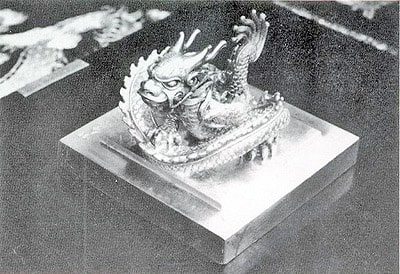
The gold seal is under investigation.
DISCOVER THE TRUTH
Based on observations of photographs of the ceremony handing over the imperial seal and sword to Bao Dai (even though Bao Dai was absent) in Hanoi in March 1952, and photographs of Bao Dai sitting next to the seal in Paris, and further reference to relevant historical sources, it is clear that restoring reliable information about both the seal and the sword is feasible.
What was the name of the national seal that Emperor Bảo Đại presented to Trần Huy Liệu in Huế on the afternoon of August 30, 1945? Was it the "Seal of the Kingdom" as Nguyễn Hữu Đang recalled, or the "Treasure of the Nguyễn Dynasty" as Bùi Mộng Điệp recalled? What was the shape of the seal? When was it made? Did it weigh 5 kg, 7 kg, 10 kg, 10.500 kg, 11.2368 kg, or 12.9 kg?
By consulting the Imperial Compilation of the Great Nam Dynasty's Regulations and Precepts of the Nguyen Dynasty (Thuan Hoa Publishing House, Hue, 1993), posterity learns that the Southern Dynasty once possessed many gold and jade seals, but most were considered "documentary treasures." Only 20 seals – including 14 gold seals and 6 jade seals – were classified as imperial seals. Each seal had its own function and meaning, andAll 20 of those imperial seals were crafted from the reign of Gia Long onwards.In addition, there isThese four seals date back to the time of the Nguyen lords.They were classified as "treasures of the museum" for safekeeping and not for use. All 24 seals mentioned above were called "national treasures" by the Nguyen dynasty.There is absolutely no item bearing the name "Kingdom's Seal" or "Nguyen Dynasty's Treasure."chief.
Looking closely at the close-up photos of the artifact from various angles, it's clear that the seal's surface is square, but...The push button is not square.as described in the magazine "Past and Present" 31 (September 1996). In reality,The knob of the seal is shaped like a dragon coiling and tumbling.The dragon is elaborately crafted. Its head is held high, with the character 王 (wang) carved on it. The dragon's tail stands upright right behind its head. Its four legs are firmly planted, each with five claws.
On the top of the seal, on either side of the dragon knob, there are two lines of Chinese characters carved in the Kai script style, which here are the transliteration and translation.
Right side:Ten taels of gold, weighing two hundred and eighty taels, nine coins and two cents.Meaning: A seal cast in 10-karat/24-karat gold, weighing 280 taels, 9 mace, and 2 phân (approximately 280 taels, 9 mace, and 2 phân).10.5345 kg of pure gold.
Right side:In the fourth year of Minh Mạng's reign, on the fourth day of the second month, at an auspicious time, it was commissioned.Meaning: The seal was made at an auspicious time on the 4th day of the 2nd month of the 4th year of the Minh Mạng reign, which corresponds to March 15, 1823.
The underside of the seal features four raised Chinese characters engraved in small seal script:Emperor's Treasure寶 / 宝, pinyin phát bảo, Sino-Vietnamese pronunciation phát bảo, means the seal of the king. The name of the national seal, so that's quite clear.
According to the Imperial Decree on the Regulations of Dai Nam (cited above), the Imperial Seal is one of the 20 imperial seals, used only in cases of "celebrating special occasions, granting favors, granting general amnesty to the entire kingdom, and issuing decrees to high-ranking officials to tour various places to inspect the localities, all such solemn ceremonies, and issuing decrees and letters to foreign countries."
The Đại Nam thực lục chính biên (Official Chronicle of Đại Nam) of the Nguyễn Dynasty's National History Institute (Social Sciences Publishing House, Hanoi, 1963) also records: "On the Giáp Thìn day (March 15, 1823), the Emperor's Seal was cast, with a two-tiered dragon-shaped knob, 3 tấc 2 phân square, 5 phân thick, made of 10-karat gold." Converting this to the currently widely used measurement system throughout Vietnam, it is sufficient to determine that the Emperor's Seal was indeed of considerable value.Square face, each side measuring 12.8cm and 2cm thick..
From its creation in the spring of 1823 until its handover to representatives of the Viet Minh government by Emperor Bao Dai in the autumn of 1945, the Imperial Seal of the Emperor is 122 years old. While simply comparing its age to that of many antiques in Vietnam and around the world, that amount of time is not considered "ancient," its unique historical significance makes the Imperial Seal of the Emperor a priceless national treasure.
Some believe that knowing the age of the Emperor's Seal immediately reveals the age of the sword. Perhaps this conclusion stems from the fact that the seal and sword were originally a complete set? While this conclusion seems logical, it unfortunately doesn't match reality. The sword accompanying the Emperor's Seal is significantly older: a delay of approximately a century.
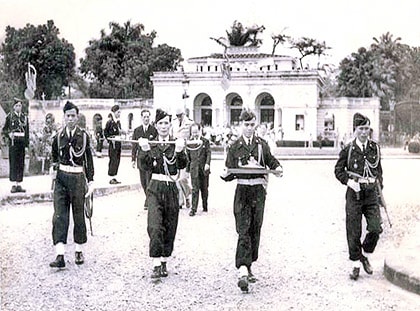
France organized the handover of the royal seal and sword to
Head of State Bảo Đại in Hanoi, March 1952.
Examining the photographic evidence, it's clear that the entire sword is meticulously crafted and artistic, with a style somewhat influenced by Western design. It's a longsword with a hilt inlaid with white jade. The hilt also has a loop for the hand to rest on. The blade is likely made of high-quality steel, not gold. The sword has a "slightly curved" shape, just as Mộng Điệp recalled. The scabbard is over 1 meter long and made of an alloy in which gold makes up a certain proportion.
It is noteworthy that, according to Le Van Lan, the scabbard of the sword has two lines of Chinese characters engraved on it.
A line of text:Four taels of gold, seven coins, five tenths of a tael.Meaning: The gold content consists of 4 taels, 7 mace, and 5 phân; equivalent to 178.125g of gold. With such a small amount of gold, it is unclear what other metals were present in the mixture. Nevertheless, this evidence is sufficient to refute the claims that "the sword blade was also made of gold like the scabbard" and "the scabbard was gold inlaid with jewels" or "the scabbard was gold inlaid with silver".
The other line reads:Khai Dinh era calendarThis means it was produced during the reign of Emperor Khai Dinh, specifically during the nine-year period of Nguyen Phuc Buu Dao's rule – from the year of the Dragon (1916) to the year of the Ox (1925).
As of the historic date of August 30, 1945, the sword in question was less than 30 years old. However, just like the Imperial Seal, due to its unique historical significance, the national sword is a priceless treasure of Vietnam.
Ideally, the most appropriate place to preserve and display these artifacts would be the National Museum of History in Hanoi or the Hue Imperial Fine Arts Museum. Alas! Cruel fate has led to the exile of the Nguyen Dynasty's national seal and sword. Rumors of Bao Long secretly selling the Khai Dinh-era sword remain unverified, but they still cause public concern. And the golden imperial seal has certainly fallen into the hands of the widow Monique Baudot. When and how will this historical seal and sword return to their homeland?
_________________
(1) That is, Regiment 102 of Division 308. Nguyen Dinh Thi composed the song "People of Hanoi" to give to this regiment.
(2) Commando: commando, special forces.
(3) Viet Minh incident.
(4) This place name in the Ede language is Buon Ama Thuot, which means the village of Father Thuot.
(5) The memoir Le Dragon d'Annam (Plon Publishing House, Paris, 1982) although printed with the author SM Bao Daï on the cover, was actually written by the French general Jean Julien Fonde. The Vietnamese translation Con rồng Việt Nam was published by the Nguyen Phuoc clan in 1990 in California, USA.
PHANXIPANG