
A myriad of feelings of longing for home.
(Baonghean) - At the beginning of the new year, the bustling, lively atmosphere of Tet (Vietnamese New Year) still lingers in the once poor, small villages, now filled with many new, multi-story, spacious houses. We shared with Mr. Nhung: "Our village, our commune, has improved so quickly!" He smiled, but his eyes were full of worry: "Yes, but the joy will only last a few days. Beautiful houses will be abandoned. After the full moon, the village becomes very quiet…"
(Baonghean) - At the beginning of the new year, the bustling, lively atmosphere of Tet (Vietnamese New Year) still lingers in the once poor, small villages, now filled with many new, multi-story, spacious houses. We shared with Mr. Nhung: "Our village, our commune, has improved so quickly!" He smiled, but his eyes were full of worry: "Yes, but the joy will only last a few days. Beautiful houses will be abandoned. After the full moon, the village becomes very quiet…"
Nghi Van (Nghi Loc district) was once known as a barren land where "dogs eat rocks and chickens eat pebbles," one of the most difficult localities in the district. The entire commune has 480 hectares of land for two rice crops per year, largely dependent on rainwater, resulting in very low yields. Even in favorable spring weather, rice yields only reached 55 tons/ha, and the autumn crop might yield 20 tons/ha. Because production depended on the unpredictable weather, Nghi Van still cultivated the "embryonic rice" variety. This variety has been replaced by other hybrid rice varieties decades ago. The simple reason is that only this "embryonic rice" variety could survive in that arid land. Farming alone was not enough to make a living, so most of the young workforce in Nghi Van chose to leave their hometown to seek work elsewhere. Their children, working far away, brought back the main source of income for this region...
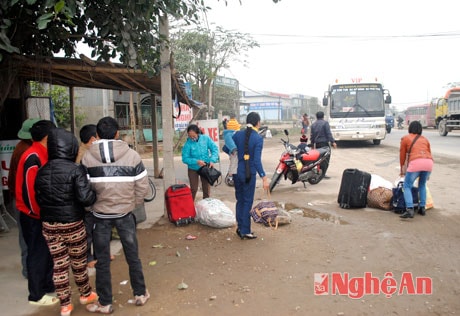 |
| After the Lunar New Year, many people take buses to travel back and forth between the North and South of Vietnam. |
Upon arriving at Hamlet 13, we met Mr. Nguyen Nhu Nhung, the hamlet head. He recounted: The hamlet has 122 households, with only about 18 hectares of land for two rice crops and 22 hectares of land specifically for growing peanuts. The land is scarce and infertile, making it impossible for the people to make ends meet through agriculture. Sons and daughters, after finishing high school, often leave to find work far from home. Previously, they often went to the South to work as factory workers or unskilled laborers. In recent years, young people have been flocking to Laos to work in various professions, such as construction workers or small-scale traders. Of the 576 inhabitants of the hamlet, more than 150 are young workers who spend their lives working far from home. Thanks to this main source of income from working away from home, the hamlet's appearance has improved rapidly. The multi-story houses, sturdy buildings, and strong fences are all thanks to this income. As a result, 100% of the families in the hamlet now have stable housing, and only 18 households remain classified as poor according to government regulations.
With cash available, mobilizing people to build public works in the hamlet is easier. Especially during the New Rural Development program, when returning home for Tet (Lunar New Year), every household expressed their willingness to contribute money alongside the government when discussing concrete road construction. Children working far from home are the main source of income for families, but they leave a heavy burden on those left behind. The majority of those working far from home are between 18 and 50 years old, leaving behind often children or elderly and infirm people. In some cases, both parents bring their young children along to work, thus disrupting the children's education. When important matters arise in the hamlet, the hamlet committee faces significant difficulties due to a shortage of young laborers.For example, when someone dies, assigning personnel to dig the grave and bury the body inevitably requires mobilizing elderly people, a task that should ideally be undertaken by younger generations.
The same goes for farming; the leased land isn't much, but some families are willing to leave it fallow because the children and elderly at home lack the strength to work. In Hamlet 13, there's about 1 hectare of arable land that has been left fallow for many years. And that's not even counting those who left healthy, well-behaved, and full of determination to change their lives, only to return as alcoholics, addicted to gambling, or resorting to theft… The village, therefore, has become chaotic and suspicious of one another. Mr. Nhung said, his eyes distant: "Throughout the year, the only time it's lively is during Tet (Lunar New Year). Even if you build a big, beautiful house, you just leave it there. After the full moon, the village is very quiet!"
Mr. Le Quoc Viet, Vice Chairman of the Nghi Van Commune People's Committee, said: "Every year, many young people from the commune leave to work far from home. Therefore, by the 4th day of Tet (Lunar New Year), commune officials have to come to the commune office to work so that young people can complete the paperwork for going to work abroad. By the 6th day of Tet, 50% of the local young workforce has already left for the South or Laos. According to incomplete statistics, every year the locality has 1,000 laborers going to work abroad. Of these, about 250 specialize in working in construction in Laos. In addition, there are more than 300 laborers going to work abroad in Russia, Germany, Poland, etc. While the benefits of young people leaving home to work far from home are that they gain access to society and bring economic benefits to their families, it leaves many disadvantages for the locality. The most obvious is that it limits the quality of activities of local organizations." Some organizations, such as the Youth Union in several Catholic hamlets, have been inactive for many years. This is because they cannot find a branch secretary, and there are no members left to participate in activities. Some Party branches haven't admitted any new members for the past 10 years. All 23 hamlets in the commune face the awkward situation where, when there is heavy work to be done, elderly and infirm people have to be mobilized.
That's the situation in the lowland districts, but up in the high mountains, we encountered similar scenes and emotions. The short Tet holiday quickly came to an end. From the 5th or 6th day of Tet, the groups were already preparing to set off. As the full moon approached, in some clans in Lo village, Xa Luong commune, Tuong Duong district, the atmosphere was still like Tet. This Thai village, located along National Highway 7, still maintains the custom of celebrating Tet with their clans. After the 1st and 2nd days of Tet, the main Tet celebrations of the village, the clans take turns holding their "clan Tet" celebrations. Unlike many Thai communities in Nghe An, there is no custom of celebrating the full moon of the 6th or 7th lunar month, so this is a rare occasion throughout the year for them to gather at the head of the clan's house. For the Luong clan in this small village, they only hold their clan Tet celebration on the 10th day of Tet. However, this rare joyous occasion saw a rather sparse presence of young members.
Kha Thi Kim, one of the few young people from her village who stayed behind for Tet (Lunar New Year), unlike most of the boys and girls in her village, didn't go south to "work in businesses" but followed a group of friends to Quang Nam province to work as a gold miner. Being a girl, Kim's main job is washing clothes and cooking. At only 17 years old, Kim has been working as a gold miner for three years. From 2011 until now, after finishing her work, Kim packs her bags and returns to the "company." After getting off the bus, she treks through the forest to the gold mine. Despite her experience, when asked which district of Quang Nam province the gold mine belongs to, she hesitates for a long time before answering: "Kham Duc district." However, Kham Duc is actually the central town of Phuoc Son district (Quang Ngai province). This mountainous district has dozens of active gold mines attracting many laborers from the northern central provinces, mostly young people from the mountainous areas of Nghe An.
The job of a gold miner is arduous and fraught with risks. Workplace accidents are just a small part of those countless dangers. Kim shared: "The 'boss' where I work, whom the gold miners call 'the director,' usually makes 'verbal contracts' with workers for six months at a time. After six months, if the miners don't object, the 'contract' is automatically extended for another six months. Many people work tirelessly all day in the gold mines, sometimes forgetting the dates, and the mine owner is elusive, making it difficult for workers to meet him to terminate the contract."
To retain workers, the mine owners often withheld two or three months' wages. Many, unable to endure the hard labor, tried to escape but were caught and beaten by the owners. However, for Kim, despite the hardship, she would return to the gold mine in a few days. The reason was that the mine owners were still withholding 9 million dong, the three months' wages they had paid her for working in the treacherous jungle. Another reason was that if she stayed home, there were no better jobs available than farming!
In the mountainous district of Con Cuong, young people mainly seek employment in industrial zones in southern provinces such as Binh Duong, Dong Nai, and Ho Chi Minh City. Every year, after the Lunar New Year, a large number of young people, some even having just finished 9th grade, rush to "enter the workforce." It's also not uncommon for older people, those with families and children, to choose to leave their hometowns to find work. Some are eager with the hope of "changing their lives," while others choose to leave as an escape, or because they have no other option.
Ms. S, from Chi Khe, Con Cuong, was one of the most beautiful girls in her village. After finishing 9th grade and staying home for a few years, many young men from the village proposed to her, but she chose a man from Luong Minh (Tuong Duong). For a village girl like Ms. S, her husband's hometown was a distant place. After the initial passionate period, her husband revealed his true nature as a drug addict. He gradually sold off all the family's possessions. Having shed countless tears for her husband, and seeing the rampant drug problem in his village, Ms. S longed for her peaceful homeland. Then, she decided to take her child and return to her mother's home. To earn money to support herself and her child, Ms. S followed the young people in her village to the South to find work, leaving her newborn child with her mother. The longing for her child never subsided in the young mother's heart. She recounted that every time she heard her child babbling on the phone, her heart ached, and tears streamed down her face. At the end of last year, despite the skyrocketing bus ticket prices and family members advising her not to return home because it was too much trouble and expense, she waited patiently to get a ticket back. She said: "Even if I only get to hold my child in my arms for a few days, it will be enough!"
More distressed than Ms. S., Ms. Ngo Thi Thanh from Hamlet 5, Tuong Son Commune (Anh Son District) will not be returning home for Tet this year. She works as a domestic helper in Hanoi, taking advantage of the Tet holiday to earn extra money, but the most important reason is her fear of her husband's unwarranted beatings. Life in her hometown is difficult because of the limited farmland and lack of planning. Her husband had wandered for decades, working in various places, and returned empty-handed. Moreover, he brought back the habit of drinking and beating his wife and children. When her two children grew up, they each sought work far away because they were fed up with the life at home. Ms. Thanh stayed behind alone, enduring her husband's beatings. Finally, unable to bear it any longer, she left home. She sent her savings back to her husband, but he squandered it on alcohol. So she resorted to entrusting money to her neighbors so that whenever her husband was in dire need, they could lend him a little. This Tet, missing home and loved ones, Ms. Thanh will have to endure it with a heavy heart.
Such is the hardship of being far from home; those who leave yearn for it, and those left behind also feel a longing for it. In every rural area, it's not uncommon to see children growing up in the arms of their grandparents and parents. Some children, when their parents come to visit, resolutely refuse to acknowledge "strangers." Going to the fields means encountering only the elderly. Household and community work is therefore stalled. In some cases, people leave only to return empty-handed. Some even bring back tragicomic events: children without fathers, people bring back vices, diseases, or accidents that become a burden to their parents back home. Some families are broken apart due to mutual suspicion between spouses?! And so, the scene of people carrying packed lunches and traveling back and forth during Tet (Lunar New Year) is a recurring sight throughout the countryside every year. The elders in the villages sigh: Is our land too difficult, or is it because we don't know how to do business? We wish there were more factories right here in our village so people wouldn't have to travel so far. Young people also aspire to learn a trade, get jobs, and be taught how to do business. There are countless examples of millionaires and billionaires who made their fortunes from farms, fish ponds, and orchards right here in their hometowns.
Let me conclude this article with the joyful story of Mr. Nguyen Van Hung (Quynh Dien - Quynh Luu), who has three children: two sons working far away, and a daughter married to someone in a neighboring village. Two years ago, he lamented the "quietness of the house" after Tet (Lunar New Year). This year, he says his daughter has found a job as a garment factory worker near home, and his son, who lives in Ho Chi Minh City, has decided to return to his hometown to live with his parents. "There's no place like home," he said. "He's come back to find a way to invest in shrimp farming with his relatives, and he'll be able to help his parents. We're getting old now..."
Vinh - Hoang - Vi