

Lesson 1: The Main artery
(Baonghean) - The project to upgrade and expand National Highway 1A is a key national project with significant social benefits, meeting the country's development towards modern industrialization and the ever-increasing transportation needs. For Nghe An province specifically, the upgrading and expansion of National Highway 1A plays a crucial role in promoting socio-economic development, attracting investment, and creating a foundation for the effective implementation of Resolution 26 of the Politburo. Therefore, the Provincial Party Committee and the Provincial People's Committee have mobilized the entire political system and the people to participate and have set a very high level of determination in land clearance to implement the project on schedule. However, currently, land clearance work is facing many difficulties and obstacles that need to be resolved…
(Baonghean) - The project to upgrade and expand National Highway 1A is a key national project with significant social benefits, meeting the country's development towards modern industrialization and the ever-increasing transportation needs. For Nghe An province specifically, the upgrading and expansion of National Highway 1A plays a crucial role in promoting socio-economic development, attracting investment, and creating a foundation for the effective implementation of Resolution 26 of the Politburo. Therefore, the Provincial Party Committee and the Provincial People's Committee have mobilized the entire political system and the people to participate and have set a very high level of determination in land clearance to implement the project on schedule. However, currently, land clearance work is facing many difficulties and obstacles that need to be resolved…
Connecting the two regions of the country
Throughout history, National Highway 1A has always held a crucial position for Vietnam. From the time Vietnam was divided into the North and South, National Highway 1A was formed in sections parallel to the waterway, allowing the Tay Son army, led by Nguyen Hue, to advance south from Quy Nhon and defeat tens of thousands of Siamese troops at Rach Gam - Xoai Mut. Following this, from Phu Xuan, Quang Trung Nguyen Hue, along the trans-Vietnam waterway and land axis, marched swiftly north to defeat 200,000 Qing troops, officially establishing this road in the miraculous curve of the sacred S-shape. However, it wasn't until the Nguyen Dynasty, after the unification of the country, that National Highway 1A was renovated and completed as the main "gateway" from North to South. During the French colonial period, they expanded and upgraded National Highway 1A and built a trans-Vietnam railway to facilitate their colonial rule and exploitation.
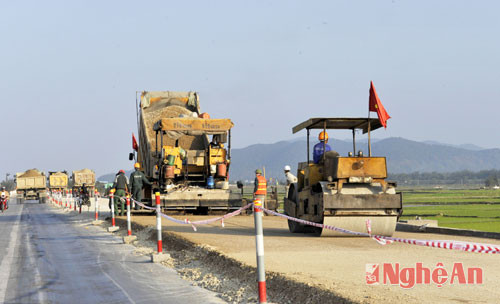 |
| Upgrading National Highway 1A bypass section around Vinh. Photo: Sy Minh |
During the war against the US, National Highway 1A played a decisive role in our nation's historic victory. After the country was reunified, the first major task of the transportation sector was to restore the Reunification Railway, and to open and upgrade National Highway 1A...
During the Doi Moi (Renovation) period, the Vietnamese government renovated National Highway 1A, passing through Huu Nghi Border Gate (Lang Son) to Nam Can district (Ca Mau), with a total length of 2,300 km and a 2-lane design. This is a crucial road in Vietnam, traversing 31 provinces and cities, connecting four major cities: Hanoi, Da Nang, Ho Chi Minh City, and Can Tho. Therefore, National Highway 1 is also known as the Trans-Vietnam Highway or the main artery. In addition, the government has invested in the second phase of the Ho Chi Minh Highway construction and built several sections of the North-South Expressway, located very close to National Highway 1A, also with the aim of ensuring seamless connectivity between the North and South.
The urgent need for upgrading and expansion.
Currently, the trans-Vietnam axis does not meet the requirements of the period of accelerated industrialization and modernization of the country, primarily regarding road infrastructure. Specifically: the Ho Chi Minh Highway has limited attractiveness due to its incompleteness (landslides during the rainy season) and the low level of socio-economic development along the route; the North-South Expressway will not be basically completed until 2030, therefore the traffic volume of the North-South route is concentrated on National Highway 1A. Meanwhile, this road is currently too narrow for actual needs, and is especially severely degraded in many places, causing congestion, posing many risks of traffic accidents, and frequently causing prolonged traffic jams that hinder socio-economic development. The selection of the National Highway 1A expansion project – a vital North-South artery – has become a pressing issue for implementing a breakthrough strategy to develop a comprehensive transportation infrastructure to serve the requirements of industrialization and modernization of the country, contributing to socio-economic development and ensuring national defense and security, as well as facilitating economic, cultural, and social connectivity and exchange between the North and South.
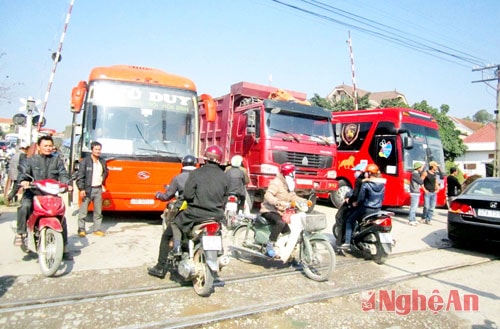 |
| Traffic congestion on National Highway 1A at the Yen Ly intersection (Dien Yen, Dien Chau). |
Therefore, in the context of the infrastructure construction sector facing numerous difficulties and challenges, in addition to State Budget and Government Bonds, the Government has allowed the Ministry of Transport to call for investment, mainly in the form of BOT (build-operate-transfer), to implement the project to expand National Highway 1A from 2 lanes to 4 lanes from Hanoi to Can Tho. The entire route is divided into 40 projects and sub-projects. Of these, 18 projects, totaling 608 km and with a total investment of VND 50,624 billion, are invested under the BOT model; 21 projects and sub-projects, totaling 696 km and with a total investment of VND 46,233 billion, are invested using State Budget and Government Bonds; and 1 project, totaling 49 km and with a total investment of VND 4,368 billion, is invested using ADB loan capital. Of that amount, the total budget allocated for land clearance along National Highway 1A is 7,350 billion VND. It is expected to be completed in 2016.
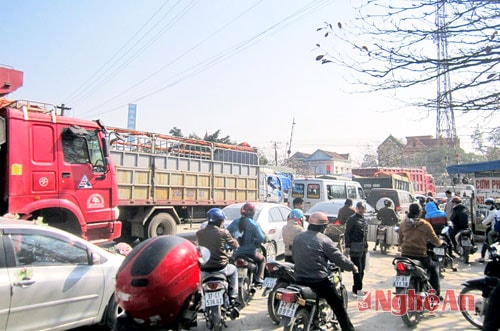 |
| Traffic congestion on National Highway 1A at the Yen Ly intersection (Dien Yen, Dien Chau). |
One of the key stages determining the progress of the National Highway 1A expansion project is land clearance. Recognizing the importance and large scale of the project in terms of investment value, impact, and socio-economic and development significance, the Government decided to establish a Steering Committee for Land Clearance. This is also the first project to establish a Steering Committee for Land Clearance from the central level down to the district level. The Central Steering Committee is chaired by Deputy Prime Minister Nguyen Xuan Phuc. The Government has assigned the People's Committees of the localities through which the highway passes to focus their efforts on leading and directing the land clearance work for the sections of the highway passing through their localities. The Government's guiding principle is that all levels, sectors, political and social organizations, and every citizen should consider this a top priority and the number one task.
In Nghe An province alone, the project to upgrade National Highway 1A, with a total main route length of 73.8 km passing through Hoang Mai town (14 km), Quynh Luu district (12.25 km), Dien Chau (28.05 km), Nghi Loc (13.96 km) and Vinh City (5.54 km), is divided into 6 projects and assigned to 5 investors for construction. Among them, the joint venture of Construction Corporation No. 4 and 319 is the investor for the 19.83 km section through Hoang Mai town and Quynh Luu district; PMU 85 is the investor for the 4.67 km section through Cau Giat town, Quynh Luu district; PMU 1 is the investor for the 18.9 km section through Quynh Luu and Dien Chau districts; and the Nghe An Department of Transport is the investor for the Dien Chau - Quan Hanh section (23.4 km) and the Quan Hanh - Quan Banh section (5.9 km), passing through Dien Chau, Nghi Loc districts and Vinh City. The Project Management Board for Traffic Safety - Ministry of Transport is the investor of the 1.1 km long railway overpass project passing through Vinh City. Like the rest of the country, for our province, the completion of this project is of great significance in expanding trade, developing the economy and society, attracting investment, and creating a foundation for effectively implementing Resolution 26 on Nghe An of the Politburo. At the same time, it contributes to reducing traffic accidents – a pressing issue in the province with many tragic accidents occurring on National Highway 1A. One of the main causes is the narrow, overloaded, and degraded road, while the daily traffic volume is too high.
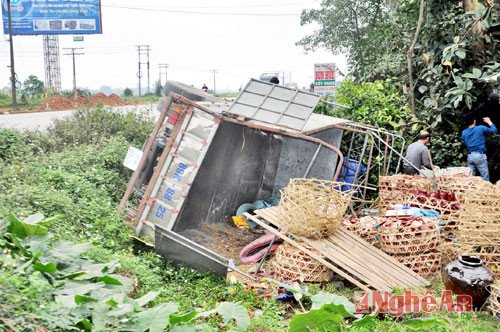 |
| Due to the narrow road, many accidents occur on National Highway 1A. |
To implement the National Highway 1A upgrade and expansion project, many households along both sides of the road (in Hoang Mai town, Quynh Luu, Dien Chau, Nghi Loc districts, and Vinh City) are subject to relocation, affected, or subject to resettlement for national benefit, with a total land clearance cost exceeding 1 trillion VND. Recognizing the crucial role of land clearance in the project's progress, following the issuance of Decision No. 04/2010/QD-UBND dated January 19, 2010, on compensation, support, and resettlement when the State acquires land in Nghe An province, the Provincial People's Committee continued with Official Letter No. 7418/UBND-CN on November 25, 2010, agreeing on compensation and support for land acquisition by the State to implement the National Highway 1A upgrade and expansion project through Nghe An province. Regarding resettlement, this is being implemented in accordance with Decision No. 10/2012/QD-UBND dated February 4, 2012, on amending and supplementing several provisions on compensation, support, and resettlement when the State recovers land in Nghe An province, issued together with Decision 04. The province's guiding principle is that all sectors, levels, and localities must uphold a high sense of responsibility, proactively advise on and apply appropriate policies, ensuring the principles of openness, democracy, transparency, fairness, and legality to create consensus in land clearance work on National Highway 1A section through Nghe An province.
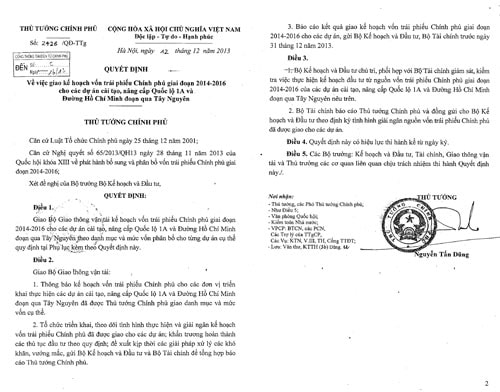 |
| The Prime Minister's decision to attract investment capital for upgrading and expanding National Highway 1A. |
In Official Document No. 7418/UBND-CN dated November 25, 2010, the People's Committee of Nghe An province agreed on the compensation and support for land acquisition by the State for the implementation of the Project to Upgrade and Expand National Highway 1A section through Nghe An province as follows: 1. For assets on land and land of households and individuals that have been cleared during the implementation of policies over the years or previous projects, the provisions of Clause 3, Article 5 and Clause 3, Article 15 of Decision 04/2010/QD-UBND dated January 19, 2010 of the Provincial People's Committee shall apply. 2. For households and individuals using land within the traffic corridor before the issuance of Decree 203/HĐBT dated December 21, 1982, by the Council of Ministers (now the Government), and whose land is now being reclaimed for road expansion according to the plan, compensation for land shall be provided in accordance with regulations. The determination of residential land and garden land eligible for compensation shall be carried out in accordance with Article 6 of Decision No. 04/2010/QĐ-UBND dated January 19, 2010, of the Provincial People's Committee. 3. For households that have been granted a Certificate of Land Use Rights by the competent authority, and the certificate clearly states that the land area within the traffic safety corridor is garden land, compensation and support for the reclaimed land area will be provided according to the regulations for garden land adjacent to residential land (within the same residential plot). 4. For households that have not yet been granted land use rights certificates, compensation plans shall be drawn up based on the origin of land use, land type, land area, and actual land use of the households, in accordance with the law. |
Text and photos:Reporters