

Turning straw into fertilizer saves trillions of dong.
Transforming rice straw into organic fertilizer.
Research and application of scientific and technological advancements in biotechnology to treat agricultural waste is considered the right direction, ensuring sustainable agricultural production in the context of fields being at risk of pollution and "poisoning" due to farmers' overuse of chemical fertilizers for crops.
Transforming rice straw into organic fertilizer.
According to statistics, in Vietnam
Therefore, to contribute to pollution reduction, the research topic is:"A microbial preparation (Fito-Biomix RR) for treating rice straw and a process for converting rice straw into organic fertilizer using this preparation."It has been applied and the Intellectual Property Office - Ministry of Science and Technology has granted patent number 956 for a useful solution to author Le Van Tri - General Director of Hanoi Biotechnology Joint Stock Company.
The topic includes numerous research and experimental projects successfully conducted in various locations, such as:
The process of converting rice straw into organic fertilizer is carried out through the following steps: fresh rice straw after harvest is piled up to a width of 2m, and every 30cm layer is watered with a solution of Fito-Biomix RR, supplemented with NPK and manure if available.
Next, compost the straw using plastic sheeting, tarpaulins, torn sacks, or mud to ensure a composting temperature of 45-50 degrees Celsius. After 10 to 15 days, check and turn the pile. This further breaks up the straw due to mechanical action, ensuring optimal moisture and temperature levels, creating favorable conditions for rapid and thorough decomposition.
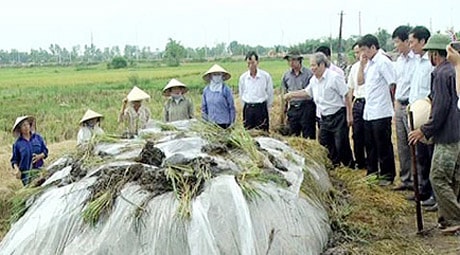
Farmers will not have to spend money on chemical fertilizers when they have organic fertilizers made from the straw and rice stalks after harvest.
During the composting process, if any areas are found to lack sufficient moisture, add more water to ensure complete decomposition of the material. After 25 to 30 days, the straw will decompose well into organic compost.
According to the author, the quality of straw after 30 days of composting with Fito-Biomix RR showed good decomposition, turning brown, with good growth of bacteria and mold, and approximately 80-85% of the straw had decomposed.
The straw compost pile is supplemented with microorganisms and nutrients. After 30 days, the total carbon content decreases, while the content of nitrogen, effective phosphorus, and the density of microorganisms all increase. After the composting process, the organic fertilizer from straw can be used immediately for the next crop or stored for use in the following crop.
Detoxifier for the fields
According to scientists, after each rice harvest, 1 hectare of rice will yield 6 tons of straw. Burning this straw would result in a loss of over 5.5 million VND, while the same amount of straw, if treated with biological products, would yield approximately 400 kg of organic fertilizer.
According to Master's degree holder Le Van Tri, the project leader, applying this organic fertilizer to rice and corn crops reduces the amount of chemical fertilizer by 20-30%, and increases crop yields by 10-15%, contributing to saving production costs and increasing economic value for farmers.
If all the post-harvest straw in the country (approximately 45 million tons) were processed, it would yield 20 million tons of organic fertilizer. Farmers would not have to spend money on chemical fertilizers (NPK) such as 200,000 tons of nitrogen, 190,000 tons of phosphorus, and 460,000 tons of potassium, thus saving nearly 11,000 billion VND.
Besides the economic benefits, using biological preparations like Fito-Biomix RR to process rice straw into organic compost for crops will utilize surplus post-harvest products to supplement organic fertilizer on-site, save costs, and encourage people not to burn rice straw after harvest, protecting the environment, increasing soil fertility, and improving crop yield and quality.
In the development of sustainable agriculture, organic fertilizers are considered a leading factor in improving product quality and soil fertility. Furthermore, the trend of small-scale livestock farming in households has almost disappeared, so the demand for organic fertilizers derived from straw is very high.
Currently, the research team has proposed a long-term plan to utilize excess straw and rice stalks after harvest to produce organic fertilizer, returning what crops have taken to the soil, improving soil quality, increasing humus content, improving soil porosity, stabilizing pH, making the soil better for rice cultivation, reducing pests and diseases, avoiding the use of harmful pesticides, and producing safe rice.
This initiative needs to be replicated in many localities across the country, combining research, technology transfer, and extensive public awareness campaigns to change people's habits of using chemical fertilizers in farming, utilizing readily available resources to both bring economic benefits and contribute to protecting the environment and agricultural ecosystem.
According to (NNVN) -HV