

Cultural identity in resettlement areas - A worry about its erosion.
(Baonghean)Six years after relocating to their new homes, and while stabilizing the economic lives of the people, preserving the cultural identity of the ethnic groups in the resettlement area is posing many concerns for the local authorities.
Having moved from the lakeside to resettlement areas, the people face numerous difficulties: insufficient and unstable land for production, unfamiliarity with new farming methods. Resettlement houses and infrastructure quickly deteriorate and become damaged. There are no local markets. To this day, the people's lives remain unstable because these difficulties have not improved much. When basic necessities like food and clothing are constant worries, the idea of preserving cultural values has become a distant one…
Visiting Thanh Son commune (Thanh Chuong district) to learn about the preservation and promotion of cultural identity among the people in the resettlement area, the Vice Chairman of the Commune People's Committee, Vi Trong Thuy, said: "The government has been concerned about encouraging people to preserve traditional cultural practices, but gradually many aspects are fading away. Only a few elderly people still use the written language, and the younger generation is reluctant to speak Thai and prefers to speak Vietnamese. Eating habits and clothing have also changed significantly. Now, people mainly wear ready-made clothes, and only a few houses in the whole commune still have looms."
"No one weaves brocade anymore, so the image of women in their vibrant dresses and skirts only remains in old memories. The traditional rice wine ceremony is rarely organized anymore. Those who held the ritual chants and incantations have gradually forgotten them. Love songs and call-and-response singing are only held during Tet (Lunar New Year). The culture of the Thai people has always been closely associated with rivers and streams, but here the rivers are dry and the streams are small, so the inspiration for the artists' creations is also dwindling."
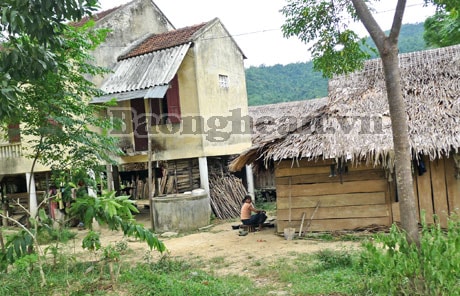
The "new style" stilt house is built with bricks and cement.
Haunted by a longing for the lost beauty of ancient culture, we expressed our desire to meet the rare artisans who represent the culture of an entire ethnic group. Comrade Thuy hesitated: “There is Mr. Lang Gia Tuyen in Cha Coong 1 village, who writes poems set to music in the style of ancient Thai melodies. Mr. Luong Van Tien in Kim Chuong village preserves musical instruments and songs. Regarding the gong culture of the Khmu people, there is Mr. Kham Chan in Thanh Hoa village. I'm just afraid they are busy going to the forest and streams, and won't be home.”
Asking the villagers for directions, we learned that Mr. Tuyen and Mr. Tien hadn't been seen writing poetry or playing the flute for a long time, preoccupied with making a living and lacking an audience. Mr. Tuyen, in particular, was probably saddened that his youngest son was one of the more than ten drug addicts in the village, so he had no interest in writing or reciting poetry. Upon arriving at their house, we found that, as Comrade Thuy had said, Mr. Tuyen and Mr. Tien were out collecting snails and in the forest, and it was unknown when they would return. We only found Mr. Kham Chan sitting under the stilt house, whittling bamboo.
He spoke haltingly, whether from being preoccupied with work or from shame and sadness, as he said, "The gongs are all sold. People from the lowlands came up to buy them for 10 million dong each, but we don't have rice to eat, so we had to sell the gongs." Seeing us inquire about the gongs, Mr. Moong Duc Thang, former Secretary and Head of Kim Da village (old), who lives right next to Mr. Kham Chan's house, invited us to his home to see the male gong that his family treasured. He said that out of the 81 households in the village (two-thirds of whom are Khmu people), only one pair of male and female gongs remains, used for playing during festivals, New Year celebrations, and the harvest season. The sound of the gong echoed for a moment before fading away, as if the stilt houses nestled under the coconut trees of Kim Da village appeared in his eyes for a fleeting moment before blurring...
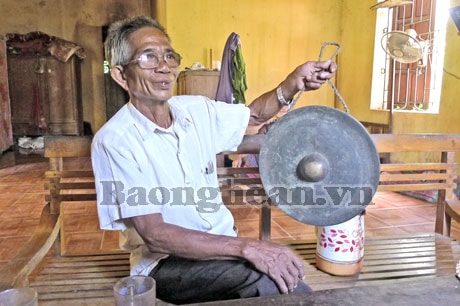
Mr. Moong Duc Thang with the only remaining male gong in Thanh Hoa village, Thanh Son commune, Thanh Chuong district.
Similarly, the O Du people in the Van Mon resettlement village, Nga My commune, Tuong Duong district, are experiencing cultural decline. As one of the oldest but smallest ethnic groups in Vietnam (over 600 people), the O Du are losing their cultural identity for various reasons. In this resettlement area, it is almost impossible to distinguish between the stilt houses of the O Du and those of the Thai people. (The traditional O Du stilt houses used to have two staircases, but now they only have one, similar to Thai houses).
Village head Lo Van Tinh shared his joys and sorrows: “From the reservoir to our new home, the O Du people learned many things from the Thai people, such as animal husbandry, trade, customs, and language. For example, before, the O Du people didn't have the custom of celebrating Tet (Lunar New Year), but now they do. We learned a lot, but we also lost a lot. Gradually, our customs and language have followed the Thai and Kinh people. Now, only about 5-6 people in the whole village speak the O Du language fluently, and they are all elderly people over 60 years old.” Younger people like Ms. Lo Thi Phuong, Mr. Tinh's daughter, only know and speak about 30-40% of the O Du vocabulary, even though she has attended language classes organized by Nghe An province in coordination with the Culture Department of Tuong Duong district. O Du children now mainly speak Thai, Khmu, and Vietnamese.
Regarding the decline of ancient customs and traditions, there are both positive and negative aspects. Taking the culture of rice wine as an example: According to Mr. Moong Duc Thang, Khmu weddings used to involve drinking 5 or 6 jars of rice wine, but now, following the Kinh tradition, they do it more quickly and simply, using only 1 or 2 jars for offerings and celebratory drinking, rather than the extravagant feasting and drinking that continues day after day. Thus, the gradual forgetting of the rice wine culture is due to the people themselves recognizing the need for change to achieve a more progressive and scientific life. When relocating to resettlement areas, contact and interaction with other ethnic groups inevitably lead to the adoption of new things and the discarding of old ones for a more progressive and developed life. This is the subjective reason why people are "changing" themselves, sometimes excessively, leading to the "loss" of their identity. The objective reason is that difficult economic conditions leave people without the time and inclination to preserve traditional activities (usually festivals and ceremonies).
According to Vi Trong Thuy, Vice Chairman of the People's Committee of Thanh Son commune: “The commune has 16 villages with 1,137 households and 4,902 people, including both Thai and Khmu ethnic groups, and the poverty rate is still as high as 86.79%. Unfamiliar with the farming methods here, the people only know how to grow cassava, but this is the third year now, so the soil is depleted and the cassava doesn't produce tubers. Acacia trees take 5 or 6 years to harvest, so many households who planted acacia have closed their doors and returned to their old hometowns to make a living. We coordinated with the leaders of Tuong Duong district to persuade the people to sign commitments and return to the resettlement area. They signed commitments, but so far, we haven't seen them return.”
Here, the difference between a poor household and a household that has escaped poverty is sometimes only 10,000 dong, but the subsidy system is completely different, so everyone volunteers to be a poor household rather than admitting to... escaping poverty! As long as there is hunger and poverty, where is the mental capacity to dance and sing? The difficult economic situation not only negatively impacts ancient customs and traditions but also affects cultural, educational, and social life in general. The free migration of people makes it difficult for authorities at all levels to control the situation, and children who follow their parents to earn a living have to drop out of school.
What solutions are there for the alarming erosion of ancient cultural identity in resettlement areas? This question constantly troubles village elder Kha Thien Phuc, former Chairman of Huu Duong commune, Tuong Duong district (formerly), now residing in Nhan Pa village, Ngoc Lam commune: “We elders are very worried that our ethnic culture will be lost when we come here, so we regularly campaign and educate the villagers, and instill in the youth and children the awareness to preserve our culture. The village requires women to always wear Thai skirts; singing and dancing are organized at village meetings. Preservation should begin with educating the younger generation. For example, schools in resettlement areas should have a regulation that students must wear their traditional ethnic costumes on Mondays. In addition, there should be programs to teach ethnic languages and music.”
Mr. Luong Quang Ba, Vice Chairman of Ngoc Lam commune, Thanh Chuong district, said: “We need an economic development strategy for the people in resettlement areas with many specific actions. We need practical solutions to support our people; poverty and hunger will only lead to the decline of culture. Furthermore, we need the support of all levels and sectors in preventing social vices and drug addiction in resettlement areas. Most addicts are young people, and protecting cultural values is not just the responsibility of the elderly.” Mr. Vi Trong Thuy, on the other hand, hoped that “the province and district would provide funding for resettlement communes to establish cultural and artistic clubs.”
We left behind the resettlement areas with their dilapidated stilt houses, a mixture of cement, concrete blocks, and mortar, and couldn't help but wonder: As they blended into the flow of time and the "Kinhization" process, would the Thai, Khmu, and O Du people we met lose their traditions, and in doing so, lose themselves? Of course, the authorities have a great responsibility in preserving the cultural values of these ethnic groups, especially since these people left their ancestral homeland at the urging of the government for the benefit of the community. But their own responsibility is also immense, because the culture of an ethnic group will truly disappear when that group lacks the self-awareness to preserve it.
Thanh Son - Hai Trieu