

Vinh during the scorched-earth resistance days.
(Baonghean) - Immediately following President Ho Chi Minh's call for nationwide resistance, the First Military Conference adopted the policy of "completely scorched earth in Hanoi and Vinh to uphold the fighting spirit of our people." Responding to this policy, with the spirit of "decisive victory," and wholeheartedly devoted to the revolution, the people of Vinh city did not hesitate to sacrifice their homes, property, and fields...
CPrior to the "scorched earth" resistance period, Vinh was a major city in Central Vietnam with three main centers: Truong Thi, Ben Thuy, and Vinh town. This is clearly evident in old photographs that are still preserved today, showing Vinh with its ancient cultural architecture, including the majestic Diec Pagoda and its three-arched gate, the Vo Mieu Temple, the Vinh Citadel, and the Confucius Temple and its disciples. Vinh was also once a major industrial and commercial city with the Truong Thi Railway Factory, Vinh Market, Vinh Railway Station, and the bustling Cua Tien Bridge. Furthermore, Vinh was a city with many modern buildings reflecting French architecture, such as the courthouse, the Commissioner's Residence, and old villas.
The memoirs of Ms. Thanh An, one of the people who lived in Vinh during that period, clearly record: Vinh had many large streets. The main street (now Quang Trung Street), also known as Marechal Foch Street, had a large train station. Along this street was house number 132, the house of Mr. Han Binh, the parents of the revolutionary martyrs Minh Khai and Quang Thai. Next to it was the RO shop specializing in opium, an embroidery shop, and the Vuong photo studio. Opposite was the police station, and then the Hotel dela gare.
One of the most beautiful villas in the city was that of Mrs. Ky Nam, often called Mrs. Hoang Lao, wife of Mr. Xuphanuvong, located opposite the national school. Adjacent to the school was the Nam Cao Xuan Duc Primary School. Across the street was a massive bank occupying an entire block. The Vinh market district was a bustling commercial area with Indian fabric shops, Western silk shops, department stores, and Chinese confectionery shops, the largest being Nhi Thien Duong. The Tran Dinh Quan photo studio, the Vuong Dinh Chau printing house, and Mrs. Phan Hap's fish sauce shop were located on the odd-numbered side of Marechal Foch street; this was also the headquarters of the French administration, which the locals often called the "Travoux pulic" office…
Now nearly 90 years old, Mrs. Ton Nu Thi Cuc (Truong Thi ward) still hasn't forgotten her childhood days in Vinh. She showed me old family photos, pictures no bigger than postage stamps, but revealing the opulence of a middle-class family back then. There were pictures of her, a high school student at Thuan An High School, wearing a white ao dai (traditional Vietnamese dress) with her hair clipped to one side. There were pictures of her mother, an elegant woman, wearing a gold necklace and black velvet shoes. There were also pictures of her sisters as children, dressed in Western-style suits, berets, and dresses… Her memories also included days riding on the back of her father's motorbike, a teacher at Cao Xuan Duc School, taking her all over the town to see the streets and neighborhoods. Her favorite time was going to the Majestic cinema to watch movies. She still remembers that after the August Revolution, despite the difficulties, the people were very enthusiastic: "At that time, people didn't greet each other normally on the street; instead, when they met, they would raise their hands in a firm handshake as a symbol of the working class, peasants, and soldiers."
The peaceful life didn't last long, as at the end of 1946, the French colonialists returned with their "quick victory" plan, and Hanoi and Vinh were two of their key targets. Losing Vinh to the French colonialists would mean losing a crucial strategic area, as the French could use Vinh as a springboard to expand the war throughout the province and the Thanh-Nghe-Tinh region. However, given the overwhelming power of the French colonialists, holding Vinh proved extremely difficult; it had to be sacrificed to prevent it from falling into French hands unscathed… With this resolve, immediately after the order to "completely scorch the earth in Hanoi and Vinh" was issued, the people of Vinh wholeheartedly responded.
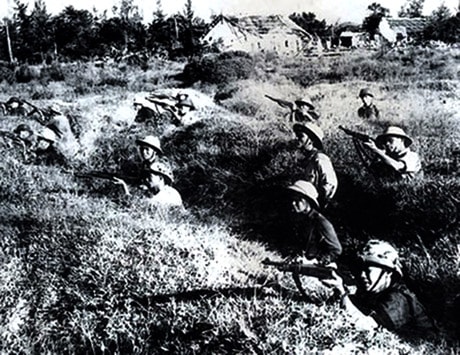 |
| Militia members of Ward 1 fought to defend Vinh City. |
In a short period of time, Vinh town, with many solid structures built after 1989 (when King Thanh Thai issued the decree establishing Vinh town) such as the Truong Thi railway factory, the power plant, the automobile repair factory, and various shops, was razed to the ground… Recalling that day, Mrs. Ton Nu Thi Cuc mused: “My family at that time was considered well-off, most notably the Vinh Delagare hotel chain and a property spanning thousands of square meters, including a villa and a row of five-room wooden houses in the area of building A3, Quang Trung today… That lifetime's accumulated wealth was wiped out in just one and a half days. My whole family of more than ten people moved to Hung Thang (Hung Nguyen) to carry out the evacuation order.”
After the August Revolution, the Minh Tam automobile factory owner's family had just finished building a spacious three-story house. Before they could even inaugurate it, the scorched-earth resistance order was issued, wiping out the entire famous wealthy neighborhood along with large businesses such as Ky Hai, Han Phuong, Bao Nguyen, Vinh Hung Tuong… Simultaneously with the scorched-earth policy, defensive preparations and the building of resistance forces were also intensified. To prevent surprise attacks and the mobility advantage of the French colonialists' motorized vehicles, the town's people and soldiers decided to destroy transportation routes, aiming to prevent motorized vehicles from operating. In addition, thousands of meters of railway tracks, dozens of automobiles, and locomotives were dismantled and thrown into the river to hinder enemy ships. Throughout the town, a series of trenches and fortifications were dug, and barricades were erected; a short stretch from Vinh town to Ben Thuy alone had 31 large mounds built…
Over five months of implementing the scorched-earth resistance strategy, workers in Vinh - Ben Thuy contributed 45,700 man-days of labor, demolishing 1,335 houses, including 31 multi-story buildings, 300 train carriages, and 12 locomotives. Nine officials and civilians were injured, and two soldiers of the National Guard were killed. Following directives, the main offices and factories were relocated to the Do Luong, Thanh Chuong, and Nghia Dan areas; the people either evacuated to rural areas or to areas where they lived with relatives. Significantly, the influx of urban residents greatly influenced the awareness, thinking, and lifestyle of the rural population. They learned to live more civilized lives, maintain better hygiene, and participate in collective activities.
In particular, thanks to the fact that each village had at least a few families who had moved from the city, literacy classes were widely developed. Therefore, in a short time, Nghe An eradicated illiteracy… These factors also led to the establishment of the “Golden Rice Farm” model – the first collective production model of Nghe An youth in Trieu Duong (Anh Son), and the “Soldiers' Inn” model established by the Women's National Salvation Association of the town along Highway 1 through Quynh Luu to assist soldiers and cadres on marches or missions…
After the Geneva Accords, the North proceeded with economic recovery and the initial stages of building socialism, and the people of Vinh town returned to rebuild their homeland. Under the guidance of the town's recovery committee, the people quickly reorganized and stabilized their lives; many new factories sprang up, and many shops were opened…
 |
| Comrade Do Muoi laid the foundation stone for the reconstruction of Vinh City on May 1, 1974. Photo: Archival material. |
Walking through the spacious city of Vinh today, reminiscing about the past fills me with even more pride and love for my city. A city that generations before me did not hesitate to sacrifice their property, blood, and even lives to protect, nurture, and build…
My Ha