

Exposing the chemicals used to "transform" rotten meat into fresh meat.
As Tet (Lunar New Year) approaches, authorities are discovering more and more cases of transporting and slaughtering dead pigs. How can meat from dead pigs be sold to consumers? Yet, unscrupulous traders still manage to do it.
By buying dead pigs at low prices, treating them with chemicals to make them look like fresh meat, and selling them at high prices, unscrupulous traders are making huge profits at the expense of consumers' health.
Massive amounts of meat from dead pigs are flooding the market.
On December 25, 2013, the economic police of Trang Bom district, during a surveillance operation, discovered that Mr. Than Thanh Binh's household in Tan Binh hamlet, Binh Minh commune, had purchased 10 dead pigs (equivalent to 400 kg) and brought them home to prepare for slaughter. Upon arrest, the internal organs of these dead pigs had already been removed.
Not only in Trang Bom district, but also in the neighboring Thong Nhat district, on January 11, 2014, Team 1 of the Market Management Department (under the Dong Nai Market Management Sub-department) discovered a pig slaughtering facility owned by Ms. Nguyen Thi Tuyet Ngoc (32 years old) in Vo Dong 2 hamlet, Gia Kiem commune, Thong Nhat district, "storing" over 600 kg of pork and offal marinated in many styrofoam containers emitting a foul odor.
Additionally, there were three dead pigs being slaughtered at the facility. Initially, Ms. Ngoc confessed that the facility purchased dead pigs from farms in the area daily at a flat price of 10,000 VND/kg, then slaughtered them and distributed the meat for consumption in Ho Chi Minh City and Binh Duong province.
Previously, on January 5th, Market Management Team No. 1, while inspecting a pig slaughtering facility in Phuc Nhac 1 hamlet, Gia Tan 3 commune, Thong Nhat district, owned by Mr. Nguyen Vuong (34 years old), discovered that the facility was slaughtering dead pigs. The amount of pigs and offal found totaled over 400kg. Mr. Vuong confessed to buying the sick and dead pigs from farmers, butchering them, and selling the meat to establishments that make "roasted pork."
In Ho Chi Minh City, in 2013 alone, the amount of "rotten meat" entering the city was so large that the Thu Duc Animal Quarantine Station, in coordination with the Rach Chiec Traffic Police Team, detected nearly 300 cases of illegal transportation and trading of animals and animal products.
In particular, many cases involved the business and transportation of spoiled, foul-smelling animal products. For example, on December 24, 2013, the station, in coordination with the Rach Chiec Traffic Police Team, discovered a 16-seater tourist bus driven by Mr. Pham Quoc Huy (District 8, Ho Chi Minh City) transporting dead pork from Trang Bom, Dong Nai to Ho Chi Minh City for consumption.
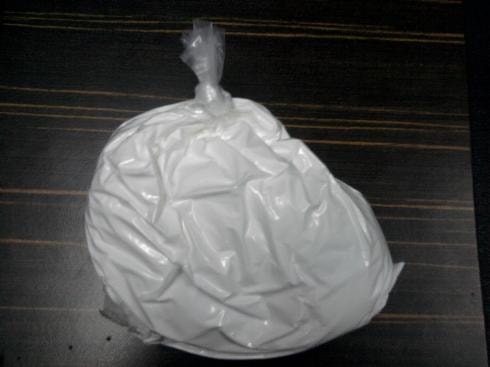 |
| Powder for bleaching rotten meat to make it look fresh (25,000 VND/kg) |
The amount of dead pork was determined to be 550 kg, contained in eight sacks on the floor of the vehicle and without a quarantine certificate. This was also the third time in 2013 that the station had detected Mr. Huy transporting rotten pork from Trang Bom to Ho Chi Minh City for consumption.
Following the guidance of a local veterinary officer, we had the opportunity to contact Mrs. V, the owner of an illegal pig slaughtering facility (now defunct) located in Binh Minh commune, Trang Bom district, Dong Nai province.
Ms. V revealed that to make a substantial profit from illegal slaughtering, they have to buy up sick and dead pigs from local farmers in small quantities. While the price of live pigs is 47,000 VND/kg, sick pigs are only one-third of that, and dead pigs are even cheaper, at only 8,000-10,000 VND/kg. However, the meat from dead pigs is usually bluish-purple, not fresh and red like live pork. So, how do they sell this "spoiled meat"?
Ms. V revealed her secret: “After bringing the dead pig home, the first thing to do is remove all the internal organs, then cut it into pieces and soak it in a powder similar to tapioca starch, which is odorless. According to experience, if the pig has been dead for one day, soak 100 kg of meat in this powder. If the pig has been dead for two days or more, use a stronger mixture, sometimes 2-3 kg of powder for 100 kg of meat. Thanks to the effect of this powder, even if the meat is spoiled, it won't smell bad. The meat will still look fresh and bright. The processed meat can then be sold to local markets and meat floss production facilities.”
According to Mr. Nguyen Trung Thanh, Deputy Head of the Veterinary Station of Trang Bom District, there are currently 24 licensed slaughterhouses in the district, of which 5 are managed by the province and 19 by the district. In addition, there are many other unlicensed slaughterhouses that cannot be fully identified.
"These are family-run slaughterhouses with a capacity of around a dozen pigs or less. They usually buy sick or dead pigs, slaughter them, then soak them in chemicals before selling them on the market. When caught, they claim they sell them to crocodile farms (!?)", Mr. Thanh said. On the other hand, due to insufficient evidence of selling meat from dead pigs on the market, authorities can only fine these illegal slaughterhouses a few million dong and that's it!
List of chemicals used to "clean" rotten meat.
Posing as a trader needing to buy a white powder to treat rotten meat, we went to the Kim Bien chemical market. A staff member at Xuyen's stall said it was "sulfur" (SO2). When I questioned why SO2 was a gas, she snapped, "I told you it's sulfur, people buy it all the time, if you don't want it, then don't. This is powder for soaking and washing spoiled meat, priced at 25,000 VND/kg. And I don't know where it comes from!"
According to some people knowledgeable about chemicals, this powder is likely sodium sulfite (Na2SO3). On the market, it's sold in 50kg bags labeled in Chinese. Stall owners repackage it into 1kg nylon bags for retail sale to customers. "Customers here are familiar with it; some buy a hundred kilograms, and sales are even higher during the period leading up to Tet (Lunar New Year). This powder is odorless, easy to use, and doesn't seem toxic when ingested," said a chemical seller at Kim Bien market.
Meanwhile, Dr. Phan The Dong, former Head of the Food Technology Department at the Ho Chi Minh City University of Agriculture and Forestry, stated that there are three compounds with similar properties: Na2SO3 (sodium sulfite); NaHSO3 (sodium bisulfite); and Na2S2O5 (sodium metabisulfite). All three have similar effects: when soaked in water, they release SO2 gas. SO2 gas acts as a cleaning agent, removing the foul odor from food.
"Currently, I'm not sure if these substances are on the Ministry of Health's list of permitted substances. I only know that they have been used in food, specifically NaHSO3 (code E222) and Na2S2O5 (code E223). (The E code is the EU code for food additives). However, the acceptable dose for the body is 0.7 mg/kg of body weight. If used in larger quantities, there is only a risk of allergic reactions in sensitive individuals, and it is especially harmful to people with asthma," said Dr. Dong.
Dr. Dong further explained that the aforementioned chemicals have little or no ability to kill bacteria or the toxins they produce. They can only bleach the color and remove the odor of rotten meat to make it look like fresh meat.
Even when treated with chemicals, rotten meat is bland and mushy. However, by adding flavorings, colorings, borax, and spices, the processed rotten meat can still look appealing and smell good, deceiving consumers. But a discerning eye will notice the difference compared to fresh meat. Remember, cooking rotten meat that has been treated with chemicals will not kill all pathogens but carries a high risk of poisoning.
According to NNVN