
Which summer is right for you?
Unlike urban children, who enjoy more comfortable lives, impoverished children in the mountainous region of Ky Son create their own simple joys during the sunny summer days. Many of them struggle to make a living, helping their families earn money to buy books and prepare for the new school year…
(Baonghean)Unlike urban children, who enjoy more comfortable lives, impoverished children in the mountainous region of Ky Son create their own simple joys during the sunny summer days. Many of them struggle to make a living, helping their families earn money to buy books and prepare for the new school year…
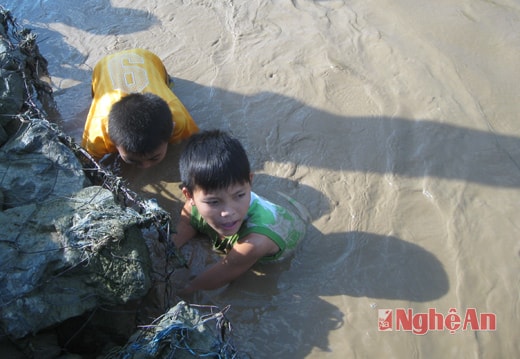 |
| Dive into the river to catch fish. |
Ha Quoc Phong (from Muong Tip commune, Ky Son district), currently studying at the district's Ethnic Minority Boarding Secondary School, happily shared: "During summer vacation, I go fishing in the streams with my dad or trap animals in the forest. Eating food that I've caught myself is truly wonderful." Similarly, Oc Van Cong from La Ngan village, Chieu Luu commune, also traps rats for his family's food. This is their daily routine and a source of joy for these mountain children during the summer.
For most children in the highlands, the joy of summer is being able to freely swim in waterfalls and streams, and dive underwater. Even though they know it's unsafe, they have nowhere else to play. Another joy that these children long for is going to the border market. Seeing them walking barefoot on the rocky road, their heads covered in the sun, their mouths chattering to their mothers, shows just how excited and happy they are. At the market, they get to admire the many kinds of colorful traditional clothing, watch people buying and selling... while their mothers are busy selling their goods. Only when the sun is directly overhead do their mothers buy them a few fried cakes or a bag of popcorn, or, if they're lucky, some sweet soup or ice cream. "The ice cream is so small, I only dare to suck on it; three bites and it's gone. Even if we had money at home, nobody would sell it," explained Loong Y Man, a little girl from Muong Tip commune, who accompanied her mother to the border market.
Witnessing firsthand the simple joys of mountain children, we couldn't help but feel sorrow for the hardships they endure. Despite their young age, they don't shy away from any work, such as carrying baskets and walking dozens of kilometers into the deep forest to chop firewood, pick vegetables, and gather bamboo shoots to sell and earn extra income for their families. Vu Y Phua, from Tong Khu village, Na Ngoi commune, shared: “I help my parents clear land, plant rice and corn. Every day I wake up at dawn, pack my lunch, and go to the fields until sunset. I'm exhausted. I feel so sorry for my parents.”
Along the scorching road, I arrived in Nam Can commune – a border commune bordering Laos – a place that felt like a blazing inferno. I encountered children in tattered clothes playing in the sun by the roadside, and their older siblings carrying water home. Their faces were smudged with dirt, their blonde hair matted. Their cracked, bare feet hopping on the gravel road sent a chill down my spine. The wooden houses were silent, their doors locked and bolted. This season, the villagers spend more time in the fields than at home. Only a few sisters from one house in Thach Thanh village were pounding rice. It was hard work. The older sister, Quy, was in 8th grade but looked like a primary school student. Seeing a stranger taking pictures, the children looked at each other and giggled, but didn't forget to keep pedaling the mortar. Quy said, "Mom, Dad, and my brothers are in the fields. I look after the house, take care of five younger siblings, and pound rice. At mealtime, I fetch water to cook. In the evening, Mom brings back vegetables she's picked from the forest to cook." When asked if she bathed the children, Quy shook her head, "They bathe themselves in the water pipes flowing down from the stream." After pounding the rice, the task of sifting out the husks and picking out the grains was her responsibility, while Quy's younger siblings rushed to the water pipes, leaning their heads against them to let the water fill their mouths, faces, and bodies.
Down towards Muong Xen town, the cliffs offered shade from the sun, but the hot, dry Lao wind still stifled the skin. Below, the Nam Mo River, now a shallow stream (due to a dam built by the hydroelectric power plant in Ta Ca commune), was teeming with people panning for gold. Vi Chien Thang, from Hoa Son village, Ta Ca commune, hadn't finished secondary school, but his experience in gold panning began at the age of 10: “When I was little, I helped my parents, and now I’m used to it. When they go to the fields, I go alone. In the summer, the water is low, making it easier to work than in the rainy season, so we have to take advantage of it. Sometimes we work all night.” Around him, many children even younger than Thang followed their parents to the river to pan for gold. They pumped water, tossed gravel, and ran back and forth carrying things like real laborers. It seemed their childhoods had been swept away by the muddy waters of this river.
When will children in the highlands finally escape the worries of providing for their families and experience the true taste of childhood summer?
Mac Khue