

Crop failure in the spring season.
(Baonghean) - Lush green cornfields with no ears or no kernels, peanut fields with few kernels and shriveled seeds are common occurrences in agricultural areas during this year's spring crop production. While the spring rice crop is considered to have the highest yield ever, many other crops in the region have suffered losses due to droughts during crucial growth periods.
Seedless corn
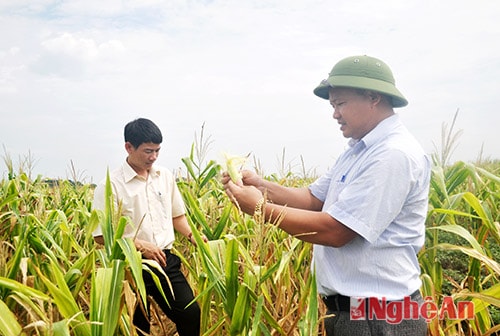 |
| Corn without kernels in Cat Van commune (Thanh Chuong district). |
Bong Khe commune, Con Cuong district, has agricultural land primarily consisting of arable land along the Lam River. It also has the largest corn cultivation area in the district. This spring, Bong Khe planted 170 hectares of corn. Due to the hot weather combined with strong winds from Laos, 157 hectares of corn (mainly the NK4300 hybrid variety) suffered from dried tassels, preventing pollination and resulting in kernelless ears. Mr. and Mrs. Tran Van Tuan from Vinh Hoan village said: "Our family has 8 sao (approximately 0.8 hectares) of spring corn. In previous years, we harvested 3-4 tons, but this season we couldn't harvest a single kernel. The corn plants were green and healthy, with uniform ears, but the tassels dried during the prolonged hot weather, leaving no kernels when peeled. We heard that TH Milk Company was buying corn stalks from farmers to use as feed for dairy cows at a price of 800,000 VND per ton, but the company hasn't come to buy them yet, so we had to cut down the corn stalks and feed them to our buffaloes." Mr. Tuan's family's livelihood mainly depends on 8 acres of arable land; they have no land for rice cultivation, and this spring-summer corn crop was completely lost, greatly impacting the family's economy.
Mr. Nguyen Van Tan, head of Vinh Hoan village, expressed his concern: "This spring, the whole village planted nearly 50 hectares of corn, but almost 36 hectares withered and died, resulting in a total loss. There's no other way, so we contacted TH Milk Company to buy the corn from the villagers, because our family's buffaloes and cows can't eat it all. However, to date, TH Milk Company hasn't announced any purchase, and the villagers are anxious because the longer we wait in this hot weather, the more the corn will dry out." This spring-summer season, Con Cuong district planted 915 hectares of corn in the communes of Bong Khe, the town center, Binh Chuan, Thach Ngan, Cam Lam, Don Phuc, Yen Khe… with Bong Khe commune having the most, nearly 170 hectares. However, only the corn in Bong Khe commune was damaged by the heat; the remaining communes have already finished harvesting, and the corn yield is not lower than the previous season. Therefore, because the spring corn planting schedule in Bong Khe commune is later than in other localities, the corn tassels late, leading to the aforementioned consequences.
Similarly, in the vast, all-encompassing floodplain of Cat Van commune (Thanh Chuong district), corn fields stretch endlessly, but the ears are stunted, crooked, and almost devoid of kernels. Out of 140 hectares of corn in the commune, almost 70% were completely destroyed. According to Mr. Hoang Dinh Truong, Vice Chairman of the Commune People's Committee: This year, prolonged heavy rains and floods delayed the planting of winter corn until mid-October, and spring corn planting was delayed until the end of February, later than in previous years. Initially, the plants developed well, but from the beginning of May, a severe heatwave lasting nearly a month, right during the ear formation period, severely affected corn yields. The corn tasseled but could not be pollinated, resulting in most areas having no ears or, if any, no kernels. Normally, the yield of field corn ranges from 2.5 to 2.7 quintals per sao (approximately 1000 square meters). However, currently, the commune is directing the harvesting to use the stalks and leaves as animal feed, and is accelerating the land preparation and planting of summer-autumn crops according to the seasonal schedule.
According to Mr. Le Dinh Thanh, Head of the District's Agriculture Department: Thanh Chuong district has 2,000 hectares of spring corn, and according to reports from the communes, over 1,400 hectares suffered damage of 70% or more. From May 5th to May 25th, there was no rain in the district, and the prolonged heatwave, with temperatures reaching 41-42°C on some days, greatly affected spring crops, especially corn, peanuts, and some vegetables. About one-third of the corn planted in early February avoided damage because the plants had already formed ears before the drought hit. The remaining two-thirds, planted from mid-February onwards, were completely lost due to the late harvest of winter crops.
Peanut yield has decreased.
While Nghi Loc district experienced a bumper corn crop this spring thanks to early planting, many peanut fields throughout the district suffered severe damage due to drought. Mr. Nguyen Xuan Son's family (Hamlet 1, Nghi Thach commune) has 4 sao (approximately 0.4 hectares) of land, with 2 sao planted with peanuts just before the Lunar New Year. In previous years, peanut yields reached 1.5 quintals per sao, but this spring, even the best fields yielded less than 1.2 quintals per sao. "One sao of peanuts on the high mounds only yielded just over 70 kg due to the severe drought. The drought hit right during the peanut flowering period; every plant had few tubers, and the peanuts weren't firm or beautiful," Mr. Son said. Nghi Thach commune has 210 hectares of peanuts, of which about 40% died from the drought since the beginning of May. Farmers have begun harvesting due to the dead plants, with yields only reaching 60-70 kg per sao.
The remaining areas, located in deeper soil with better moisture, still yielded 1.2-1.4 quintals per sao (approximately 1000 square meters). Mr. Dang Ba Huong, Vice Chairman of the People's Committee of the commune, said: "In the near future, the commune plans to convert about 30-40% of the peanut growing area in high-lying, drought-prone land to corn cultivation." This year's spring crop was considered a harsh production season for peanuts. The beginning of the season was overcast, followed by a prolonged period of intense heat at the end, especially in mid-May when the peanut plants in Nghi Loc were forming kernels. This caused widespread premature death of peanuts, forcing farmers to sadly harvest about 1,000 hectares of immature peanuts.
According to Mr. Nguyen Duc Tho, Head of the District's Agriculture Department, approximately 2,000 out of 3,700 hectares of peanuts in the district experienced a 30-40% yield reduction, while the remaining 20-30% decreased compared to last year's spring crop, yielding around 21-22 quintals/hectare (compared to 25 quintals/hectare in the 2013 spring crop). Only two communes in Nghi Loc district, Nghi Dien and Nghi Yen, did not have peanut crops. Every year, spring peanuts are sown a week before or after the beginning of spring. This year, due to favorable weather conditions, about 70% of the peanut crop was sown between January 20th and February 4th. However, throughout the entire growing season there was no rain, especially from early April to May. While in previous years there were usually thunderstorms favorable for peanut flowering and pod formation, this year the prolonged heatwave, with temperatures frequently reaching 38-40°C, occurred while the peanut plants were in the period of accumulating nutrients in the seeds, which determines yield. The peanut plants withered prematurely, especially in the semi-mountainous communes of Nghi Van, Nghi Lam, Nghi Kieu… Although the percentage of tubers was still sufficient, the percentage of kernels was low, the kernels were small, and not plump. “Combating drought in the cultivated areas is currently very difficult. The peanut growing area is entirely dependent on rainwater; there are no irrigation systems. In the district's current solutions, we can only try to arrange the planting schedule earlier, cover the peanuts with plastic sheeting, and in higher areas, switch to growing corn and beans,” Mr. Tho shared.
This spring, the entire province has 5,700 hectares of corn affected by drought, mainly in the floodplains of Anh Son, Thanh Chuong, and Tan Ky districts, with over 4,000 hectares losing more than 70% of their yield; 4,200 hectares of peanuts and vegetables were also damaged, with 2,200 hectares losing more than 70% of their yield. The cause is believed to be the prolonged and early onset of drought. Meanwhile, in some localities, due to the late harvesting of winter crops, the spring planting was delayed, especially for corn in floodplains. Currently, to support farmers, the Department of Agriculture is working with localities to conduct initial assessments and compile data to prepare a report for the Provincial People's Committee to announce drought damage and provide assistance to the people. However, in the long term, necessary solutions are needed. According to Mr. Nguyen Van Lap, Deputy Director of the Department of Agriculture and Rural Development, in the current context of climate change, it is necessary to review the weather and hydrological conditions to arrange a more reasonable planting schedule in different crop-growing areas.
In fact, despite the drought, some localities in Dien Chau still had a good peanut harvest thanks to early planting. This is more difficult to achieve in lowland areas, but to overcome this, farmers need to speed up the harvesting of winter crops and urgently plant spring corn in accordance with the current summer-autumn production principle of "harvesting and immediately preparing the land; one field may be being harvested while another is already being prepared and planted." At the same time, consideration should be given to changing the corn variety structure to be more rational, towards using short-day varieties, even if the yield is not as high. Currently, we are using high-yield, intensively cultivated corn varieties with a growth period of up to 125 days. Given the unpredictable weather conditions we are experiencing now, safety should be prioritized over yield, using varieties with a shorter growth period of around 110 days to minimize losses if the drought arrives early and is as severe as this year.
Phu Huong - Xuan Hoang