

Common problems with motorcycle mechanical brakes.
What happens if you apply the brakes to bring the car to an emergency stop, but the car continues to move forward?
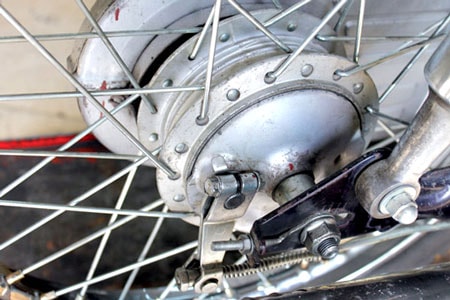 |
| Early detection of drum brake malfunctions will help keep you safer while driving. |
Currently, drum brakes (also known as drum or shoe brakes) that use a pivot pin on the same side with equal force on both brake pads are still widely used on the front and rear wheels of many vehicles, from entry-level to mid-range models, due to their advantages of being inexpensive, highly reliable, and providing good protection against dust and dirt. However, they also have several disadvantages, such as low braking force, high braking force required, and if not regularly cleaned, they can easily lead to rust, rapid wear, and scratches on the working surface of the brake drum, or even cause brake slippage.
Signs of damage
Brake failure: This is when the driver presses the brake pedal very hard but the vehicle slows down very slowly or not at all. The main cause of this is that the brake pads are excessively worn but have not been adjusted or have reached their maximum adjustment limit. Additionally, worn-out brake pads or grease buildup on the brake surfaces can also cause this problem.
Brake noise: Most noises coming from drum brakes need to be inspected and repaired immediately. Some causes of brake noise include: worn brake pads causing slippage when braking, sand or water getting into the brake pads, worn cam shaft, and scratched working surface of the brake drum (hub).
Heavy braking: This phenomenon mainly occurs in front drum brakes due to dry brake cables and cam shafts.
Brake binding: This is when the brake pads do not separate from the brake drum surface after releasing the brake. The cause may be uneven wear or lack of lubrication in the brake drum, a weak brake return spring, deep grooves on the working surface of the brake drum, or excessively worn brake pads. When the brake is applied, the brake drum rotates 90 degrees, preventing it from returning to its original position. Additionally, leaving the car overnight after a recent wash or after driving in the rain can easily lead to brake binding, causing the brake pads to seize.
Common types of failures
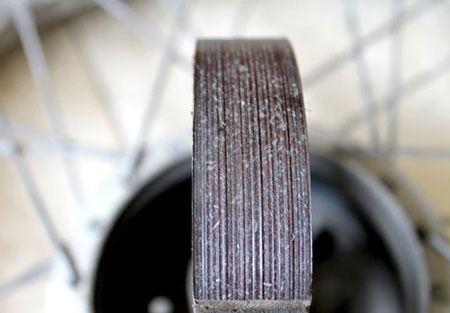 |
| Brake pads will lose grip when they wear unevenly, causing the brake drum surface to wear into grooves. |
Brake pad wear is a natural occurrence during use, but if the wear is rapid or uneven, it may be due to poor quality brake pads or scratches on the brake drum surface.
Brake pads become dull due to the user's habit of frequently applying the brakes, leading to overheating, hardening of the friction surface (pad), and reduced grip. This phenomenon is also common with brake pads that have been used for too long, affected by usage habits and the environment, but have not yet worn down to the point where replacement is necessary.
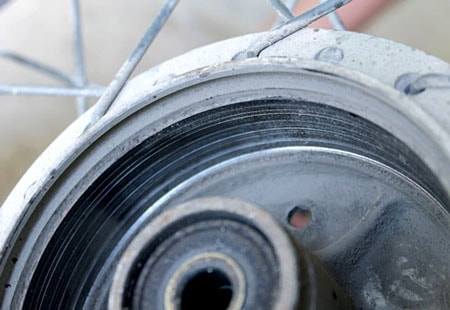 |
| When the brake drum surface has worn down into deep grooves, the only way to fix it is to re-press it. |
Grooved brake pads are a common problem when users replace them with low-quality pads. These types of pads often lack uniform hardness across the pad, with some areas being too hard and others too soft – a result of using the wrong materials and manufacturing technology. The consequence of using low-quality pads is that the working surface of the brake drum wears down into grooves; if the grooves are too deep, new pads must be pressed on rather than simply resurfacing to fix the problem.
Brake pads may become detached or cracked. This type of failure is uncommon but very dangerous when driving on busy city streets or highways. When brake pads detach or crack, it can easily lead to brake seizure, causing the wheel to suddenly lock up, and the driver will have almost no time to react, potentially leading to a fall.
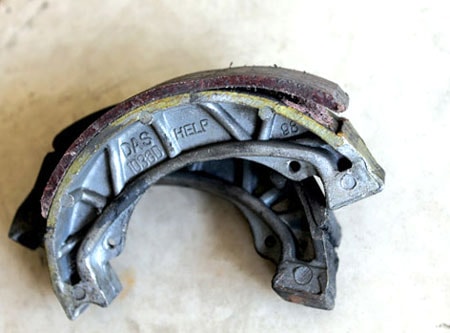 |
| Brake pad detachment is a common problem with low-quality brake pads. |
Instructions for use and repair
- Clean the vehicle regularly and after using it in muddy, dusty, or sandy road conditions.
- Regularly and periodically lubricate the drive joints and brake cables to ensure the brakes always operate smoothly.
- Exercise caution when gluing the PCB, as the quality of the glue application depends heavily on the quality of the PCB, the adhesive, the pressure applied, and the skill of the person doing the gluing.
- Get replacements and repairs done at reputable motorcycle centers with a large customer base and appropriate warranty policies.
According to baogiaothongvantai