

Overloaded and oversized vehicles are destroying the fuel supply routes.
(Baonghean)The supply route connecting National Highway 48 with National Highway 1A (NH1) is approximately 40 km long, running through Quynh Xuan ward (Hoang Mai town) and the communes of Quynh Tan, Quynh Thang, and Tan Thang (Quynh Luu district). This road is extremely important for trade and connecting the coastal region with the midland and mountainous areas of the province. However, this road is being severely damaged by overloaded and oversized vehicles.
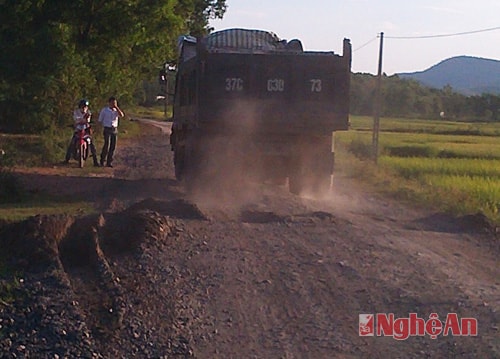 |
| Overloaded vehicles are traveling on the fuel supply road (the section passing through Quynh Thang commune, Quynh Luu district). |
To transport raw materials and minerals from mountainous districts like Quy Chau, Quy Hop, and Nghia Dan down to Hoang Mai town and other northern provinces, following the National Highway 48 - National Highway 1A route would take trucks a considerable amount of time, not to mention the constant monitoring and presence of traffic police. Therefore, once the raw material route was completed and put into use, drivers chose to take a shortcut, shortening the journey by turning onto this route. Previously, because the Khe Doc and Dap Tran bridges on the raw material route had low load capacity, only light trucks dared to pass through. But at the beginning of this year, the province invested in and renovated these bridges, increasing their load capacity, so a series of "super-heavy" trucks carrying raw materials and minerals have chosen to use them instead.
Mr. Hoang Van H, a resident of Hamlet 2, Quynh Thang Commune, Quynh Luu District, expressed his frustration: “Since the new bridge was built, heavy trucks have been constantly passing through, causing us residents sleepless nights. The bridge is designed to withstand a load of 30 tons, but many trucks carrying stones are overloaded, exceeding that limit by many times, which will cause the bridge to deteriorate quickly.”
In a short period of time, the road used for transporting materials, specifically the section running through Quynh Thang and Tan Thang communes, has been completely stripped of its gravel and stones. Potholes and uneven surfaces are widespread, and the sides of the road have sunk deep into trenches. Numerous collisions and traffic accidents have occurred on this road since the beginning of the year.
Not only do trucks carrying minerals and materials travel from Que Phong, Quy Chau, Quy Hop, and Nghia Dan to the seaports and Hoang Mai town, but in Quynh Thang and Quynh Tan communes, there are also many quarries that supply raw materials to the Hoang Mai Cement Factory and construction materials throughout the province. Because the roads are deserted and there is no traffic police control, drivers freely load stones overflowing their trucks, scattering them everywhere with each pass. Unable to tolerate the dust and the damage the trucks inflict on the road, some residents in Hamlet 5, Quynh Thang commune, have placed stones haphazardly on the road. However, the drivers still disregard the warnings and allow their trucks to pass.
In Quynh Tan commune, the newly completed raw material road, put into use a few years ago, has severely deteriorated. The road surface is cracked and subsided, creating extremely dangerous potholes. Overloaded trucks carrying sugarcane, wood, gravel, and construction materials brazenly tear up this road day and night without encountering any obstacles. At the border between Quynh Xuan ward (Hoang Mai town) and Quynh Tan commune (Quynh Luu district), dozens of trucks carrying stone from the quarry of Ho Hoan Cau Co., Ltd. travel along the raw material road to reach National Highway 1A. These trucks carry overflowing loads of stone, spilling it everywhere and causing several people to slip and fall. Despite repeated complaints from residents of Quynh Tan commune, the company has yet to take any corrective measures.
A resident of Hamlet 5, Quynh Tan Commune, expressed his frustration: "Every truck has its cargo bed extended, carrying piles of sand, gravel, and rocks without tarpaulins to cover them, so the debris falls onto the road, posing a serious danger. It's bearable when it rains, but when it's sunny, the dust is overwhelming. Houses near the road have to keep their doors closed all day. Since the bridges were completed, the roads have been damaged by the trucks."
According to Mr. Bui Van Tien, Chairman of the People's Committee of Quynh Thang commune, Quynh Luu district, the raw material road running through Tan Thang commune, Quynh Thang district, was put into use in 2004. The road was designed for light trucks, around 13 tons or less. However, recently, with the completion of the Khe Doc bridge, heavy trucks have been taking advantage of this shortcut. “With the commune's authority, dealing with overloaded and oversized vehicles is very difficult and inadequate. Many times, seeing the vehicles causing dust and damaging the road, we have sent our staff to remind them to use National Highway 48, but they don't listen. We don't have the authority to fine them. In the near future, we will submit a proposal to the district and province to seek their opinion on building road pillars and strengthening the monitoring of oversized and overloaded vehicles on this route,” Mr. Tien added.
Explaining the daily damage to roads and bridges caused by overloaded trucks carrying stones from the company's quarry, Lieutenant Colonel Nguyen Canh Ly – Deputy Director of Song Da – Truong Son Joint Stock Company ( thuộc General Corporation for Economic Cooperation of Military Region 4) said: “Our company does not own trucks; these are trucks carrying stones for Hoang Mai Cement Factory. We only manage and are responsible within the quarry area; we are unaware of how overloaded the trucks are or what damage is being caused. In the communes of Quynh Thang, Quynh Chau, and Tan Thang, besides our quarry, there are several other quarries operating. The road damage is not only due to overloaded trucks but also because the road design is too weak and does not meet the current traffic demands.”
Regarding the issue of overloaded vehicles damaging the fuel supply roads in recent times, the Chairman of the People's Committee of Quynh Luu District, Mr. Le Duc Cuong, said: “This road was designed for moderate load capacity, but oversized and overloaded vehicles weighing from a few tens of tons to fifty or sixty tons are using it, causing rapid damage and deterioration. However, overloaded vehicles mainly operate at night, making it difficult for the district police to control and handle them. In the coming time, we will direct more rigorous monitoring and inspection on this road to minimize damage to roads and bridges.”
Luu Quynh