

A sustainable solution is needed.
(Baonghean) - The provincial National Assembly delegation, along with representatives from relevant provincial departments, recently conducted a monitoring visit on the implementation of poverty reduction policies and laws in Que Phong district. Through this monitoring, while the results of poverty reduction policies in the area have been quite good, some issues remain, requiring appropriate adjustments during the implementation process.
(Baonghean) - The provincial National Assembly delegation, along with representatives from relevant provincial departments, recently conducted a monitoring visit on the implementation of poverty reduction policies and laws in Que Phong district. Through this monitoring, while the results of poverty reduction policies in the area have been quite good, some issues remain, requiring appropriate adjustments during the implementation process.
Tri Le commune, one of the most disadvantaged border communes in Que Phong district (in 2010, 73% of households were still poor), has a fragmented terrain making trade and transportation very difficult. The commune has 33 hamlets, with over 400 households of the Mong ethnic group, accounting for a quarter of the population, living in 8 hamlets quite far from the center, making investment in transportation a challenging task. In recent years, thanks to the State's investment through programs and projects, Tri Le's socio-economic situation has improved significantly, with the poverty rate decreasing rapidly from 73% in 2010 to 57.7% in 2013. One of the models that has yielded high economic efficiency and is suitable for the climate and soil conditions is passion fruit cultivation.
Although only planted in 2011, the commune now has 24 hectares of passion fruit, yielding approximately 40 tons/ha, opening up new business opportunities for the people of Tri Le and Que Phong district. Currently, in addition to seeking export markets, a business has invested in building a passion fruit seedling nursery to provide seedlings and expand the planted area in the locality. Besides passion fruit, with the support of the government, new plant varieties such as Japonika rice, purebred rice, hybrid rice, vegetables, peanuts, hybrid corn, sugarcane, peaches, and livestock such as cattle and deer... have all been introduced for trial planting and breeding in Tri Le. Among these plant varieties, the cold-tolerant Japonika rice model, the clean vegetable model in Chieng village, and the sugarcane model in Minh Chau village... have initially shown effectiveness. Japonika rice yields reach 49 quintals/ha with good quality rice, and sugarcane yields reach 45 tons/ha with high sugar content, truly opening up a path for people to escape poverty.
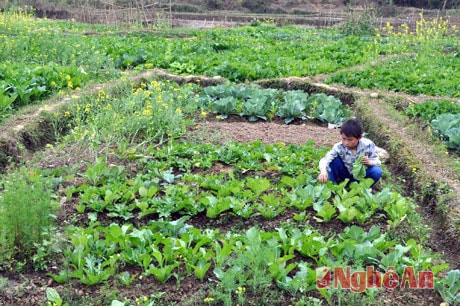 |
| A model for growing clean vegetables in Chieng village, Tri Le commune (Que Phong). |
Ms. Truong Thi Tuyet Mai, Vice Chairman of the People's Committee of Que Phong district, said: "Not only Tri Le but also other communes such as Que Son, Muong Ngoc, Tien Phong... with investment and support from the state and preferential loan capital, have formed many models of crop and livestock farming to alleviate poverty. Within 8 years (2006-2012), preferential credit capital for poor households in Que Phong has provided loans totaling over 239.7 billion VND to over 26,617 households, with an average loan of 15-19 million VND per household. Of this, loans under Resolution 30a amounted to 31.57 billion VND with 6,314 households receiving loans. Overall, the credit program for poor households has rapidly increased in both scale and quality, with the average loan amount continuously increasing from 4.3 million VND to 17 million VND per household." This capital has helped 11,980 poor households to buy more buffaloes and cows, fruit trees, and wood for building houses…
In addition, the implementation of housing support policies for poor households under Decision 167/2008/QD-TTg and support for vocational training, job creation, and labor export in the area has also achieved some encouraging results. Since its implementation, nearly 3,000 households have received 23.296 billion VND to build houses, and more than 50 vocational training classes have been opened for 1,620 students learning practical skills for rural areas such as motorbike repair, carpentry, and agricultural techniques; more than 726 workers have been introduced to work abroad. Besides loan capital, Que Phong has invested over 85.4 billion VND from national target programs to upgrade technical infrastructure at the commune and village levels, gradually changing the face of rural mountainous areas. On the other hand, from the production support fund for districts under Decree 30a, the district has invested over 30 billion VND in supporting projects related to seedlings, livestock breeds, and the construction of 25 production support models, some of which have been successful and are being further replicated…
It can be said that, thanks to state investment support, the poverty rate in Que Phong district has decreased rapidly, with an average annual reduction of 5% of poor households, equivalent to 700 households per year, which is a very encouraging result. However, surveys and monitoring in Que Phong have shown that the implementation of poverty reduction policies in the area still faces some difficulties and obstacles that need further adjustment.
That is, the inadequacy of resources. For example, passion fruit has proven to be one of the effective and suitable crops for Tri Le in particular and Que Phong in general. However, expanding the planted area is not easy. Besides finding a market for the product, the first step is to proactively secure a source of seedlings. Currently, passion fruit seedlings in the area are mainly imported from Taiwan, so not every person can afford them. A resident in Chieng village said that her family really wanted to plant passion fruit but couldn't because only poor households receive government support for seedlings. In reality, it's not just poor households with land that are eligible; only those with knowledge of cultivation are selected. Similarly, cold-resistant rice varieties like Japonika, or livestock like cattle and deer, are quite expensive, making it difficult for people to buy new varieties. Mr. Lo Xuan Phong, Secretary of the Party Committee of Tri Le commune, said: "To introduce passion fruit, rice, or sugarcane to the area, the commune must have a resolution and then organize trial runs for people to follow. Currently, to expand the area of passion fruit and rice in the commune, the government needs to have policies to support people, especially poor households, with seeds, technical guidance on care, and disease prevention for livestock."
In reality, the current loan limits for housing construction are too low. According to regulations, each household can only borrow approximately 5 million VND for housing construction with a repayment period of 5-7 years. With such a small loan amount and short repayment period, borrowers can barely afford to renovate their homes. By the time the loan term expires, the house is often dilapidated and in need of further repairs, thus failing to achieve the intended purpose and lacking sustainability.
The implementation of relief rice distribution and other preferential policies is currently too slow, affecting the stability of people's lives. According to a representative of the People's Committee of Que Son commune, the distribution of relief rice during lean seasons, natural disasters, storms, floods, and the Lunar New Year is currently too slow. Typically, it takes 1-2 months after the locality requests the rice for it to arrive. For example, in 2013, due to the impact of typhoons No. 9 and No. 10, people suffered from food shortages. The commune and district requested relief rice in late September and early October, but it wasn't until November, when people had finished harvesting and had new rice to eat, that the relief rice arrived, making it unsuitable for the needs of the people. Similarly, the policy of tuition fee exemption and reduction under Decree 49/CP for children of policy-beneficiary families and poor households is too slow, with families only receiving payment for the first semester at the end of the school year. In some families in Que Phong, the tuition fee exemption and reduction support only arrives after the children have finished school and started working, and the authorities notify the families to come and collect it, causing many people to wonder and question the process.
The final and most significant problem is the shortage of arable land and stable employment. For this reason, despite being assessed as a locality with a relatively rapid poverty reduction rate, Que Phong district also faces a high risk of re-poverty. Further investigation revealed that one of the reasons for Que Phong's rapid poverty reduction in recent years, even reaching 7.9% in some years, was the compensation received by residents of the three communes of Thong Thu, Dong Van, and Tien Phong for the hydroelectric project, leading to an increase in average income. However, now that the Hua Na hydroelectric project is completed, the shortage of arable land in the resettlement communes and some other communes is directly impacting sustainable poverty reduction. Ms. Truong Thi Tuyet Mai, Vice Chairman of the People's Committee of Que Phong District, outlined the solution: “Along with other solutions, one of the district's priorities is to focus all resources on investing in poor communes and poor households by leveraging investment from the central and provincial governments for infrastructure in communes under the Government's Program 135/CP and Program 30a. The immediate investment direction in these communes is to focus on projects that meet the essential needs of the people, ensuring conditions for economic development and stable living standards with the motto 'Do the difficult things first, the easy things later,' ensuring the goal of sustainable poverty reduction…”.
Nguyen Hai