

Mysteries in the world of sedans
With the strong growth of the automotive market, concepts such as sedans, SUVs, and coupes have become familiar. However, the nature, classification criteria, and categorization methods of these vehicle types, including sedans, are concepts that not everyone understands.
With the strong growth of the automotive market, concepts such as sedans, SUVs, and coupes have become familiar. However, the nature, classification criteria, and categorization methods of these vehicle types, including sedans, are concepts that not everyone understands.
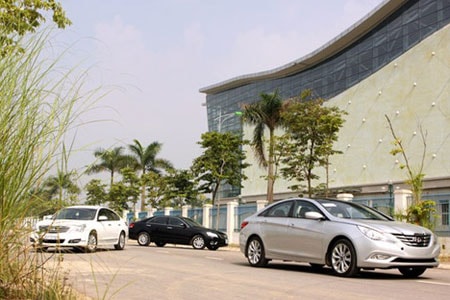 |
| The Nissan Teana, Toyota Camry, and Hyundai Sonata are three typical models in the premium mid-size sedan segment in the Vietnamese market - Photo: Bobi. |
Essentially, a sedan has a passenger compartment that is completely separate from the luggage compartment and engine compartment, usually with 4 or 5 seats and 4 doors. With the explosion of media, the concept of a sedan has also expanded, and many car manufacturers use this concept as a default way of defining a passenger car that offers comfort and smoothness.
Furthermore, the development and blending of designs among car manufacturers sometimes makes differentiating car models quite challenging. The criteria for classifying sedan models in general, and car segments in particular, are now quite diverse and vary to some extent depending on the specific market.
Generally, there are five basic criteria for differentiating sedan segments. These criteria include design, size, performance, features, and price. Performance, in particular, encompasses factors such as engine displacement and power output.
The equipment and features on a vehicle are the most relative factor, as they depend on the specific versions in different markets. However, this factor is primarily used to differentiate between the budget and luxury car segments, because the materials used in manufacturing, as well as the amenities in these segments, vary greatly in quality and, especially, in price.
While sedans may have slightly different names and classifications across markets like the US, UK, Europe, and Asia, they can essentially be divided into seven categories:
- Subcompact carsThis includes models such as the Toyota Vios/Yaris, Ford Fiesta, Hyundai Accent, etc. Most of these models also have a hatchback version - a 5-door hatchback.
- Mid-size sedan (compact car)This category includes typical models such as the Ford Focus, Toyota Altis, Kia Forte, Chevrolet Cruze, and Honda Civic. The defining criteria for this category are a wheelbase ranging from 4250 to 4500 mm and an engine displacement from 1.4 liters to 2.5 liters.
- Premium mid-size sedan (large family car/mid-size car)This includes models such as the Ford Mondeo, Toyota Camry, Honda Accord, and Hyundai Sonata. The criteria for this vehicle class are a wheelbase of approximately 4,700 to 4,900 mm, depending on the market, and typically a 6-cylinder engine with a displacement of 2.0 to 3.5 liters. However, each specific model may have multiple engine versions and equipment options depending on the market. For example, in the US market, the Toyota Camry has up to 6 different versions with varying options and prices, with engine displacements ranging from 2.5 liters to 3.5 liters.
- Full-size sedanThis segment includes typical models such as the Toyota Avalon, Ford Crown Victoria, and Chrysler 300C. A characteristic of this segment is that the vehicles are longer than 4,900 mm and usually have very spacious interiors.
- Compact executive car (mid-size luxury sedan)This segment includes models such as the BMW 3 Series, Audi A4, Mercedes C Class, Lexus IS, and Acura TSX. The criteria for this segment are similar size to the compact cars mentioned above, but with more powerful engines, typically featuring 4 to 8 cylinders. Interior features such as seats and steering wheels are upholstered in premium leather. Several safety and driver assistance technologies are also included in vehicles within this segment.
- Mid-size luxury sedan (executive car/mid-luxury car)The most noticeable examples are the BMW 5 Series, Audi A6, Mercedes E Class, and Jaguar XF. These models are characterized by a length of 4,900 mm or more, larger than premium mid-size sedans, and more powerful engines with capacities ranging from 2.5 to 5.0 liters and 6 to 8 cylinders. The equipment and features are all high-end. The right-hand seat in the rear is designed for maximum passenger comfort.
- Full-size luxury sedan/Grand saloonThis includes models such as the BMW 7 Series, Lexus LS, Mercedes S-Class, Audi A8, etc. The criteria are that the vehicles must be over 5 meters long, have 6 to 12 cylinders, and a displacement of 4 liters or more. The equipment uses very expensive materials, and the most advanced technologies from the manufacturers are incorporated into these models. In particular, the right-hand seat in the second row is usually luxuriously designed and allows control of most in-car functions, except for the driving function.
According to VnEconomy