

Lack of recreational spaces for students.
(Baonghean) - As the educational and training center of the North Central region and the whole country, Vinh City is home to 5 universities, 11 colleges, and many other vocational schools with over 80,000 students. Despite this, students in particular, and young people in Vinh City in general, are currently facing a severe lack of recreational spaces.
(Baonghean) - As the educational and training center of the North Central region and the whole country, Vinh City is home to 5 universities, 11 colleges, and many other vocational schools with over 80,000 students. Despite this, students in particular, and young people in Vinh City in general, are currently facing a severe lack of recreational spaces.
Bach Lieu Street, located in Ben Thuy Ward right next to Vinh University, is a prime real estate area, so almost all the land here is used to its full capacity for business. The main customers are students, with thousands of rented rooms in the surrounding area. For many years, students have known this street as the location of pawn shops, game arcades, motorbike rental shops, guesthouses, and bars. Even after searching extensively, you won't find any service or entertainment spot suitable for students.
Having moved from the mountainous district of Thanh Chuong to Vinh City to attend university three years ago, student Nguyen Dinh Duc has completely lost his habit of playing football in the afternoons. Duc confided that back home, he could play football and volleyball with his uncles, older brothers, and friends in the neighborhood every afternoon, but in the city, if he wanted to play football, he had to rent a field, even at a cheap price, at least 150-200 thousand dong per hour – a huge amount for students. Therefore, Duc and many other students have completely abandoned the habit of playing football and exercising. Their new habit is gathering around the school after classes to drink tea. “It’s also from these cups of tea that many students have started smoking cigarettes and pipe tobacco. Some others spend all their time in game arcades, forgetting about their classes and schedules,” Duc worried.
Currently, Vinh City has five universities: Vinh University, Vinh University of Technology and Education, Vinh Medical University, Ho Chi Minh City University of Industry, and Nghe An University of Economics (recently upgraded from Nghe An College of Economics and Technology), along with many other colleges, vocational colleges, and professional secondary schools. The general situation at these schools is a severe shortage of playgrounds for students to practice sports, play, and have fun after classes. The land allocated for sports and recreation is shrinking. Some schools that have built artificial turf fields rent them out, and some even have to take students to empty or barren land for physical education or national defense training. Dr. Nguyen Hong Minh, Rector of Vinh University of Technology and Education, stated that despite expansion compared to the past, the facilities for student sports still do not meet the needs. In the near future, the school will build two more artificial turf fields and complete the existing clay and concrete courts to provide recreational spaces for students after classes.
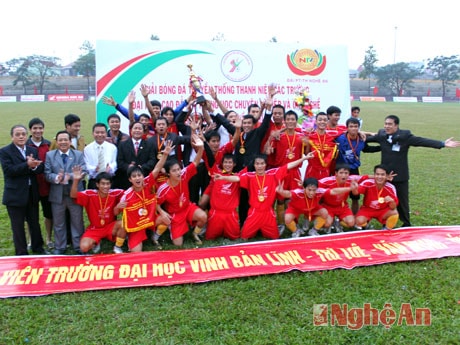 |
| Vinh University students win the University and College Football Tournament. |
Dr. Nguyen Anh Chuong, Secretary of the Youth Union of Vinh University, believes that student playgrounds should not be limited to football, volleyball, and badminton courts, but should also include clubs, talent-based groups, cultural and artistic competitions, sports activities, and scientific research. All of these are currently lacking in Vinh City. While approximately 60-70% of localities nationwide have established youth cultural centers, Vinh City completely lacks one. In other educational centers like Hanoi, Ho Chi Minh City, Da Nang, or Hue, students have many recreational options after classes at youth cultural centers. These are cultural and artistic clubs where students can develop their talents in singing, hosting, or sports like football, basketball, badminton, volunteer groups, and groups that train soft skills and communication skills. All these playgrounds are free and truly provide a healthy environment for young people to develop their strengths. However, in Vinh City, it's completely the opposite. To participate in arts activities, students have to wait for competitions or holidays; to play football or volleyball, they have to pay to rent a court; and to join soft skills training centers, they have to pay to attend classes.
An alarming trend in recent times is the increasing rate of juvenile delinquency in Vinh City, with many offenders being university, college, and vocational school students studying in Vinh City. Most recently, the Yen Thanh District Police arrested a university student in Vinh City for stealing telecommunications cables; the Thanh Chuong District Police arrested a vocational college student for buying and selling firecrackers; several students have been involved in drug-related cases; many have been arrested for theft, disturbing public order, organizing the use of methamphetamine; and many others have had to drop out of school due to involvement in gambling and illegal lottery schemes. Besides the students' own sense of responsibility, the lack of healthy recreational activities is also a contributing factor to this phenomenon.
The lack of healthy recreational activities for students in particular, and young people in general, has been a long-standing problem that has not received sufficient attention or resolution. It is thought that resolving this issue requires the decisive involvement of many agencies, departments, universities, and especially youth organizations and associations in the area. First, youth organizations and student associations need to bring together students from universities and colleges for joint activities and competitions in academics, scientific research, culture, arts, and sports. Provincial and city youth unions need to proactively understand the needs and preferences of students to create more recreational activities and attract them. Ward youth unions and neighborhood youth branches where students reside need to create conditions to meet the minimum needs of young people in general, and students in particular, and facilitate student gatherings in extracurricular activities. The city of Vinh needs to plan and build recreational areas for young people and students that are sustainable, well-directed, and aligned with the city's future development trends.
Nguyen Khoa