
We need to pay attention to the "output" aspect.
(Baonghean) - A few years ago, at a beauty pageant in Japan, when asked what she was most proud of about her country, one contestant confidently said: "It's the public restrooms." In the perception of many people in our country, mentioning restrooms seems to make them think of something unhygienic, indecent, and impolite.
(Baonghean) - A few years ago, at a beauty pageant in Japan, when asked what she was most proud of about her country, one contestant confidently said: "It's the public restrooms." In the perception of many people in our country, mentioning restrooms seems to make them think of something unhygienic, indecent, and impolite.
This is because in our country, there are no public sanitation facilities that meet hygiene and environmental standards, and no toilets have been built to the required standards and aesthetic appeal. Meanwhile, in many countries around the world, public sanitation facilities are one of the elements that reflect culture and civilization.
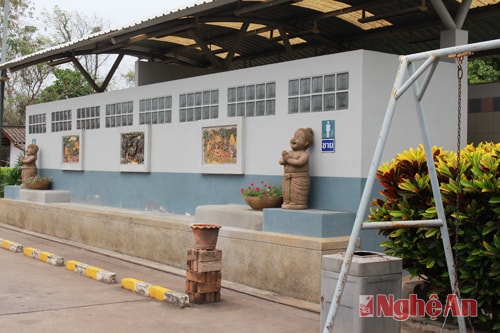 |
| Public restrooms within the premises of a gas station in Nong Khai province, Thailand. |
People live, work, and study with different personalities, psychological states, and emotions. Depending on the time, everyone experiences different "joys, anger, love, and hatred." But when it comes to "output," no normal person can claim to be able to control it. Yet, the notion persists today: "Input is primary, output is secondary." This thinking has become ingrained not only among the people but also in the mindset of urban, tourism, and environmental sanitation managers. That's why you can't find a single public restroom in Vinh City to address people's distress and frustration. In fact, Vinh used to have some restrooms serving passersby, tourists, and the general public. However, for some reason, they all gradually disappeared. In the C7 building area of Quang Trung Apartment Complex (opposite the flower garden of Cua Bac Green Park), there used to be a public restroom, but for over 10 years it has been repurposed and turned into kiosks for advertising and private businesses. It's unclear how much profit these businesses make, but it's certain that many people visiting Vinh will have to cover their pants or lift their shirts to "drill and cut concrete" under trees or on the roadside.
The lack of public restrooms in Vinh City has angered many people. Mr. Dang Van Quyet, from Dang Son commune, Do Luong district, recounts a story that's both funny and heartbreaking. One beautiful day at the beginning of the year, he and his wife and children traveled from their hometown to Vinh for sightseeing. While enjoying their stroll through the city, an unexpected "need" struck him. He couldn't find a place to relieve himself, his legs kept twisting and turning, and his body kept contorting. In a moment of sudden inspiration, his wife thought of Vinh Bus Station. So they sped off like crazy. Unfortunately, on that unlucky day, he was pulled over by traffic police and fined for running a red light. His face turned pale; he was so scared he forgot about the rule of "following behind." Unable to explain, he had to let the traffic police issue a fine and confiscate his vehicle documents. Luckily, his car wasn't impounded, so he still had a means of transportation to take his wife and children home. When telling this story, he still innocently said, "Even now, I still find it both 'shit' and funny."
This is just one of countless stories that have unfolded and are still unfolding in this first-class urban city – the economic and cultural center of the North Central region in the near future. Only when urban leaders find themselves in a similar situation will they realize the importance of the "output" issue. It seems that as life becomes more modern and developed, and people's travel needs increase, the thinking about "output" becomes increasingly outdated.
The Quang Trung Emperor Temple on Dung Quyet peak was constructed from 2005 and completed in 2008. Despite its size and beauty, attracting many visitors for worship and sightseeing, the only drawback was that the restroom facilities were only built in March 2014. For a long time, visitors who needed to use the restroom had to hide in a bush and "enjoy the freedom of nature."
Let's compare it to Thailand. In some provinces in northeastern Thailand, even though their living standards are among the lowest in the Land of the Pagodas, the public sanitation facilities are impeccable. Along the highway, every fifty to seventy kilometers there's a roadside gas station. These aren't just ordinary gas stations like in our country; they're truly civilized sanitation systems. Within the green spaces, there are mini-supermarkets, rest areas, cafes, and most importantly, incredibly clean restrooms. The toilets are designed and decorated so tastefully that anyone who uses them once will never forget them. Speaking of this, it reminds me of our country with its very "natural" image: occasionally, a passenger bus stops by the roadside, and young men and old men rush out to sit and stand on the roadside. Young women and elderly ladies, more discreet, are also compelled to squat down somewhere. Everyone thinks: Who will remember my face amidst the myriad paths of life? And it has become a hard-to-break habit.
Returning to Vinh City – a Class 1 urban area and the center of the North Central region – Mr. Nguyen Trung Chau, Vice Chairman of the Vinh City People's Committee, acknowledged that the fact that Vinh has yet to build a single public restroom is a regrettable reality. In the context of a developing society and improving living standards, the issue of public toilets in urban areas is no longer a minor matter. It reflects the level of education and civilization of a city. Therefore, the leaders of Vinh City need to implement specific and appropriate solutions to meet the minimum and essential needs of its people.
Text and photos:Dao Tuan