

Sri Lanka: Religious violence
(Baonghean) - In the suburbs of Aluthgama City in southwestern Sri Lanka – a region famous for its picturesque coastline attracting many tourists – Muslim and Buddhist communities have lived together peacefully for generations. However, this has been altered by a wave of violence sparked by a gathering on Sunday, June 15th, organized by monks belonging to an extremist nationalist Buddhist sect.
(Baonghean) - In the suburbs of Aluthgama City in southwestern Sri Lanka – a region famous for its picturesque coastline attracting many tourists – Muslim and Buddhist communities have lived together peacefully for generations. However, this has been altered by a wave of violence sparked by a gathering on Sunday, June 15th, organized by monks belonging to an extremist nationalist Buddhist sect.
This far-right Buddhist organization is called Bodu Bala Sena (meaning "Power Force").
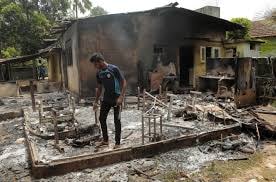 |
| A Sri Lankan Muslim assesses the damage to his tailor shop after the attack. |
Buddhism - BBS). This rally was reportedly in response to an alleged brawl between a group of Muslim youths and a monk and his driver during an important Buddhist holiday earlier that day. Speaking before a crowd of thousands last Sunday, BBS leader Galagoda Aththe Gnanasara delivered an inflammatory speech.
Footage of the event shows a monk in an orange robe speaking of Muslims in offensive terms, cheered on by a shouting crowd. The monk even vowed that if Muslims dared to harm anyone from the Sinhala community (note: the majority ethnic group in Sri Lanka), it would be their end. This was followed by nights of widespread violence, which local health officials say left at least four dead, 16 seriously injured, and others fleeing their homes, taking refuge in the city's main mosque since Tuesday, barricading themselves inside and fearing what would happen next.
Fasniya Fairooz, 80, who lives with her three grandchildren in the village of Seenawatte, a place where Sinhala and Muslim communities coexist, recounted how a violent mob suddenly stormed her home. "We begged them not to harm us. They spoke to us in very vulgar language. They stole the Quran and burned it outside; they looted our belongings." Ahmed Rahamatulla, a father of four and also a resident of Seenawatte, was also left homeless by the mob. He said: "All my possessions were stolen, my house was burned. Now all I have are the clothes we're wearing. I don't know where to go, my children are terrified." The surrounding area has been sealed off following the worst violence in Sri Lanka in years. Soldiers, transported in armored vehicles, controlled the streets where shops had been burned down, leaving only charred walls and broken window shutters. In a nearby house, Rameeza Nizar, 47, an American citizen who had returned home for the family holiday, was involuntarily trapped at her mother's house. "Every night is a nightmare. We don't dare close our eyes for fear of being attacked. We can only turn off the lights and stay together inside the house."
Ayoob Saja, a local hospital doctor and Muslim, said his community is caught in a "cycle of fear"—a consequence of the violence, in which the majority of victims are Muslim. Although the military has been deployed to control the situation and prevent further violence, Dr. Saja believes the military presence has not made things any better. "The armed forces support the majority," he said, referring to the fact that the Sinhala Buddhist community makes up three-quarters of Sri Lanka's population, while the Muslim community accounts for only 10% (2011 figures).
Radical Buddhism is gaining momentum in Sri Lanka as well as Myanmar – where a nationalist movement led by a monk has stirred up violence against the Muslim minority. Last Thursday, a monk leading a religious reconciliation movement was found bound and abandoned on the roadside in a Colombo suburb, police said he had been abducted and attacked. The victim, monk Wataraka Vijitha Thero, had been publicly threatened by BBS leader Gnanasara during a religious press conference with Muslim community leaders last April. He has since been hospitalized with multiple stab wounds. It appears this is more than just a religious conflict, as the BBS is believed to be a clandestine force supporting the government of President Mahinda Rajapaksa. This explains why the government's policies "inadvertently" aided and abetted acts of violence – something many in Sri Lanka, including Rajapaksa's political allies, oppose and criticize. The most recent violence was not the first time the BBS had acted, but the organization has never been punished by law, further reinforcing the belief in a connection between this religious organization and politics, something the Rajapaksa government has consistently denied.
Returning from the G77 meeting, President Rajapaksa visited the town where the Muslim community was attacked, promising that "fair measures will be taken and the guilty will be punished," but made no mention of the BBS. Police announced the arrest of 55 suspects in connection with the violence, responding to accusations of complicity and "turning a blind eye" to the riots. However, the situation appears to be more complicated for the authorities, as 300 citizens, including professors, lawyers, and journalists, signed a letter condemning the BBS's "speech of hatred," demanding that "the authorities immediately arrest and prosecute Gnanasara for the casualties and damage caused by the recent violence." Muslim businesspeople in the Sri Lankan capital also suspended business on Thursday to express their discontent with the attack on the Muslim community.
It is evident that religious and ethnic conflicts are escalating in a country where Islam and Buddhism have long coexisted peacefully. This confirms that these conflicts do not stem from differences between the two faiths, but rather from self-interest and political gain disguised as religion. Even a religion renowned for its love of peace, like Buddhism, is being exploited by a group of people to incite violence and killing – these are the true blasphemers of their own religion. Religion and politics – this connection has perhaps never been safe, as history has witnessed numerous wars stemming from power struggles between religions. Hopefully, Sri Lanka will not repeat the India-Pakistan conflict of the past, or the Middle East of the present.
Reishi Mushroom