

To ensure that fishermen can feel secure and continue working at sea.
(Baonghean) - In recent years, the number of workers at sea in our province has been decreasing, while the number of fishing vessels has been increasing. In some areas, such as Dien Chau and Quynh Luu, the shortage of seafaring labor has forced many fishing boats to remain idle.
In February, we visited the Lach Van fishing port in Dien Ngoc, Dien Chau, and saw many boats still docked. Mr. Dang Bon, a fisherman from Yen Thinh hamlet, Dien Ngoc commune, Dien Chau district, said: His family's boat, with a capacity of nearly 70 horsepower, mainly fishes near the shore from 3 PM to 6 AM the next day before returning to port. In previous years, from the 6th day of the Lunar New Year to the 16th day of the first lunar month, they had made more than 8 fishing trips, but this year they have only made 3 due to a shortage of labor. According to Mr. Bon, his boat needs 4 workers, but because they cannot hire or borrow laborers, and the boat is idle and unproductive, only he and his son still go out to sea, resulting in inefficient fishing productivity.
Mr. Ngoc Than, another boat owner, lamented: "Our boats mainly catch seafood for export far offshore, such as tuna and squid... Each trip requires 15 workers for 2 boats, and the cost for each trip is hundreds of millions of dong. Yet, we've only managed to hire 7 workers from everywhere. If we can't find enough people, we have to accept staying ashore because going out to sea with a labor shortage means the seafood catch won't be as good." The reason for the labor shortage in the fishing industry is that workers' incomes are still low and unstable, making it increasingly difficult for boat owners to retain workers. Fisherman Nguyen Van Son shared: "Because the labor contract between us and the boat owner is based on a profit-sharing arrangement, we all work hard at sea hoping to catch a lot of seafood. The average income is less than 3 million dong per month, so I go out to sea intermittently."
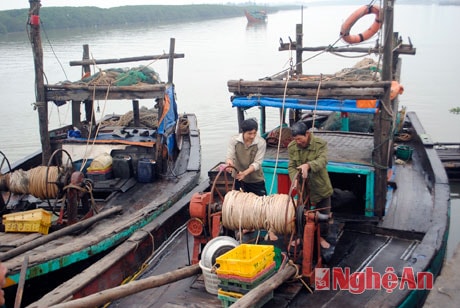 |
| Dang Bon's boat was short of labor; even with only two people on board, they still went out to sea. |
Mr. Nguyen Van Dung, Vice Chairman of the People's Committee of Dien Ngoc commune, Dien Chau district, added: Dien Ngoc currently has 398 boats, including over 56 boats with engines of 90 horsepower or more, 250 boats with 72 horsepower, and the rest with 48 horsepower. On average, 4 laborers are needed per boat, requiring a total of over 1,600 workers for the fishing industry. However, the commune's labor force can only meet the demand of about 1,200 workers. Paradoxically, many young people from Dien Ngoc - Dien Chau, who have long been involved in the fishing industry, are leaving their hometown to pursue fishing in Ca Na, Binh Thuan province. The reason is that the wages for fishermen in Binh Thuan are higher than in Dien Ngoc - Dien Chau. The average salary in Binh Thuan is 6 million VND/person/month, while in Dien Ngoc - Dien Chau the highest is 4 million VND/month, sometimes even less than 3 million VND/month. It is known that over 250 people from Dien Ngoc have migrated to Binh Thuan to work in the fishing industry.
Currently, there are no specific regulations regarding wage payments between boat owners and workers in Dien Ngoc - Dien Chau. Boat owners pay workers in three ways: monthly, daily, and based on a share of the catch. Many fishermen say they are dedicated to the fishing industry and only hope for a stable monthly salary of 5-6 million VND. However, after a year of poor fishing, many boat owners are facing difficulties, and with reduced fishing trips, many workers are shifting to other jobs.
The entire Dien Chau district currently has over 1,000 boats and ships of various sizes, mainly located in the communes of Dien Ngoc, Dien Bich, Dien Hai, Dien Thanh, etc., including over 100 offshore fishing vessels. Besides the labor shortage, the workers on these fishing vessels lack formal training, mainly practicing the trade through hereditary methods, making it difficult for them to access advanced production techniques. To date, Dien Chau has coordinated with the Department of Agriculture and Rural Development, Nha Trang Fisheries University, and the Sub-Department of Fisheries Exploitation and Protection to open training courses and issue certificates to over 60% of the vessels, including captains, engineers, and crew members.
Quynh Luu has a strong advantage in offshore fishing, with each boat needing more than 10 workers; however, labor is scarce after Tet (Lunar New Year). Mr. Tran Van Minh, an owner of an offshore fishing boat in Son Hai – Quynh Luu, sadly said: “It’s unbelievable that a fishing village doesn’t have enough people to go to sea. At the beginning of the year, we had to ‘deposit’ 1-1.5 million VND to hire people to go to sea, depending on the agreement, but we still couldn’t find anyone. I had to go all the way to Nghi Loc and Cua Lo town to find crew members, but there still aren’t enough. If we can’t find any more in a few days, the risk of the boat being idle is very high.” Nguyen Van Chinh, a fisherman in Quynh Tho – Quynh Luu, recounted: “As the main breadwinner for a family of five, a salary of just over 3 million VND per month is too low to live on, let alone contribute to our children’s education.”
Mr. Tran Van Hung, Chairman of the Son Hai Commune People's Committee, explained: Son Hai currently has 252 boats, including nearly 200 offshore fishing vessels with engines ranging from 90 to 400 horsepower. On average, 1,800 laborers are needed to meet this demand; however, since the beginning of the year, there has been a shortage of over 500 workers. According to statistics from 2013 to the present, over 300 workers in the commune have switched to other professions, or some have moved to the South to pursue fishing careers. The shift of fishermen from fishing to other service and business activities also creates difficulties for the fishing industry in finding labor. Mr. Hung continued: To overcome the difficulties of recent years, Son Hai has organized activities to link members, especially developing good logistics services for the fishing industry, promptly purchasing seafood for export from fishing fleets, supplying necessities and fishing equipment. However, due to a year of poor harvests, difficulties have arisen for boat owners, leading to low wages, which is also a reason why marine workers are switching to other professions to make a living. The entire Quynh Luu district currently has over 1,400 boats of all sizes, including 599 boats with a capacity of 90-400 horsepower. At the beginning of the year, there was a shortage of laborers going out to sea.
The current challenge is to find a sustainable solution for developing the fishing industry so that fishermen can confidently continue their work at sea. Besides facilitating investment in upgrading and improving the capacity of fishing vessels, and increasing training courses and support for vocational training, relevant sectors need to build a database system to enhance fishing ground forecasting capabilities and disseminate information on fishing grounds and fish schools to fishermen. Mechanisms and policies should be considered to provide alternative livelihoods for those currently operating small, dilapidated vessels in coastal fishing, thereby forming and expanding "models" of offshore fishing cooperatives and associations. This is also a direction for the development of the fishing industry, creating jobs for fishermen.
Van Truong