

"Settling down" but not yet "establishing a career"
(Baonghean) - Since the end of 2012, nearly 70 fishing families along the Lam River (Dang Son commune, Do Luong district) have been given the opportunity to move ashore and live in sturdy, spacious houses. However, their joy is still incomplete…
In the fishing village of Dang Son commune, bright red tiled-roof houses line the straight concrete roads. At a house at the beginning of the village, we were greeted by Mr. Tran Van Hao (born in 1949). Having spent decades transporting goods on the Lam River, living a nomadic life on his boat, Mr. Hao said: “Compared to when we lived on the boat, life in this resettlement area is much better. We live in sturdy houses, no longer constantly worried about the rainy season and storms causing our boats to be swept away, torn, or capsized. Besides that, we have electricity and clean water for daily use – things we never dared to dream of when we lived on the boat before.” Sharing the same sentiment as Mr. Hao, Mrs. Cao Thi Nghi (80 years old) confided: "For almost 80 years of my life, I've been drifting on the river doing all kinds of jobs, never daring to dream of owning a house, and I thought I would just die of old age on the boat. Now that I'm living in a sturdy house with my old neighbors, I'm very happy."
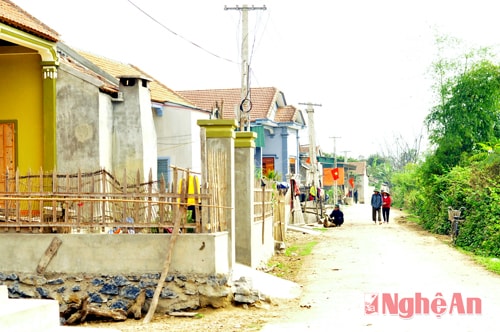 |
| A view of the resettlement area for fishermen in Dang Son commune. |
The project to build a resettlement area for fishing families on the Lam River, relocating them from flood-prone areas in Dang Son commune, was approved by the Provincial People's Committee in 2010 and began construction in 2012. By the end of 2012, 68 households (including fishermen and those engaged in transportation on the Lam River) had moved to the resettlement area, including 39 households from Hamlet 6 and 29 households from Hamlet 7. According to the project, each household received 150m2 of land, a well, and 20 million VND in support for house construction after the investor completed infrastructure, transportation, electricity, and a community center (leading to the establishment of a new hamlet). Currently, the households in the Cay Sang resettlement area have formed three neighborhood groups, each with more than 20 households, and elected group leaders and deputy leaders. Mr. Tran Dinh Danh – Head of Neighborhood Group No. 3 – one of the first 20 households to move here in July 2012, said: “Living in this resettlement area, we truly understand the concept of ‘settling down’ as we no longer have to cope with storms and floods like before. With the government providing us with the opportunity to move ashore, our whole family has worked hard to build a decent house to welcome our new life. The children can also study with peace of mind, so none of them had to drop out of school midway through the past school year.”
However, after a year and a half of moving to the resettlement area, the lives of the people here are still fraught with difficulties. Mr. Tran Van Hoa, head of Hamlet 6, Dang Son Commune, said: “For more than a year now, every time we receive a policy from the commune, after disseminating and implementing it for the people in the hamlet, I have to go back up to National Highway 7 a few kilometers to hold a meeting with the 39 resettled households to explain it again. I hope that the commune will merge these households into Hamlet 5, or soon establish a new hamlet for the resettled people so that we can have an easier time and the lives of the people can become more stable.”
However, merging or separating to create a new hamlet faces considerable difficulties. Since Hamlet 5 already has over 200 households, adding nearly 70 more is illogical. Furthermore, regulations require a hamlet to have at least 100 households, so creating a new hamlet would necessitate transferring agricultural residents from Hamlet 5. But neither the residents of the resettlement area nor those of Hamlet 5 want this kind of merger or separation, due to differences in customs, production methods, and lifestyles between the agricultural and fishing communities.
But the most important issue for the people now is stabilizing production. According to the people, although they have new housing, besides the 150-160 square meters of land for building houses and outbuildings, they have no land for agricultural production, growing vegetables, or building livestock pens. Therefore, they still make a living along the Lam River, about 4 to 5 kilometers away, by fishing, transporting goods, or mining sand and gravel. Mr. Tran Dinh Danh – Head of Neighborhood Group No. 3, expressed: “Because we have lived on boats, drifting on the water for many years, adapting to land-based work is extremely difficult. Without land for production, after moving ashore, people continue their old occupations, while others go to work in the South, Laos, or as migrant laborers. It's not uncommon for people to build houses, lock their doors, and go work far away. For families with many children or those with multiple generations living together, making a living is even more challenging. Therefore, we hope the government will quickly allocate land for production so that people can stabilize their lives.”
According to Mr. Hoang Ngoc Tuan, Chairman of the People's Committee of Dang Son Commune: "To stabilize the administrative situation for the people in the fishing village resettlement area, this year the commune will mobilize and relocate the households from Hamlet 5 to form a new hamlet. According to the commune's statistics, the number of poor households in the resettlement area is currently higher than the commune's average (approximately 10%, compared to 2.95% of the entire commune), therefore the commune has made great efforts to stabilize production for the people. When implementing policies to support production, vocational training, and technical training for poor households, we always prioritize the fishing village people. Regarding production land, in mid-2013, the commune allocated some riverside land for the resettled people to rent for production. However, after only a short time, due to limited awareness and poor farming skills, the people abandoned the land, so the lack of arable land cannot be entirely blamed. On the other hand, to create supplementary occupations for the people, we..." I also suggested to the district that they establish a rattan and bamboo weaving village for the resettled people. However, surveys have shown that the educational level of the people is very low, making it very difficult to establish and maintain such a village.”
Discussing this issue, Mr. Nguyen Cong Chau, Vice Chairman of the People's Committee of Do Luong District, said: “It can be said that the district is also facing many difficulties in providing employment and stabilizing production for people in the fishing village resettlement area. Besides the limited land area, the limited awareness of changing occupations and the level of onshore production skills of the people are also significant obstacles. In the coming time, the district will coordinate with the government, departments, and organizations in the commune to strengthen propaganda and training for people on livestock and crop farming techniques so that people can independently change to suitable occupations. In addition, the district will direct the expansion and development of mulberry cultivation, silkworm rearing, silk reeling, and yarn spinning in Dang Son. The formation of a large-scale mulberry cultivation and silkworm rearing village in the area will help the resettled fishing village people have a stable small-scale handicraft industry, gradually reducing their dependence on river-based occupations.”
It is thought that, in order for dozens of fishing families to establish themselves in their new homes, besides the proactive efforts of the people, the role of the local authorities is crucial. Hopefully, in the future, Do Luong district and Dang Son commune will pay more attention to and invest in vocational training and skill development; and develop additional rural industries to help fishing families have a stable income in their new homes.
Text and photos:Minh Quan