
To bring "good trees" back to the Hmong village.
(Baonghean) - In recent times, the leaders of Que Phong district have shown great interest in improving the lives of 10 Mong ethnic minority villages, including 8 villages located high in the misty mountains along the Northwest border with Laos and 2 villages that have moved down to the new economic zone since 2002. Previously cultivating only one rice crop per year, they have now been introduced to new techniques and seeds to guide the people in increasing rice cultivation to two crops per year;
(Baonghean) - In recent times, the leaders of Que Phong district have shown great interest in improving the lives of 10 Mong ethnic minority villages, including 8 villages located high in the misty mountains along the Northwest border with Laos and 2 villages that have moved down to the new economic zone since 2002. Previously cultivating only one rice crop per year, they have now been introduced to new techniques and seeds to guide the people in increasing rice cultivation to two crops per year;Seeing that peach blossom trees bring branches down from the mountains to sell during Tet (Lunar New Year), they allocated funds to support the local people in planting peach trees; passion fruit is currently a lucrative crop in the indigenous forest land, so they are passionate about opening transportation routes to bring this "good crop" to each village in the future... However, in reality, there are still many difficulties ahead.
In the highlands of Que Phong, approximately 3,000 Mong ethnic minority households live in the border commune of Tri Le, comprising 440 households. Their lives are still marked by hardship, difficult transportation, and the persistence of some old customs, leading to complex issues affecting security and order in the area. Economic development, such as two-crop rice cultivation, passion fruit, and sugarcane, has become ingrained in the mindset and practices of the Mong people in the two new villages of D1 and D2 in Minh Chau; therefore, the main concern is focused on the people of the eight villages of Pa Khom, Pieng Luong, Huoi Xai 1, Huoi Xai 2, Nam Tot, Muong Long, Huoi Moi 1, and Huoi Moi 2.
Twelve years after descending from the mountains, the lives of nearly 80 Mong ethnic minority households in the Minh Chau Economic Zone, located near the center of Tri Le commune, have undergone significant changes. Returning after many years, I noticed that the gardens of the Mong people in Minh Chau are not as lush and green as I had imagined; instead, they remain overgrown and overgrown with weeds. There are a few scattered passion fruit gardens, but as Mr. Tho Chong Po, Vice Chairman of the Tri Le Commune People's Committee, said: "Lack of water prevents the passion fruit plants from thriving, resulting in low yields; several families have given up planting them!"
Mr. Xong Ba Xuan from village D1 also shared his story: “Our family planted 60 passion fruit vines in 2011, the most in the village, but now we don't want to plant them anymore because of the lack of irrigation water, resulting in low yields, and some have died.” The lack of irrigation water for both production and daily life in the Minh Chau Economic Zone has existed for many years, and it is said that no one is to blame (!?), because the old water supply system (according to the project) is ineffective due to the depletion of natural water sources at the headwaters. Currently, a new water supply system has been built, drawing water from the spillway in Noong 2 village, but it has only been operational for a few months and the water supply is not yet stable.
According to Mr. Lo Xuan Thu, Chairman of the Tri Le Commune People's Committee, "It's incorrect to assume that the poor development of passion fruit plants in Minh Chau is solely due to a lack of water. The main reason is that the people haven't truly followed the technical procedures in caring for them. Furthermore, a passion fruit plant typically only lasts about 3 years before it begins to degenerate and needs replacement. Since the passion fruit plants were planted in Minh Chau in late 2010 or early 2011, they have already reached the stage of degeneration and gradual death. Some people don't understand this and attribute the deaths to a lack of water, creating a negative general sentiment." – "If people don't understand, then a clear explanation is needed, isn't it?" – "That's also a difficult issue for the commune. Not only with passion fruit cultivation, but also with other crops introduced to the Mong ethnic minority villages, despite extensive propaganda and persuasion efforts by commune officials, we haven't yet achieved high levels of consensus," the Chairman acknowledged.
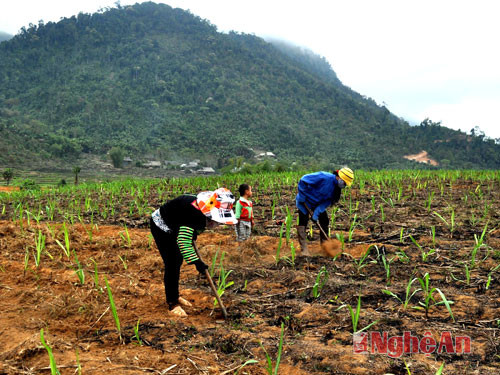 |
| The Mong people of D1 village, Tri Le commune, Que Phong district, are tending their sugarcane crops. |
We also met Mr. Ly No Po (from village D1), one of the "sugar cane kings" of Minh Chau – the recent harvest was also the first time he earned 36 million dong from selling sugar cane to Tate & Lyle. He said: "Only 5 households in the whole area cultivate nearly 5 hectares. Many people are afraid that if they plant now, the company won't buy at a good price anymore, and if they sell at a loss, they won't know how to repay the loan for planting sugar cane." – What do you mean? The sugar cane grown in Tri Le is considered to have a fairly high yield (averaging 70 tons/ha), and has the highest sugar content in Nghe An. And recently, after purchasing at the right price, Tate & Lyle even rewarded sugar cane farmers with millions of dong!
Upon hearing this, Mr. Lo Xuan Thu explained that there was information circulating that this company was buying sugarcane at high prices only to recoup its initial investment for the 2013 season, and that the price would be significantly lowered in the following season due to high transportation costs. Although Tate & Lyle still affirms that it will protect the farmers' interests, there are currently no plans to expand the sugarcane acreage in the area. Furthermore, the fact that in many of the company's sugarcane growing regions, the sugarcane is still flowering and waiting to be harvested in the recent season has contributed to the farmers' anxiety as mentioned above...
For the 8 Mong villages in the high mountains, besides livestock farming, the people still mainly practice slash-and-burn agriculture, cultivating one crop of wet rice per year according to traditional customs. At the beginning of 2014, recognizing that Tri Le peach blossoms fetched good prices during Tet (3-7 million VND/branch), the commune allocated budget to support 4 households participating in a peach blossom cultivation model with 300 trees in Pa Khom village, which have now taken root and are developing well. Regarding wet rice fields, after Que Phong district conducted a survey and measured the wet rice area of each household, the total wet rice area of 362 households in 8 villages was approximately 135.5 hectares, previously cultivated only one crop per year. In 2013, a 5-hectare model of cold-tolerant hybrid rice varieties such as Nhi Uu 838 was established in Muong Long village, with two cropping seasons. The results were promising: previously, with the old variety, farmers only harvested 32-35 quintals/hectare/crop/year for one crop, while the model yielded 42-45 quintals/hectare/2 crops = 82-90 quintals/hectare/year.
The benefits are clear, and at this time the district is enthusiastically planning to expand the model to one in each village in 2014 (the province and district will supply 100% of the seeds to the people). However, when we spoke with the leaders of Tri Le commune, they said that although the model has not yet been implemented, the remaining 7 villages have already conducted pilot projects. The results showed that due to their higher altitude compared to Muong Long, the colder temperatures caused the seedlings to develop slowly, making it difficult to cultivate two crops per year. Therefore, it is difficult to persuade the people to adopt the model.
– So, could the model be expanded to the entire area of Muong Long village, which has a suitable altitude? The Chairman of the commune shook his head slightly: “Not yet, because the Party Secretary of this village, Tho Chong Ly, is considered a respected figure, but recently he has shown negative behavior, opposing the commune's policy of not encouraging people to cultivate two rice crops per year. With such a village Party Secretary, it is very difficult for commune and district officials to persuade the people to follow. On the one hand, the roads to the eight villages are extremely difficult to access, practically impassable on rainy days, so commune officials cannot regularly visit the villages; on the other hand, that is also a major reason why it is difficult to consider changing the crop structure to create marketable crops in these areas.”
Thus, in the future, for passion fruit or any other "good crop" to reach the eight Mong villages in the high mountains of Tri Le, the first and most fundamental problem must be solved – transportation. Currently, following the directive of the Standing Committee of the District Party Committee on organizing the "Youth Volunteer Project to Build Roads to Mong Villages," the Que Phong District Youth Union is deploying a plan to Tri Le, mobilizing approximately 500 cadres, youth union members, and border guards in the area to build a road from Kem Ai to the Mong villages of Huoi Moi 1 and Huoi Moi 2. The road will have a width of 2-2.5 meters, a reduced elevation of 40-50 cm, and three temporary bridges, each 2 meters long, crossing streams and ravines.
This is considered one of the practical actions demonstrating the determination and aspirations of the leaders of Que Phong district to implement solutions for economic development and improve all aspects of life for the Mong people in the area; with a focus on converting to advantageous crop varieties.
Dinh Sam