
Prevent slash-and-burn agriculture.
(Baonghean) - In Tien Phong commune, Que Phong district, besides the allocated farmland according to the plan, we found that many households here were illegally clearing land for farming. Walking along Na Den village and the resettlement villages of Pieng Cu I, Pieng Cu II, Huoi Muong, and Na Cang, we saw natural forests right next to residential areas, being cleared by the villagers, waiting for the hot weather to burn them for farming. Lo Van Xuan, from Na Den village – one of the households illegally clearing land for farming – said: Due to a lack of arable land, his family took the risk of illegally clearing land to grow cassava to make a living.
(Baonghean) - In Tien Phong commune, Que Phong district, besides the allocated farmland according to the plan, we found that many households here were illegally clearing land for farming. Walking along Na Den village and the resettlement villages of Pieng Cu I, Pieng Cu II, Huoi Muong, and Na Cang, we saw natural forests right next to residential areas, being cleared by the villagers, waiting for the hot weather to burn them for farming. Lo Van Xuan, from Na Den village – one of the households illegally clearing land for farming – said: Due to a lack of arable land, his family took the risk of illegally clearing land to grow cassava to make a living.
Na Den has 110 households, mostly of the Thai ethnic group. The people there still face very difficult living conditions, with a poverty rate of 83%. The entire village has less than 8 hectares of paddy fields and over 10 hectares of planned upland fields. Due to the severe shortage of arable land, many households have illegally cleared forest land to cultivate crops. Mr. Nguyen Dinh Kiem, Vice Chairman of the Tien Phong Commune People's Committee, expressed his concern: "The particularly dangerous situation is that in the four resettlement villages of Pieng Cu I, Pieng Cu II, Huoi Muong, and Na Cang, the villagers have not yet been allocated arable land, making it very difficult to prevent resettled households from illegally clearing forest land."
Mr. Bach Duc Hanh - Head of the Forest Protection Center - Que Phong Forest Protection District (responsible for the areas of Hanh Dich and Tien Phong communes) said: From March 15th to the present, the forest protection force, in coordination with the People's Committee of Tien Phong commune, has discovered and stopped 17 households from illegally clearing land for farming in the Na Den village area, with an illegal farming area of over 12,000 m2. Many households cleared land on a large scale, such as Vi Van Tuyet with 1,800 m2, Nguyen Thi Tam with 1,000 m2, and the rest with areas ranging from 500 to 800 m2.
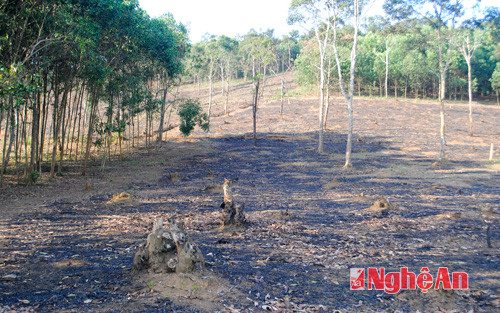 |
| Slash-and-burn agriculture in Muong Ngoc - Que Phong. |
In Thong Thu commune, there are quite a number of households illegally clearing land for farming, concentrated in the Hiep An and Hiep Phong areas. The entire Thong Thu commune has over 40,000 hectares of forest (the largest area in the district), with 13 villages, including 9 villages in the Hua Na Hydropower resettlement area, mostly located close to the forest edge. Previously, the commune had 138 hectares of rice paddies, but due to the shrinking size of the hydropower reservoir, only about 60 hectares remain. Adding the 30 hectares of cultivated land allocated according to the plan, the people of Thong Thu commune still lack land for production. Therefore, since the early summer heatwaves of 2014, many people have organized illegal land clearing for farming. Recently, the functional forces of the Pu Hoat Forest Protection Unit and Thong Thu commune discovered and stopped 13 households from illegally clearing land for farming.
Mr. Le Hai Ly, Head of the Que Phong District Forest Protection Department, stated: The entire Que Phong district has been allocated over 800 hectares of cultivated land across 8 communes according to the planning. However, due to the demand for agricultural land, illegal slash-and-burn farming has occurred since the beginning of 2014 in the communes of Dong Van, Thong Thu, Tri Le, Tien Phong, etc. Since the start of the hot season, the Que Phong Forest Protection Department has coordinated with forest owners and the People's Committees of the communes to expel and stop over 50 individuals engaging in illegal slash-and-burn farming throughout the district and is advising the communes on imposing penalties according to regulations.
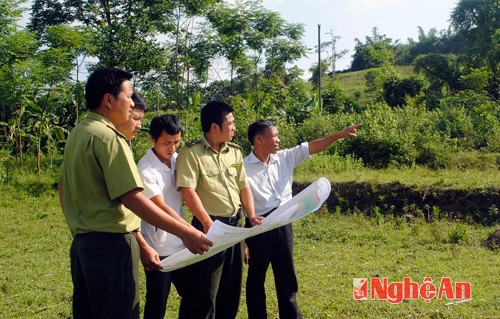 |
| The Que Phong Forest Protection Unit, in coordination with the Que Phong District People's Committee, allocated upland farming land to the people of Tien Phong commune. |
To minimize slash-and-burn farming that causes forest fires, the Que Phong and Pu Hoat Forest Ranger Stations have strengthened coordination with relevant agencies at the district and commune levels to review the boundaries and area of slash-and-burn fields and plan for stable production and effective forest fire prevention and control. This has led to the implementation of a plan to closely monitor slash-and-burn farming practices according to established procedures. They guide people to cultivate fields in accordance with the plan and regulations on forest fire prevention and control, requiring them to notify the local authorities and the Forest Ranger Station before burning fields. Local forest rangers are responsible for guiding the burning process, assigning personnel to constantly monitor the area to prevent the fire from spreading into the forest, and mobilizing firefighting forces if a forest fire occurs. During periods of extreme drought and high forest fire risk, slash-and-burn farming must be temporarily suspended. Strict penalties will be imposed on those who violate regulations or exploit slash-and-burn farming to illegally clear forests or cause forest fires. Statistically determine the current status of the area, types of cultivation, and cultivated subjects of shifting cultivation; review and plan shifting cultivation to ensure consistency with the planning of the three types of forests and the local land use plan.
To mitigate the risk of forest fires during the dry season, Que Phong needs to develop a sustainable agricultural transformation program focusing on intensive terraced farming. The locality needs to establish mechanisms and integrate programs and projects to provide financial support and technical guidance to local people for planting forests, industrial crops, fruit trees, and fodder crops... to create jobs, increase income, and protect the forest. For the resettlement villages of the Hua Na Hydropower Plant, land for production should be allocated early to help people stabilize their lives and reduce slash-and-burn farming in the forest.
Van Truong